
15,991 views ·
17 replies
16k views
17 replies
Splice floor joists, scarf or overlap?
About to lay floor joists on a new build.
The span is 7.12m with a support almost in the middle (20-30cm off).
I have beams of 480cm available.
According to the designer, I should lay the floor joists end to end and splice on both sides with a 1200mm piece and nail.
It requires a lot of sawing and measuring.
I'm considering overlapping the joints instead and laying the beams alternately. Feels significantly quicker, just throw up and nail.
Which solution is best?
Pictures of the two proposals below.
The span is 7.12m with a support almost in the middle (20-30cm off).
I have beams of 480cm available.
According to the designer, I should lay the floor joists end to end and splice on both sides with a 1200mm piece and nail.
It requires a lot of sawing and measuring.
I'm considering overlapping the joints instead and laying the beams alternately. Feels significantly quicker, just throw up and nail.
Which solution is best?
Pictures of the two proposals below.
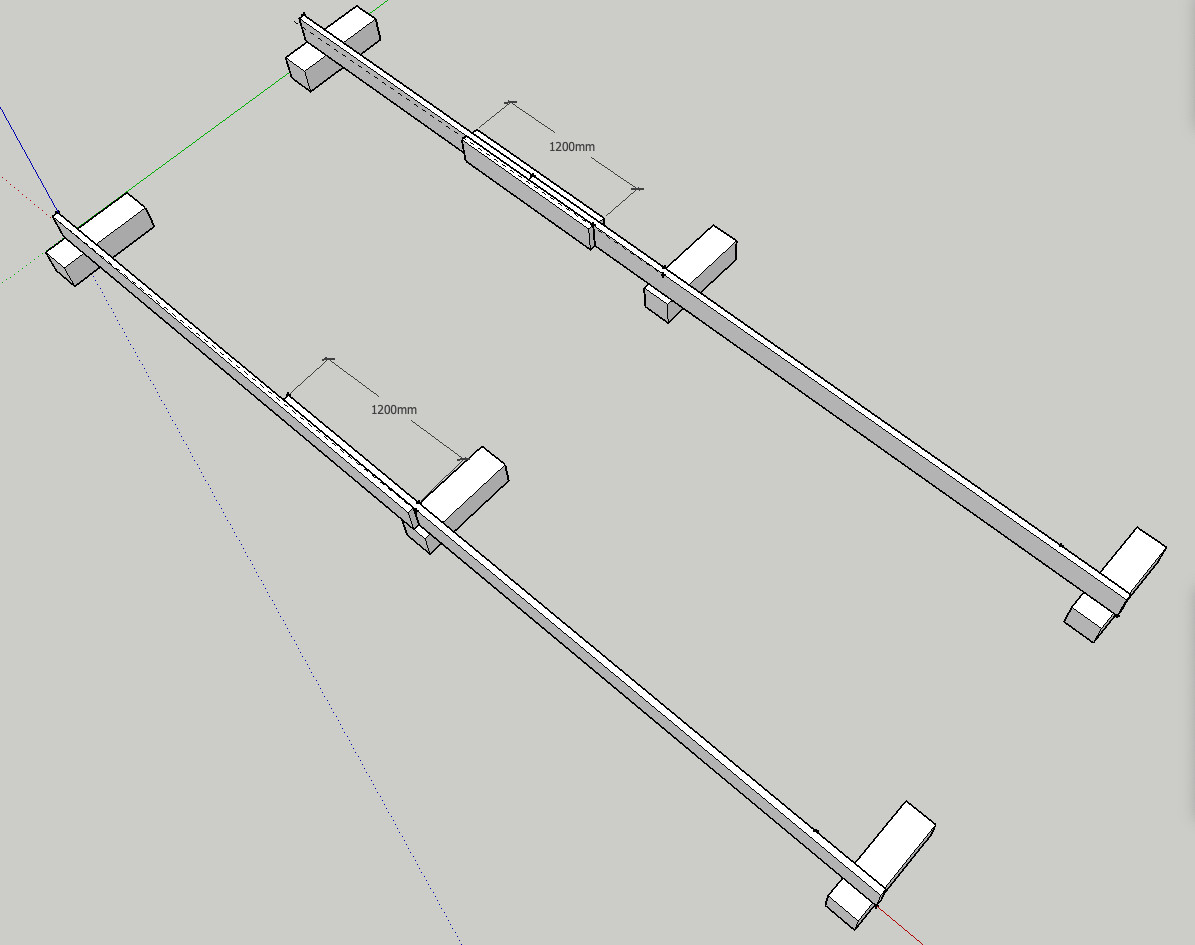
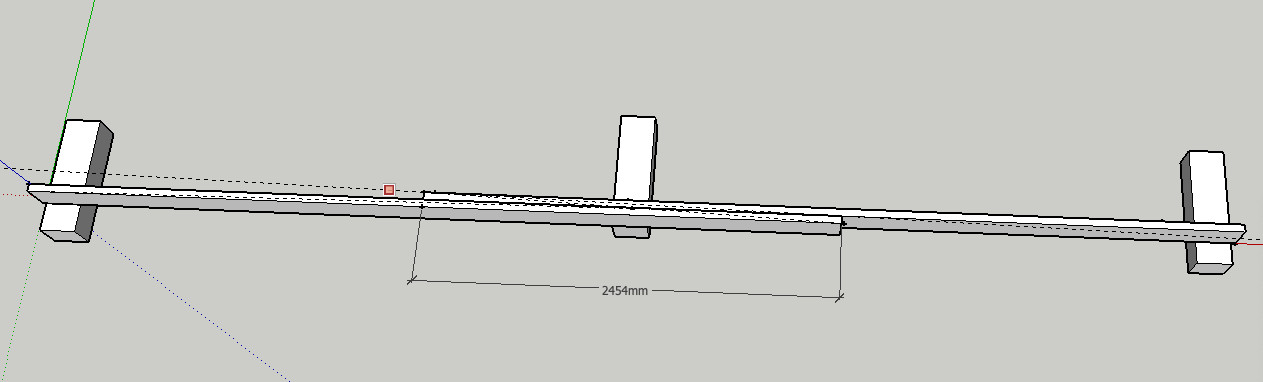
The only drawback with overlap joints is that the joists don't end up directly over the vertical studs in the exterior walls. But a 45mm "offset" shouldn't matter.A Emil_K said:

So... 2 x 1200 mm = 2400mm long. At most lumberyards, the wood is sold in lengths of 2.7m and up.R ramini said:About to lay joists on a new build. The span is 7.12m with a support almost in the middle (20-30cm off).
I have 480cm joists available.
According to the engineer, I should lay the joists end to end and splice on both sides with a 1200mm piece and nail.
That’s a lot of sawing and measuring.
I'm thinking maybe it would be faster to overlap the joints and lay the joists alternately. It feels significantly quicker, just throw them up and nail.
Which solution is best?
Images of the two suggestions below.
If you take the shortest standard length and cut it in half, you now have two pieces that are 1350mm. And who knows, maybe your yard also has 2.4m? Then it's exactly 1200mm!
What the engineer means is that to get acceptable strength on the splices, they must be at least 1200 mm. It doesn’t matter if you have an extra 120mm on the splicing. If you lay it somewhat in the middle of the joint, it's only 75mm extra on each side. At worst, that’s 4-8 extra nails per splice. It’s really not much, especially if you have a nail gun.
Want to make measuring and cutting faster? Do this:
- Buy all the extra joists you need for splicing (that is, one extra 2.7m joist for every joint).
- Place them all on their edges side by side, lay another joist across their ends and push against them, pulling them towards you so they are all perfectly aligned. All the pieces to be cut are now parallel next to each other. Mark 135 cm on the right side of the stack. Mark 135 cm on the left side. Snap a chalk line between these points. Bingo, you’ve now marked exactly where each joist should be cut.
- Stand by the saw and just feed through until you’re through the entire stack. You now have all the splice pieces ready.
- (Optional) Splice together all the joists before you put them in place.
I don't know how many cuts you have to make here, but if I arbitrarily guess the house you’re building is 15 meters long and you’re laying the joists at 600cc, it’s 25 joists to splice. That means 25 extra joists, 25 cuts to saw, and somewhere in the order of 100-200 extra nails to hammer in.
The extra hours this takes is an amount of time that disappears entirely in a house build, and if you ask me, it's not worth deviating from the engineer’s instructions to save time. But that’s just my opinion.

Mats-S
Construction veteran
· Sollentuna
· 3 646 posts
Mats-S
Construction veteran
- Sollentuna
- 3,646 posts
That is absolutely the best solution, splice over the center beam edge to edge. Place long reinforcements on both sides, about 1m. This solution assumes the center beam is similar to the ends. If you want to "overdo" a bit, use through bolts through the splice planks, about 2X5 pcs, unbreakable thenKretikos said:

Last edited:
Why would it be better than overlapping? In terms of strength, I see the downside that the position doesn't become identical.
Mats-S
Construction veteran
· Sollentuna
· 3 646 posts
Mats-S
Construction veteran
- Sollentuna
- 3,646 posts
Because you get the correct position at the ends (and all the way in between so that you always know where you can nail/screw into the joists), plus you get a stronger construction with the extra reinforcement boards on both sides. That doesn't mean that overlapping won't hold, but I think this is a neater solution ;-)D Daniel 109 said:
I agree with the position. But I don't understand why having two unbroken beams over the support that take up each other's bending moment would be worse. Why?
Mats-S
Construction veteran
· Sollentuna
· 3 646 posts
Mats-S
Construction veteran
- Sollentuna
- 3,646 posts
As I wrote, it's probably equally durable in the end, but there's a great advantage in having the floor joists in a single line, not broken in the middle.D Daniel 109 said:
Regarding cutting/measuring, let the end stick out on one side, snap a chalk line when everything is in place, then cut. Super easy and quick
So now it is not stronger anymore?
Mats-S
Construction veteran
· Sollentuna
· 3 646 posts
Mats-S
Construction veteran
- Sollentuna
- 3,646 posts
Thank you for all the answers!
Now I have spoken with the constructor - absolutely okay to splice overlapping, even better he thought.
And for me, who is very dependent on good weather and short building sprints, every step that can be skipped (sawing/measuring/etc.) without compromising the final quality is something that is necessary.
Now I have spoken with the constructor - absolutely okay to splice overlapping, even better he thought.
And for me, who is very dependent on good weather and short building sprints, every step that can be skipped (sawing/measuring/etc.) without compromising the final quality is something that is necessary.