
3,107 views ·
22 replies
3k views
22 replies
Sparse panel garage roof building tips
Hello
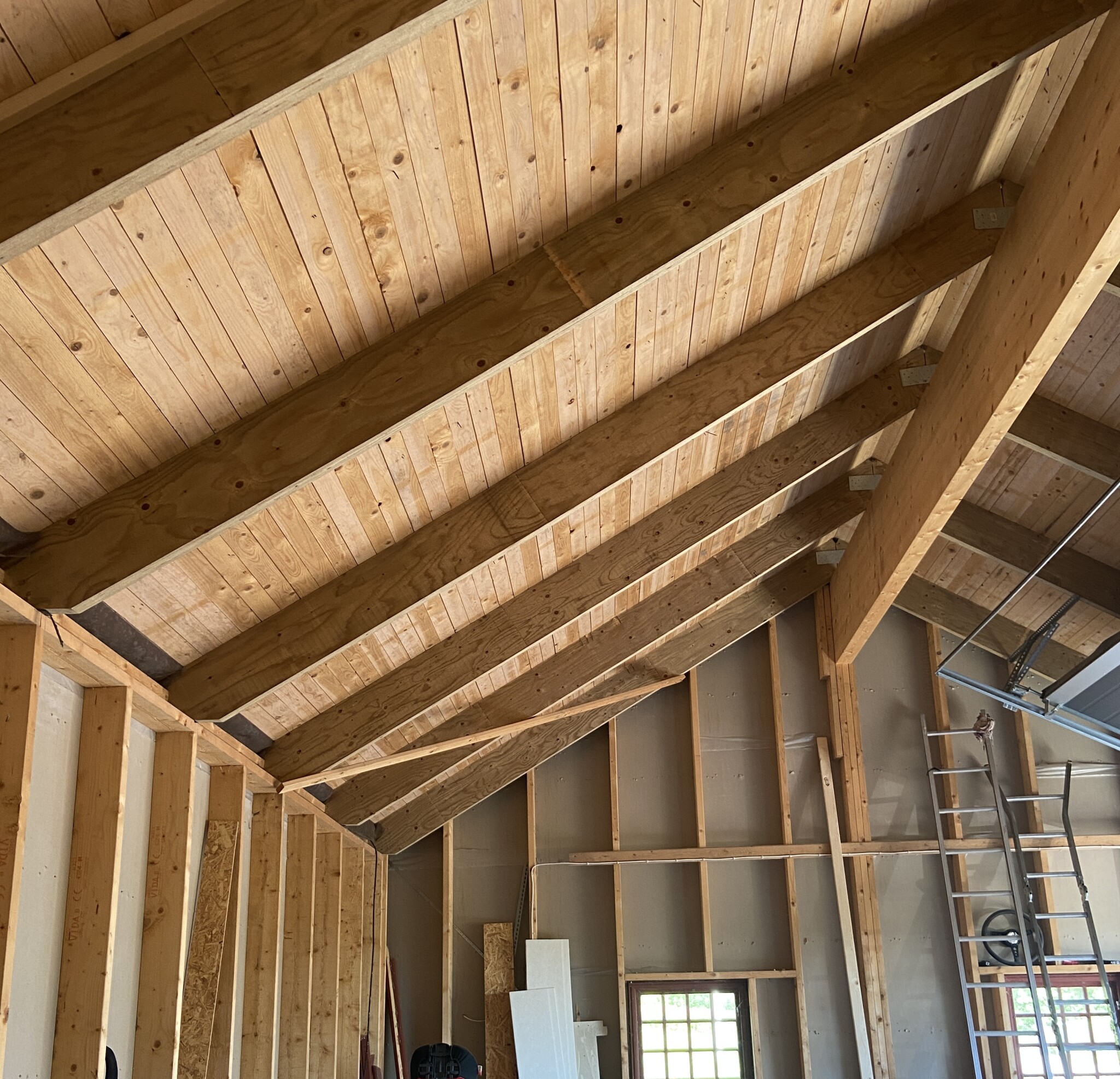
Planning to install plastic sheeting and battens in my garage ceiling, a gabled roof open to the ridge.
After that, loose insulation and drywall.
The area is about 8m wide and 4.5m high per side towards the ridge. (See picture, air gap exists but not in picture)
Battens with tongue and groove seem convenient
Questions and tips:
Do the battens need to be glued in the tongue or just pressed together?
How do you best manage to maintain cc30 when installing the battens, spacer pieces in between that you move with you? Chalk line?
And should all the plastic be installed before the battens or take it along as you go?
I have access to a rolling scaffold.
Planning to install plastic sheeting and battens in my garage ceiling, a gabled roof open to the ridge.
After that, loose insulation and drywall.
The area is about 8m wide and 4.5m high per side towards the ridge. (See picture, air gap exists but not in picture)
Battens with tongue and groove seem convenient
Questions and tips:
Do the battens need to be glued in the tongue or just pressed together?
How do you best manage to maintain cc30 when installing the battens, spacer pieces in between that you move with you? Chalk line?
And should all the plastic be installed before the battens or take it along as you go?
I have access to a rolling scaffold.
You don't need to glue the end joints, but you should only join every other spar in the same section. A template piece usually works well, but you need to check occasionally to ensure it doesn't go off track. There is special c/c tape if you want it. You can staple the plastic up in advance or bring it along as needed. You'll quickly notice what works for you.
Thanks for the response
Regarding cc tape, do you apply it to each rafter and read it there during the installation of the glesen?
Is it overkill with tongue and groove gles?
I assume you need at least one joint on an 8m length depending on the length of the glass.
Regarding cc tape, do you apply it to each rafter and read it there during the installation of the glesen?
Is it overkill with tongue and groove gles?
I assume you need at least one joint on an 8m length depending on the length of the glass.
Last edited:
Tape is sufficient for every other roof truss.
Regarding end-jointed sparse boards, it is convenient for long surfaces or if you want to use short lengths. Otherwise, you can just cut and nail all of them in the same section before you need to move the scaffolding.
Regarding end-jointed sparse boards, it is convenient for long surfaces or if you want to use short lengths. Otherwise, you can just cut and nail all of them in the same section before you need to move the scaffolding.
If you plan to install fach vis, you don't need an end tongue since you will cut the panes to the correct length before installation.
The tape is preferably placed on the rafter, otherwise you have to stretch the plastic very well to avoid misalignments.
The tape is preferably placed on the rafter, otherwise you have to stretch the plastic very well to avoid misalignments.
Thank you
I have a haki on wheels, 3m wide so I can reach at least 2 sections at a time.
In that case, do I need to offset every other joint so that they don't all end up on the same rafter?
I'm thinking 4.8 and 3.6m lengths since the total width is 8m, correct thinking or how should I think there?
I have a haki on wheels, 3m wide so I can reach at least 2 sections at a time.
In that case, do I need to offset every other joint so that they don't all end up on the same rafter?
I'm thinking 4.8 and 3.6m lengths since the total width is 8m, correct thinking or how should I think there?
If you splice on the rafters you don't need to stagger the splices. If you are working alone, I would go with 3.6m lengths as they are easier to work with. If there are two of you, you can use longer lengths.

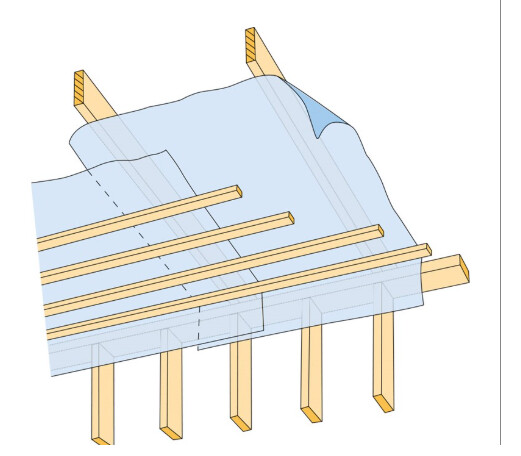
I usually apply plastic along the house. In other words, across the rafters.
Keep in mind when spacing that the distance between the first beam and the second beam will be less than c/c 300mm. You should have 300mm from the wall to the center of beam number 2.
Keep in mind when spacing that the distance between the first beam and the second beam will be less than c/c 300mm. You should have 300mm from the wall to the center of beam number 2.
Yes, it might be just as easy to plastic across the roof trusses, there will be quite a bit of rolling with the scaffold but it should work.Matti_75 said:
Do you usually start at the ridge and work your way down or the other way around?
Good tip with the distance from the first to the second spacing. 👍
It will be cc30 since loose fill insulation will be used and the company recommended this.G Gabbe1 said:
I think in my case, 120 drywall will be too big to handle as the ceiling height is almost 5m at the highest point.