
18,826 views ·
31 replies
19k views
31 replies
Span of joists upper floor, cross bracing etc?
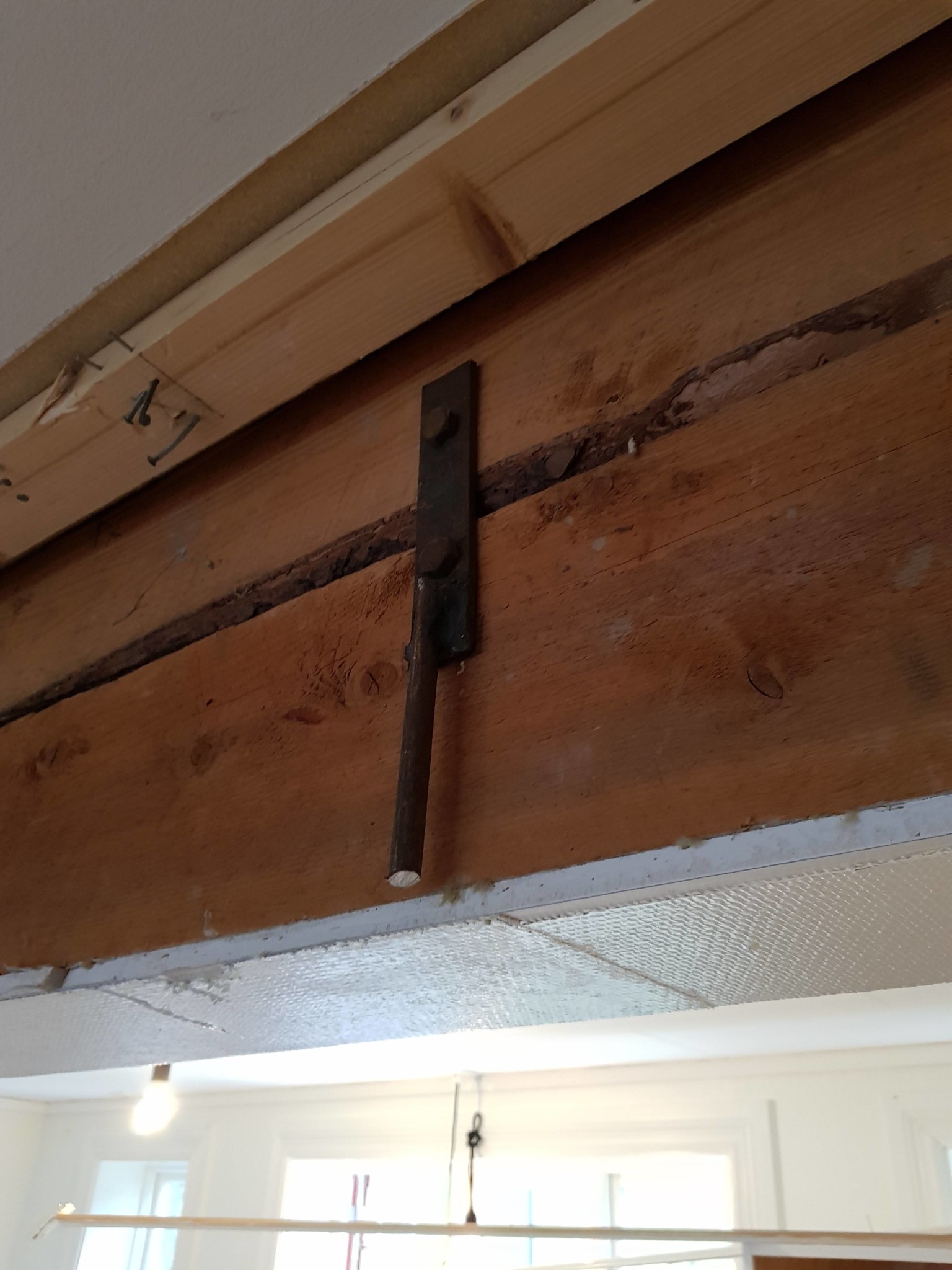

It certainly looks a bit strange. Do you have any sectional drawing that you can post?
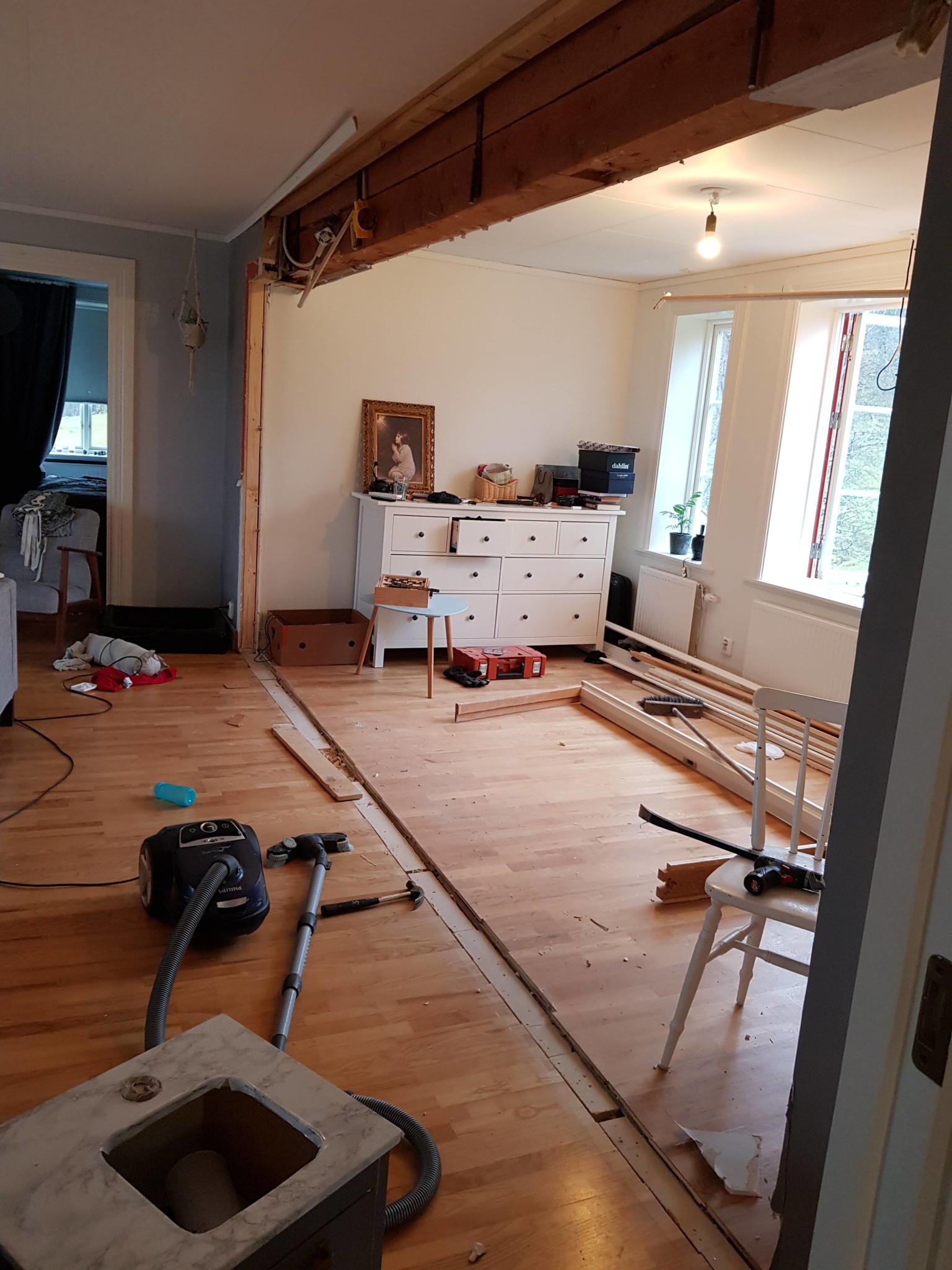
The important question is what do you want to achieve? If you want more help here from the forum, you need to try to describe how it looks with words, plus provide some measurements.
Is it a stone house, i.e., solid masonry exterior walls? Year built? Interior dimensions of the house? Number of floors? What does the roof look like? Feel free to take some more photos.
No joists built with standard timber dimensions can handle a 6 m span.
Is it a stone house, i.e., solid masonry exterior walls? Year built? Interior dimensions of the house? Number of floors? What does the roof look like? Feel free to take some more photos.
No joists built with standard timber dimensions can handle a 6 m span.
Update.
Dug in the track under each iron. Sure enough, there is a corresponding one there too.
Someone has for unclear reasons cut them and put up a wall..
That it flexes less when the wall was up is probably only because the wall pressed down the floor.
Tried to put up a beam and force down the floor and then it flexes less.
But I don't think that's right.
Since we want to bring out the beam again and have an old-fashioned style.
So I'm thinking of taking down the horns and welding threaded rods.
Put on a type of turnbuckle and tighten the floor a bit so it can't flex and becomes slightly suspended in the ceiling beam.
Dug in the track under each iron. Sure enough, there is a corresponding one there too.
Someone has for unclear reasons cut them and put up a wall..
That it flexes less when the wall was up is probably only because the wall pressed down the floor.
Tried to put up a beam and force down the floor and then it flexes less.
But I don't think that's right.
Since we want to bring out the beam again and have an old-fashioned style.
So I'm thinking of taking down the horns and welding threaded rods.
Put on a type of turnbuckle and tighten the floor a bit so it can't flex and becomes slightly suspended in the ceiling beam.
J justusandersson said:The important question is what do you want to achieve? If you want more help here from the forum, you need to try to describe what it looks like with words, and you also need to provide some measurements.
Is it a stone house, i.e., solid masonry exterior walls? Year built? The interior dimensions of the house? Number of floors? What does the roof look like? Please take a few more pictures.
No joists built with standard lumber dimensions can handle a 6 m span.
Wooden house.
Circa 1900
Upper floor added in 1985.
The beams are spaced at 50 centers and are 60x200
Before you do that, I think you should check that you are not doing anything foolish. Is there an attic above and a residential floor below? What is the dimension of the beam visible in the ceiling? Aren't there two beams stacked on top of each other? The construction year is also important information.
On which floor was the photo taken? 60x200 almost exactly corresponds to 45x220. It's good but not enough for 6 meters.
Haven't measured the exact height of the beam as it’s such a small gap to dig out all the shavings. But it's at least 50mm wide.J justusandersson said:
The upper floor was built in 1985, that much I know for sure.
And it has held since then :/
Yes, there are two beams, 150x170 and about 7m long.
Exactly, a small attic above and the ground floor below.
But I don’t know how to check it further.
A friend who is a carpenter was here and looked, but he couldn't say more than that it holds. If I wanted to stop the bouncing, though, it was either to reinforce it and push the floor down or lift it a bit...

Could have been a suspended floor. We have that in a neighboring house (almost identical to ours). About 5.5 m wide, with approximately 5x6" beams, cc about 120 cm. Masonry cross walls with about 3.5 m between. Along the house is a bearing central beam about 6x8" that helps to stiffen the intermediate floor. At the chimney, there is no support, so there the cross beam hangs on a chain up to the rafters' high legs. That floor is rock solid.
Yes, the dimensions of the beams in the ceiling are so robust that it could actually be a hanging joist. But in that case, it would still only be a floor joist hanging if there isn't a supporting beam underneath. Can you check if there is a supporting beam in the ceiling on the floor below?
I'll try, there used to be 4 of those fittings in the past. I was thinking of having two.J justusandersson said:Yes, the dimensions of the beams in the ceiling are so substantial that it could actually have been a hanging floor structure. But in that case, it's still just a floor joist hanging unless there's a bearing beam underneath. Can you investigate if there's a bearing beam in the ceiling of the floor below?
Since it’s been remodeled, there haven’t been any!
Without a blueprint, I find it difficult to orient myself, but you seem handy. If there are 2 pieces of 150x170 beams loosely stacked on top of each other, you could bolt them together in a few places to make them cooperate better.
Yes, I understand, but unfortunately, I don't have any :/J justusandersson said:
They are well put together. When they were clad, 15mm plywood was placed on the back.
So it has to stay since the backside is not that visible, so they are properly fixed together.
And the fittings are in each beam.
But as you said, they only lift in two of the 8 floor joists.
It's better than nothing, but doesn't feel entirely satisfactory. If it had been possible to let the hangers go down through a load-bearing beam under the floor joists, it would have been an option. Such a beam can then be made considerably thinner than usual. But it's difficult to calculate the loads without a drawing.