
Been browsing the forum and trying to understand a bit about how to, with simple means, improve the soundproofing of an interior wall when you're going to put up a new one anyway. I'm not quite clear on all the variants but humbly ask for a recommendation between these two examples.
Conditions:
The interior wall (which is new) will stand between the bathroom and the hallway. The requirements, due to space constraints, are that I can only use studs 45x70. On the bathroom side, there will be tiles, drywall (13), and plywood (15). The hallway side will have double drywall (13).
The alternatives I've considered are according to the sketch. Either frame normally with the "45-side" facing the wall material OR turn the studs with the "70-side" towards the wall material and stagger them with the same spacing. The latter is to create an air gap that I understand can counteract noise and vibrations (?).
So, my question is not how to generally best soundproof an interior wall but which of these two options I should choose, considering soundproofing but also the load-bearing capacity of the wall?
And should I fill the gap with insulation in both options?
Recommendations and feedback from experts with theoretical and/or practical experience are gratefully received! 😌
Conditions:
The interior wall (which is new) will stand between the bathroom and the hallway. The requirements, due to space constraints, are that I can only use studs 45x70. On the bathroom side, there will be tiles, drywall (13), and plywood (15). The hallway side will have double drywall (13).
The alternatives I've considered are according to the sketch. Either frame normally with the "45-side" facing the wall material OR turn the studs with the "70-side" towards the wall material and stagger them with the same spacing. The latter is to create an air gap that I understand can counteract noise and vibrations (?).
So, my question is not how to generally best soundproof an interior wall but which of these two options I should choose, considering soundproofing but also the load-bearing capacity of the wall?
And should I fill the gap with insulation in both options?
Recommendations and feedback from experts with theoretical and/or practical experience are gratefully received! 😌
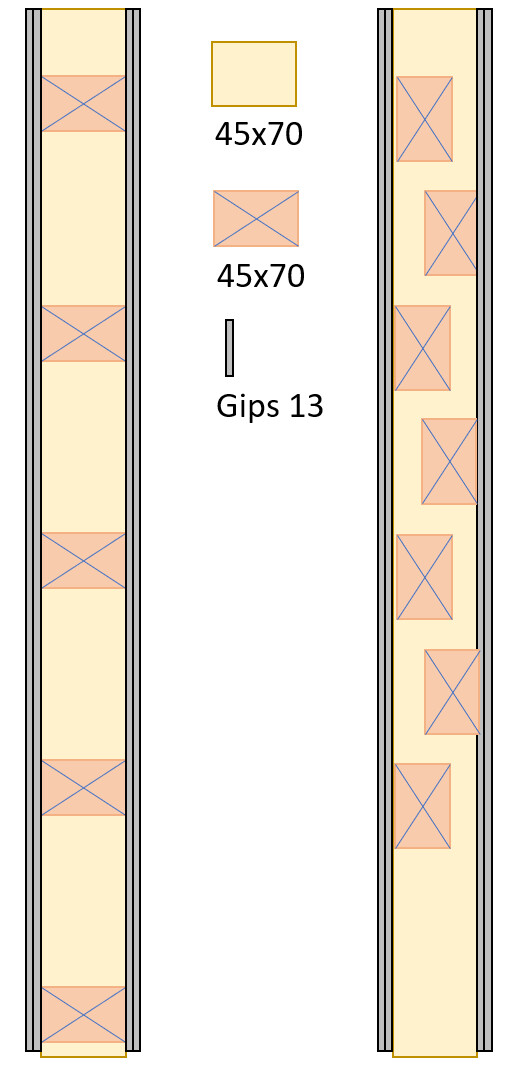
Having the studs as in option 2 is better from a sound perspective, but probably isn't stiff enough as a wet room wall. It should be a 70-regel cc450 if I remember correctly.
Yes, check this link for more info:
https://sakervatten.se/wp-content/uploads/2024/02/folder-vatrumsvagg-2012.pdf
https://sakervatten.se/wp-content/uploads/2024/02/folder-vatrumsvagg-2012.pdf
Alt.2 but not so tightly with the studs, otherwise there is no room for insulation😂D diceman said:Searched around the forum and tried to understand a bit about how to, with simple means, improve sound insulation of an interior wall when you are going to put up a new one. Not completely on board with all the variations but humbly ask for a recommendation between these two examples.
Conditions:
The interior wall (which is new) will stand between the bathroom and the hall. Requirements, due to space constraints, are that I can only use studs 45x70. On the side facing the bathroom, there will be tiles, gypsum (13), and plywood (15). The side facing the hall will be double gypsum (13).
The alternatives I have considered are according to the sketch. Either frame normally with the "45-side" facing the wall material OR turn the studs with the "70-side" towards the wall material and place them staggered with the same cc mutually. The latter is to create an air gap which I understand can counteract sound and vibrations(?).
So, my question is not how to generally best soundproof an interior wall but which of these two options I should choose, based on soundproofing but also the load-bearing capacity of the wall?
And, should I fill the void with insulation in both options?
Recommendations and opinions from experts with theoretical and/or practical experience are gratefully received! 😌
Click here to reply