Hello! My partner and I moved into a house 1.5 years ago, which is under the flight path to one of Sweden's larger airports. The distance as the crow flies is 15 km, so we are not covered by any "standard support package" from Swedavia. Depending on wind conditions, planes fly over our house, and some household members are adversely affected by it. It’s both the indoor noise level and the perceived vibrations that are disturbing.
We see two options: 1) Move (we love our house, so we would rather stay) or 2) Air soundproof the house. This thread is about option 2.
---
HOUSE CONSTRUCTION
---
The house was built in 1954 and is not designed for either thermal or sound insulation, so I believe there are significant opportunities to better insulate the house against airborne sound than it is today. I will describe how the house is built based on several areas, please ask additional questions, and I will clarify with text and images.
WINDOWS
5 windows are triple-glazed from 2006 (3 bedrooms, 1 in the living room, 1 in the kitchen)
2 windows are double-glazed from ~1970 (living room)
1 window is double-glazed from the year of construction (bathroom)
WINDOW CAVITY INSULATION
Approx. 1.5-2.5cm gap around the windows, partially filled with foam that holds the window in place
No additional insulation
Wooden window trims inside
CEILINGS
1” plank
3 rooms have gypsum board (bedrooms, hallway, inner hallway), 3 have stretched fabric (2 bedrooms, living room), 2 have some form of fiberboard (kitchen, bathroom)
ATTIC
Approx. 15 cm wood shavings on plank
Sporadically placed insulation mats along the eaves (half-hearted attempt at additional insulation by previous owners)
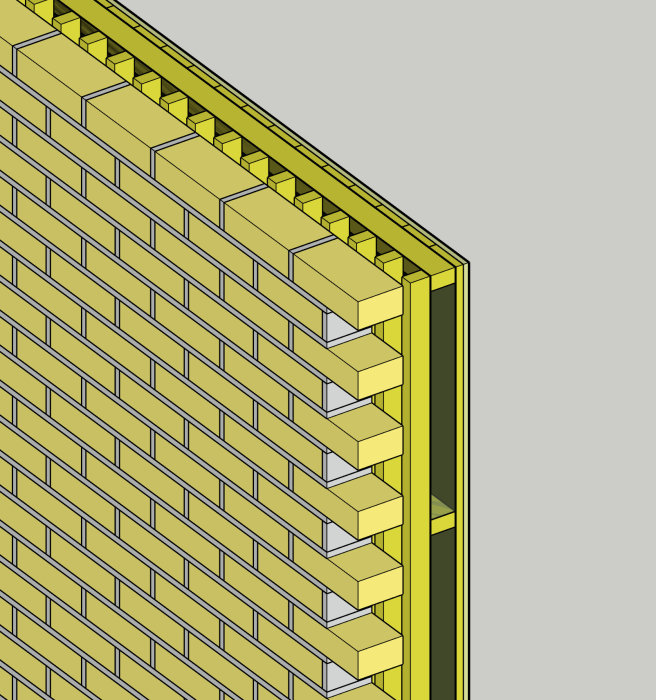
Layers from outside-in: facade brick, air gap, vertical studs 10 c/c, horizontal studs approx. 60 c/c with approx. 6.3cm mineral wool (Laxå panel), 1” plank, 1.5cm treetop
On the inside of all exterior walls, radiator pipes come up through the floor about 5-5.5cm between pipe and wall, which (possibly?) limits the ability to build the wall inward too much
EXTERIOR DOORS
Thin wooden exterior door, and an inner exterior door, forming approx. 15cm air gap between the doors
Patio door section from 1970, the door seems thin, double-glazed
I want to tackle this problem from all angles and, with your help, reduce the noise level from the planes as much as possible.
With the information above, what measures would you consider most effective against aircraft noise? Please ask additional questions, and I will do my best to answer with both text and images!
Below are sample measurements from a sound meter app on the phone. I understand that the figures you get with one of these aren't very accurate, but maybe they can be used in relation to one another or something. The values given are max/average, over about 60-90 seconds.
NO FLIGHT
Bedroom, no flight: 31/26
Living room, no flight: 41/35
Inner hall, no flight: 37/31
Outdoors, no flight: 55/44
FLIGHT (BOEING 737) (measured when directly above us)
Bedroom, 737: 44/30
Living room, 737: 50/39
Inner hall, 737: 44/36
Outdoors, 737: 73/56
Now maybe these measurement values are completely useless and cannot be used at all. But if we pretend that they can be, we see among other things that the facade sound insulation between outside and inside is (average value):
A) An additional 30-40 cm of cellulose in the attic (for both heat and sound insulation)
B) Plaster ceiling in the living room (we are considering using Norgips Silentboard here)
C) Double plaster directly on exterior walls (Norgips SilentBoard + regular plaster). Framing against the exterior wall is also an option, but since we have a total of 5.5 cm before the radiator pipes are in the way, it would have to be thin, and we do not want to tear up the floors in the rooms (newly laid or older fine flooring).
D) Insulate the windows with mineral wool
E) Sound-insulating laminate glass (2-1-2) on older windows
F) Replace the patio door section
G) Replace sealing strips on all windows, and set double
A) An additional 30-40 cm of cellulose in the attic (for heat but also sound insulation)
B) Plaster ceiling in the living room (here we are considering using Norgips Silentboard)
C) Double gypsum directly on the outer walls (Norgips SilentBoard + regular gypsum). Framing against the outer wall is also an option, but since we only have a total of 5.5 cm before the radiator pipes get in the way, it would have to be thin, and we don't want to rip up the floors in the rooms (newly laid or older fine floor).
D) Insulate the windows with mineral wool
E) Sound-insulating laminated glass (2-1-2) on older windows
F) Replace the patio door
G) Replace the sealing strips on all windows, and apply double
of option A seems to have an effect, the only thing I've seen so far that actually shows something about possible sound level reduction graph—the image from the Isocell brochure.
"ISOCELL cellulose insulation achieves in partition walls up to 3 dB and in ceilings up to 5 dB better sound insulation values than regular insulation boards. Only because all cavities are completely filled, can one assume a better sound insulation level than in panel-shaped insulation materials. This was furthermore confirmed by TGM Vienna with a comparative control. (Control no. VA AB 11961)"
How one interprets that is it should be tight? but more seems better
Had tried stapling/screwing a 2-10mm plastic sheet on the outside of the window then inside to see if there was any positive or negative effect.
Considering myself replacing the inner and/or outer glass with an insulating glass cassette.
Have a UV-protected 1mm plastic between the 2 glasses for a modest extra air pocket, nothing compared to 3 glass but cost a few hundred.
But sound problem from planes... rock wool first thought. Alternatively, mix a little like 45mm glass, 45mm rock wool since different materials for different acoustic properties? You are basically building a sound studio (stumbled upon it online where different materials were mentioned)
Maybe try to see where exactly sound vibrations sneak in, could well shake ventilation air = an air filter & possibly the frame.
Since you don't insert stiffer material inside that now shakes, some things hang more than sit tightly?
I'm a bit crazily paranoid.
A), B (regular 13mm plasterboard), C (single plasterboard regular 13mm plasterboard) as well as D-G (changed door section + all windows to 37db windows).
Haven't measured but experience a sufficiently large difference so that it doesn't "feel" the same as before. So we are satisfied with the changes. Can return with measurements (however, it varies depending on wind direction, so it's difficult to compare entirely).
I can recommend the thread "Ljudisolera för sex" where many useful tips emerged that are also applicable for aircraft noise, trains, car traffic, construction work, sound studios, etc.
Was there any measure that made a significant difference?
Multiglazed windows seem like a low-hanging fruit, possibly two windows in succession in the same frame?
Click here to reply
Vi vill skicka notiser för ämnen du bevakar och händelser som berör dig.



tehvicke said:
The measures we are considering

