
4,625 views ·
26 replies
5k views
26 replies
Slanted interior wall in stone!

Straighten an interior wall of brick and plaster.
Hi. The wall is very crooked. There's a difference of about 6-7 cm. How do you make this straight in the best way? It's straight enough where the window ends, so it's the section after the window towards the corner that needs improvement. There will be base cabinets with a long countertop along the entire wall. No upper cabinets. Should you, can you apply that much plaster and make it good and durable, or what is appropriate?
Hi. The wall is very crooked. There's a difference of about 6-7 cm. How do you make this straight in the best way? It's straight enough where the window ends, so it's the section after the window towards the corner that needs improvement. There will be base cabinets with a long countertop along the entire wall. No upper cabinets. Should you, can you apply that much plaster and make it good and durable, or what is appropriate?
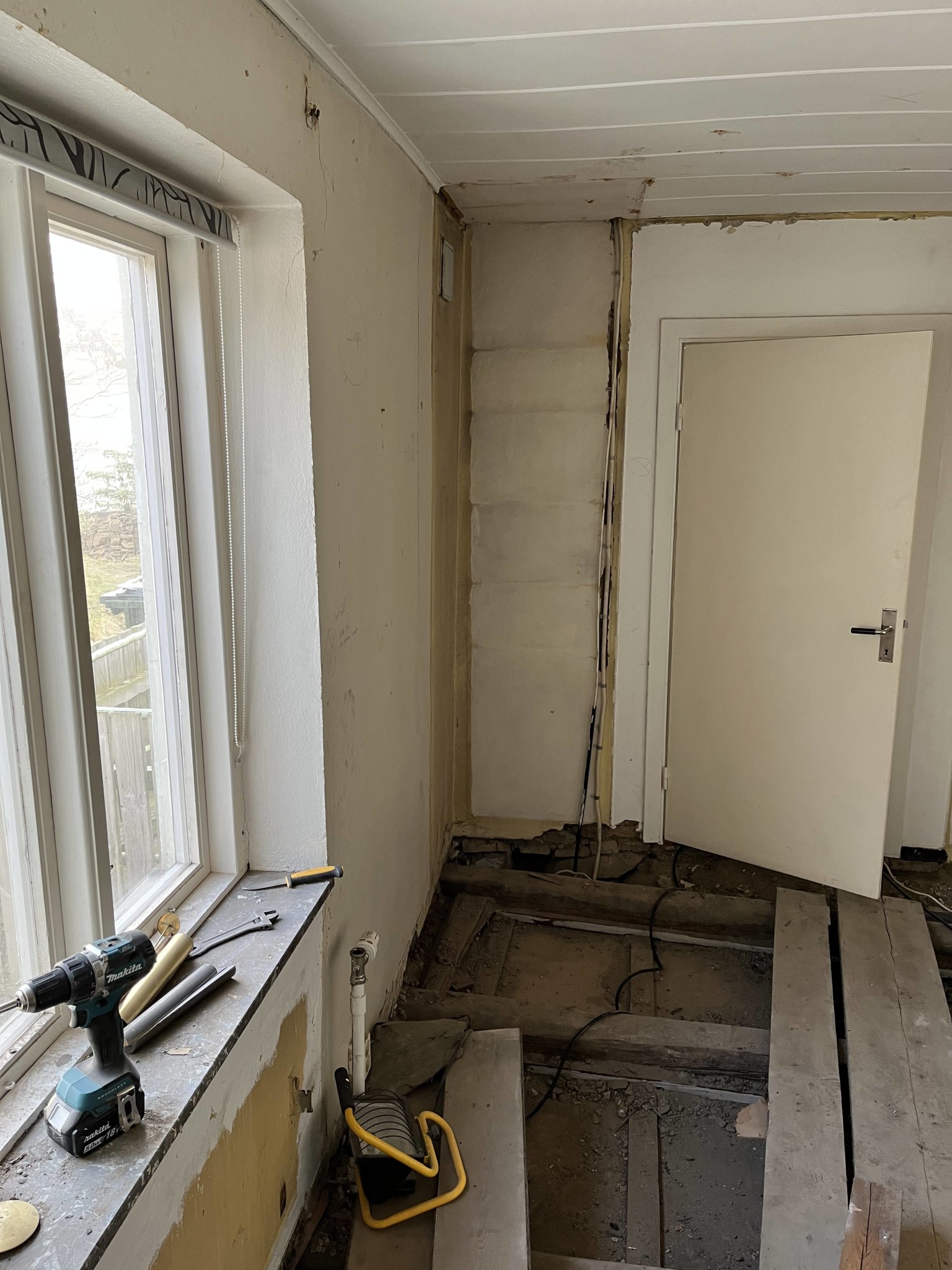

How should one say... by the window it is mostly straight. It's the road barrier afterwards that bends. If you zoom in and look at the white painted line, you can see the darker section towards the corner how it varies in width. The room is about 6-7cm wider at foot height compared to the ceiling.
hope that helped a bit..
hope that helped a bit..

Yes, but the wall isn't vertical in the corner. At the top, it goes mostly straight like the rest of the wall, but at the bottom, the gap becomes larger. So if you placed a stud in the deepest part, it would be maybe a few mm wide at the top, but up to 70mm wide at the bottom. But maybe you have to rip a couple of studs and try to make a straight wall out of that. However, the closer you get to the window, the thinner they become... I was thinking if it could be possible to fill/plaster in some way, but that might not turn out well...
U
Utsliten och utdömd
Building conservationist
· 2 795 posts
Utsliten och utdömd
Building conservationist
- 2,795 posts
I interpret it as it not being plumb, but the wall leans into the room at the top by 6-7cm.Jonatan79 said:
I would hold a vertical stud against the wall, use a long level or laser to draw a vertical line on the stud. Cut along the line and screw it onto the wall. Then attach sheets to the stud.
Construction veteran
· Stockholm
· 340 posts
Gypsum plaster should probably work
We had a really crooked wall in the bathroom.
We used some kind of construction board similar to Jackoboard waterproof board; it has a good surface with fiber cement on the side, should be possible to mesh and plaster on.
The other side we sanded down with a belt sander and shaped it according to the wall. Since the board is made of XPS, it's quite easy to work with and lightweight, so it's easy to attach to the wall.
You can't spackle/plaster 7cm. Possibly you could cast a ledge and build up with, for example, 5cm wide lightweight concrete blocks (which you have to modify to make narrower) higher up, and when you get down to maybe a 3cm difference, you can probably plaster it straight. Max about 1cm per layer of plaster, and definitely use mesh for reinforcement.
But it's a dusty job to narrow down such blocks (I've done it...).
We used some kind of construction board similar to Jackoboard waterproof board; it has a good surface with fiber cement on the side, should be possible to mesh and plaster on.
The other side we sanded down with a belt sander and shaped it according to the wall. Since the board is made of XPS, it's quite easy to work with and lightweight, so it's easy to attach to the wall.
You can't spackle/plaster 7cm. Possibly you could cast a ledge and build up with, for example, 5cm wide lightweight concrete blocks (which you have to modify to make narrower) higher up, and when you get down to maybe a 3cm difference, you can probably plaster it straight. Max about 1cm per layer of plaster, and definitely use mesh for reinforcement.
But it's a dusty job to narrow down such blocks (I've done it...).
Do I understand correctly that the wall is straight enough at the height where the countertop will be? If so, I wouldn't worry if there's an uneven gap behind the cabinet under the countertop down towards the floor. It's not something that's visible. Base cabinets are usually fastened at the top. If necessary, you can screw or glue a suitable spacer there, such as a board of the right thickness.
As long as the wall is visibly plumb over the future countertop and the unevenness underneath is hidden behind cabinets, why do anything at all? A suitable piece of wood on the edge of the cabinets, if they are hanging on a rail so that they hang vertically, is probably what's needed. If the cabinets are standing with a base on the floor, it might be less important.
I would focus more on ensuring the wall by the countertop is straight, especially if you're going to install an expensive stone slab.
I would focus more on ensuring the wall by the countertop is straight, especially if you're going to install an expensive stone slab.
Yep, that's probably the best way to go. It is likely the easiest.U Utsliten och utdömd said:
hello. No, unfortunately not. Otherwise, I wouldn't have cared either since that's the charm with old houses. BUT there is at least a 5 cm gap in height where the countertop will be.T TommyC said:Am I right in understanding that the wall is straight enough at the height where the countertop will be? If so, I wouldn't worry if there's a slanted gap behind the cabinet under the countertop down towards the floor. It's not visible. Lower cabinets are usually fastened at the top. If needed, you can screw or glue an appropriate spacer like a suitably thick beam.
Exactly, that's how it is. My previous quote. It turns out to be almost 5 cm and we're planning to have a quartz slab, so it becomes weird. 5-10 mm could probably have been compensated with tiles as splash protection. But this won't work...M myrstack said:As long as the wall is visibly plumb above the future countertop and the unevenness below is hidden behind the cabinets, why even do anything? A suitable piece of wood at the edge of the cabinets, if they are hanging on a rail, so they hang vertically, is probably what's needed. If the cabinets are to stand on the floor's base, it might be less important.
I would focus more on making sure the wall at the countertop is straight, especially if you plan to install an expensive stone slab