
37,088 views ·
35 replies
37k views
35 replies
Coat, plaster alt. Render?
Member
· Västra Götaland
· 545 posts
I just spoke with a moisture specialist company that will come here and check things out. He recommended using regular plaster and not gypsum plaster, as the gypsum plaster becomes too dense.[/quote]Nix said:
I don't understand how a plaster mix without organic additives can become too dense??? it's not supposed to work as a Melita filter ;D If the walls are not previously plastered, it's quite possible to follow the "Builder's" suggestion, even though I don't understand what he means by modernities in the same sentence as gypsum plaster...

Thanks for the feedback - the combined expertise on the forum is enormous.
I expressed myself a bit unclearly regarding our basement construction.
It’s a split-level basement where we are, among other things, converting the old garage into a recreation room. The house is made of aerated concrete from the 50s and has not previously been re-drained. The house is situated on a ridge, and the soil is very draining. Previously, the garage was fitted with, among other things, a sauna and relaxation area, framed with insulation and wood paneling on the inside - no moisture problems.
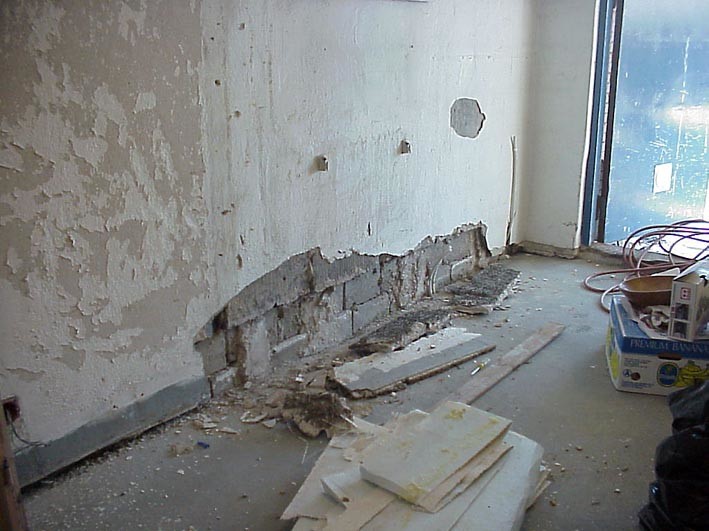
I have now removed the slab, insulated, poured a new slab with underfloor heating, and simultaneously re-drained! When the floor was removed, I noticed that the bottom 40 cm of the interior walls were in concrete hollow blocks (they go down an additional 60 cm below the floor). Above the concrete hollow blocks, regular aerated concrete blocks have been built. The section from the floor up to where the aerated concrete structure begins is insulated with wood wool panels. There seems to be some centimeters of distance to the concrete hollow blocks because I can fit my hand in certain places. The image below will illustrate the mess.
To make it look neat, the walls need to be fixed. Some wood wool sections have fallen down, and approximately 6 cm needs to be built for the finished wall. Some "ordinary" plaster has fallen off, and some parts are loose.
My idea is, as I said, to plaster the entire room with gypsum plaster. Even the relatively small sections where the wood wool has collapsed. Some sections will then be completely without insulation. Maybe thin aerated concrete blocks should be used there!?
Opinions?
I expressed myself a bit unclearly regarding our basement construction.
It’s a split-level basement where we are, among other things, converting the old garage into a recreation room. The house is made of aerated concrete from the 50s and has not previously been re-drained. The house is situated on a ridge, and the soil is very draining. Previously, the garage was fitted with, among other things, a sauna and relaxation area, framed with insulation and wood paneling on the inside - no moisture problems.
I have now removed the slab, insulated, poured a new slab with underfloor heating, and simultaneously re-drained! When the floor was removed, I noticed that the bottom 40 cm of the interior walls were in concrete hollow blocks (they go down an additional 60 cm below the floor). Above the concrete hollow blocks, regular aerated concrete blocks have been built. The section from the floor up to where the aerated concrete structure begins is insulated with wood wool panels. There seems to be some centimeters of distance to the concrete hollow blocks because I can fit my hand in certain places. The image below will illustrate the mess.
To make it look neat, the walls need to be fixed. Some wood wool sections have fallen down, and approximately 6 cm needs to be built for the finished wall. Some "ordinary" plaster has fallen off, and some parts are loose.
My idea is, as I said, to plaster the entire room with gypsum plaster. Even the relatively small sections where the wood wool has collapsed. Some sections will then be completely without insulation. Maybe thin aerated concrete blocks should be used there!?
Opinions?
Well, I don't know...
Unfortunately, it's not uncommon to have misunderstandings even among the pros.
Moisture is an incredibly troublesome subject. It doesn't get any less troublesome in basements...
EDIT: That was in response to the post before last. It might be misunderstood if one thinks the response is to the one directly above...
Unfortunately, it's not uncommon to have misunderstandings even among the pros.
Moisture is an incredibly troublesome subject. It doesn't get any less troublesome in basements...
EDIT: That was in response to the post before last. It might be misunderstood if one thinks the response is to the one directly above...
Member
· Västra Götaland
· 545 posts
Hi "A"
Install new wood wool panels, they have worked for 50 years
Then plaster the entire surface to a new structure... it doesn't matter if it gets thicker at the wood wool panel!
Install new wood wool panels, they have worked for 50 years
Then plaster the entire surface to a new structure... it doesn't matter if it gets thicker at the wood wool panel!
I think you're going to find me quite annoying...A said:Thanks for the feedback - the collective expertise on the forum is enormous.
I expressed myself a bit unclearly regarding our basement construction. It is a split-level basement where we are partly converting the old garage into a recreation room. The house is made of lightweight concrete from the 1950s and has not been previously re-drained. The house is located on a ridge and the ground is very draining. Previously, the garage was equipped with a sauna and relaxation area, framed and with fiberglass insulation and wood paneling on the inside - no moisture problems.
Now I have removed the slab, insulated it, poured a new slab with underfloor heating, and re-drained at the same time! When the floor was removed, I noticed that the lowest 40 cm of the internal walls were made of concrete hollow blocks (they then extend another 60 cm below the floor). Above the concrete hollow blocks, regular lightweight concrete blocks have been used. The part from the floor up to where the lightweight concrete structure begins is insulated with wood fiber boards. There also seems to be a centimeter gap to the concrete hollow blocks as I can fit my hand in some places. The picture below illustrates the mess.
To make it look nice, the walls need to be fixed. Some of the wood fiber sections have fallen down and about 6 cm needs to be built up to the finished wall. Some regular plaster has also fallen down, and certain parts are loose.
My idea, as mentioned, is to plaster the entire room with gypsum plaster. Even the relatively small sections where the wood fiber has come down. Some sections will then be completely without insulation. Maybe thin lightweight concrete blocks should be mortared there!?
Thoughts?
But why don't you just tear down the whole clutter to the concrete? Wood fiber isn't great to have in the basement wall, since it's organic. If you've re-drained, you probably have insulation on the outside, so that should be sufficient for heat. Also, they say that it's good to avoid insulation on the inside of the basement wall.
My suggestion:
Tear everything down. It can't take too many hours.
Plaster the stone. Plaster isn't terribly expensive and it's not so hard to apply, at least I don't think so
Even if you don't have moisture problems today, you now have a largely new construction with new conditions and new use.
Even if I agree that the risk of a problem is small, it's not fun to have that problem when you're done furnishing.
Then you'd have gladly taken those extra precautions when the wall was half open.
That's how I think in my basement renovation...
You constantly find new things when you demolish.
Including a radiator pipe that didn't withstand my reciprocating saw. Allergic, I think
It only cost 3000 kr for an emergency plumber.
It's fun to do it yourself...
Member
· Västra Götaland
· 545 posts
In this case, there's no right or wrong... just more or less troublesome... :-/
Wood wool boards do contain wood but they never cause any problems... I think it's something electronic
And as "A" writes, he has no conditions for getting into trouble... must be the only Santa in the whole country ;D
Wood wool boards do contain wood but they never cause any problems... I think it's something electronic
And as "A" writes, he has no conditions for getting into trouble... must be the only Santa in the whole country ;D
No, I agree.
Given the data we have, it will surely work excellently with träullsplattor. However, I raise a warning finger for the new conditions.
"A" will have to assess the risk themselves.
By the way, I have another piece of advice:
Tear down the house, build a new one...
It is always an option. However, not always the most economical.
Given the data we have, it will surely work excellently with träullsplattor. However, I raise a warning finger for the new conditions.
"A" will have to assess the risk themselves.
By the way, I have another piece of advice:
Tear down the house, build a new one...
It is always an option. However, not always the most economical.
Gypsum products like Gypsum are pure magic for us laymen and very, very easy to work with. When it comes to filling and polishing, I always use Gypsum. It has excellent adhesion to all the materials I've tried, and the result is great.
Member
· Västra Götaland
· 545 posts
It's just me being 'allergic' to new untested materials in relation to old ones, which I know from experience work excellently. Therefore, I've always had the approach: let others try first and learn from their mistakes. Especially in contexts like this where moisture is involved. But then it has to go five to ten years so that I can be sure they work. (Because usually, they don't.) It tends to be 'cheaper' in the long runByggaren said:
[/quote]Gypsum plaster has been on the market in Sweden since the 80s... and has historical roots that go almost as far back as lime plaster
According to "A," he also removed studs and insulation from the walls without finding any problems, so we must assume he has good conditions.
Calling the solution in "A's" house cheap construction is a bit harsh; it has been a garage and was built in the 50s... they did so, and I can't see any problems with it
Use no more force than necessary
Fun debate this! 'Economical construction or not - I think the house is well-built otherwise!
Agree with the builder that "proper" cement-based plaster is certainly the technically best option. However, the aesthete in me says that cement never becomes even and smooth, and must be skim-coated. If you're going to have to skim-coat anyway, you might as well use gypsum plaster from the start - the end result will be just as bad from a functional point of view and just as smooth and nice from an aesthetic standpoint?? The difference then is twice as much work with the former option.
Agree with the builder that "proper" cement-based plaster is certainly the technically best option. However, the aesthete in me says that cement never becomes even and smooth, and must be skim-coated. If you're going to have to skim-coat anyway, you might as well use gypsum plaster from the start - the end result will be just as bad from a functional point of view and just as smooth and nice from an aesthetic standpoint?? The difference then is twice as much work with the former option.
The question is what the price difference is between 'Gypsum' and regular plaster?sjalvdrag said:
Member
· Västra Götaland
· 545 posts
Yes, this thread got long... hope many will benefit from our efforts...
The price per square meter and millimeter thickness is somewhat higher for gypsum plaster than for KC plaster.
One bag is about twice as expensive as the KC plaster, but you get about 30 liters compared to 13 liters from one bag of plaster.
Check the link...
http://optiroc.lithoteknik.se/pid/data_sheet/pdf/2095_1.pdf
The price per square meter and millimeter thickness is somewhat higher for gypsum plaster than for KC plaster.
One bag is about twice as expensive as the KC plaster, but you get about 30 liters compared to 13 liters from one bag of plaster.
Check the link...
http://optiroc.lithoteknik.se/pid/data_sheet/pdf/2095_1.pdf
Member
· Västra Götaland
· 545 posts
No... a felted or brädskurat plaster won't become smooth, but in that case, it needs to be filled, and probably you'll also need to do some adjustment of the gipsputsen with spackle... :-/
But you've already done one room so you know how it turned out...
But you've already done one room so you know how it turned out...