
10,228 views ·
21 replies
10k views
21 replies
Slab on ground - risk construction?
Page 1 of 2
The search for our house continues...
Right now we are looking at a villa built in 1980. As I understand it, many houses from this period (late 70s, early 80s) are poorly constructed. It seems that the uninsulated slab is the culprit in the drama leading to moisture and mold under the floor. 70s houses also seem to have issues with pressure-treated timber directly against the foundation.
How big are these risks really?
Should one be concerned if the seller cannot show documents indicating that the house sits on a slab with underlying insulation?
How long was the technique of pressure-treated sills directly on the foundation used?
Right now we are looking at a villa built in 1980. As I understand it, many houses from this period (late 70s, early 80s) are poorly constructed. It seems that the uninsulated slab is the culprit in the drama leading to moisture and mold under the floor. 70s houses also seem to have issues with pressure-treated timber directly against the foundation.
How big are these risks really?
Should one be concerned if the seller cannot show documents indicating that the house sits on a slab with underlying insulation?
How long was the technique of pressure-treated sills directly on the foundation used?
Actually, the old pressure-treated sills are good because they start to smell when there is a moisture problem, allowing you to detect the problem immediately instead of it being delayed and causing significant damage.
Ask the municipality if they have building permit documents to send, as they usually contain construction drawings if you're lucky, and then you might be able to determine whether there is insulation or not.
Not all sellers know much about their houses, so nothing to worry about in that regard, I think, unless you suspect the seller is trying to hide something.
Not all sellers know much about their houses, so nothing to worry about in that regard, I think, unless you suspect the seller is trying to hide something.
Well, I learned something new!
So, it's not the construction itself with pressure-treated boards that's the problem, but rather the substance used for treatment that reacted with moisture.
An inspector will of course be brought in for a potential purchase. But the problems that these uninsulated concrete slabs suffer from, is it something that's easy to detect without having to tear up the floor and such? I have no experience with moisture and mold damage, but a trained eye and a trained nose should be able to detect those types of damage fairly quickly?
So, it's not the construction itself with pressure-treated boards that's the problem, but rather the substance used for treatment that reacted with moisture.
An inspector will of course be brought in for a potential purchase. But the problems that these uninsulated concrete slabs suffer from, is it something that's easy to detect without having to tear up the floor and such? I have no experience with moisture and mold damage, but a trained eye and a trained nose should be able to detect those types of damage fairly quickly?
Thanks for the tip! I'll check on Monday what the municipality has in their archivesKjellTimell said:Ask the municipality if they have the building permit documents to send, as they usually include construction drawings, and if you're lucky, you might be able to determine whether there is insulation or not.
Not all sellers know much about their houses, so I think there's nothing to worry about from that aspect unless you suspect that the seller is trying to hide something.

Many people think that you should avoid treated wood today, referring to it as unnecessary or citing the precautionary principle. However, it is highly doubtful whether an inspection can point it out as a construction defect.Bob-TheBuilder said:
The house was built in 1980 on a concrete slab. In 1995 an extension was made (the house was lengthened). There too, it is a slab on the ground.
Are there any risks if the foundation of the extension is not the same as the original? Suppose the house was built on an uninsulated slab and the extension on an insulated slab.
One more thing. There is underfloor heating under the tiles in the laundry room/boiler room. From what I have been able to read, it is a big no-no to install it on uninsulated concrete slabs. Especially if it is turned off during the summer. It's like asking for trouble.
Are there any risks if the foundation of the extension is not the same as the original? Suppose the house was built on an uninsulated slab and the extension on an insulated slab.
One more thing. There is underfloor heating under the tiles in the laundry room/boiler room. From what I have been able to read, it is a big no-no to install it on uninsulated concrete slabs. Especially if it is turned off during the summer. It's like asking for trouble.
Uninsulated slabs are considered a risky construction. But that doesn't mean that all houses with uninsulated slabs are ticking time bombs. It's just good to know that if it's uninsulated, tests should be conducted during the inspection. When we moved in, we unscrewed some thresholds, and in one place, there was an opportunity to look under the floors, and everything was bone dry, and there was no smell anywhere. So just do a thorough inspection, and there shouldn't be any problems. If the house has been standing since the '70s, well, that speaks for itself.

No,Bob-TheBuilder said:
the insulation was placed on top of the slab, which meant that heat exchange occurs "inside the house" and moisture is drawn towards the heat exchange (through the slab underneath the floor).
Since around 1985 and onwards, insulation is placed under the slab so moisture stays beneath the concrete.
In 1980, insulation was used to some extent but often draining layers (gravel) under the slab, so they rarely have the classic "70s" problems, but can of course still experience them.
After the late 70s, plastic was placed on the concrete and then insulation, better but still not ideal...
The only way to know for sure what you have is to make a hole in the floor to see if there's interior insulation, and then break through the slab to see if there's soil, gravel, or insulation underneath...
If it's on-ground slab with interior insulation, it can still work well, but otherwise, a ventilated floor is recommended, e.g., Nivell...
The whole point is exactly what you write, that it should not be turned off during the summer. Otherwise, there are no moisture problems, but a heck of a waste of energy.Bob-TheBuilder said:
The broker for this property is unusually hard to reach and lacks answers to many questions. Moreover, he doesn't ask the relevant questions to the seller but says "he doesn't know."
Anyway. I called the seller directly today. Maybe a bit rude, but I'm not going to buy a "pig in a poke" because the broker isn't doing his job.
The people who live there have lived there since it was built. They have all the documentation from the construction left, so you can see how it is built So it seems promising that you can find out how the construction looks.
Anyway. I called the seller directly today. Maybe a bit rude, but I'm not going to buy a "pig in a poke" because the broker isn't doing his job.
The people who live there have lived there since it was built. They have all the documentation from the construction left, so you can see how it is built
So it seems promising that you can find out how the construction looks.Followed KjellTimell's advice and indeed the municipality had extensive technical construction information
Here is an image from the building permit documents. I don't know how to interpret it, so help would be nice.
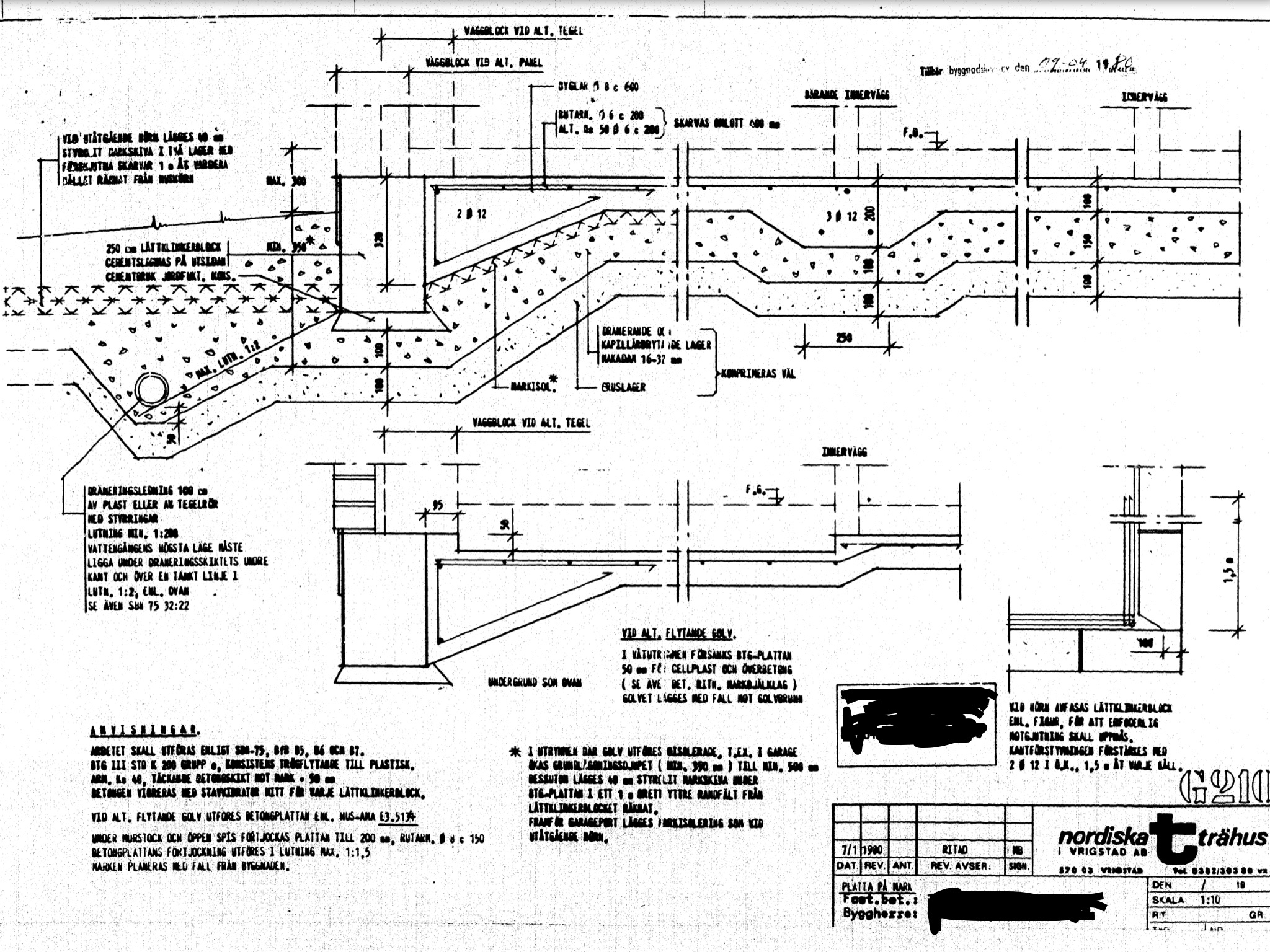
http://i.imgur.com/kM52ybV.jpg
Here is an image from the building permit documents. I don't know how to interpret it, so help would be nice.
http://i.imgur.com/kM52ybV.jpg