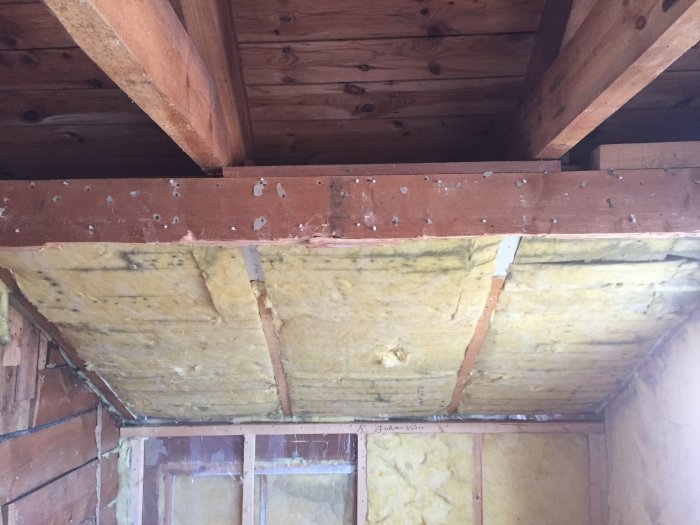
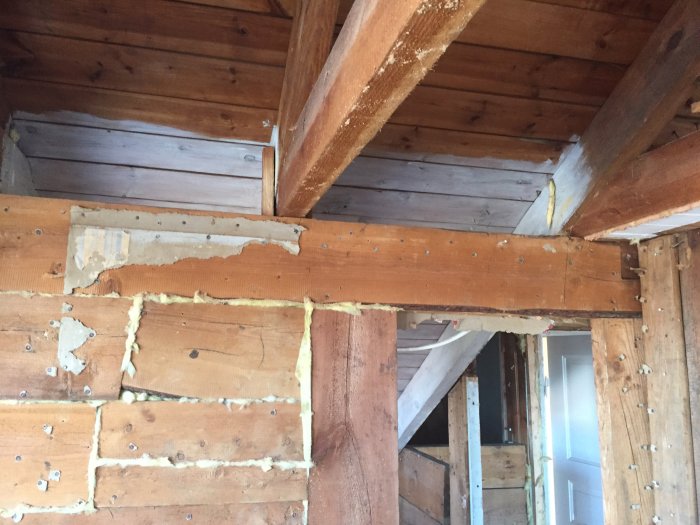
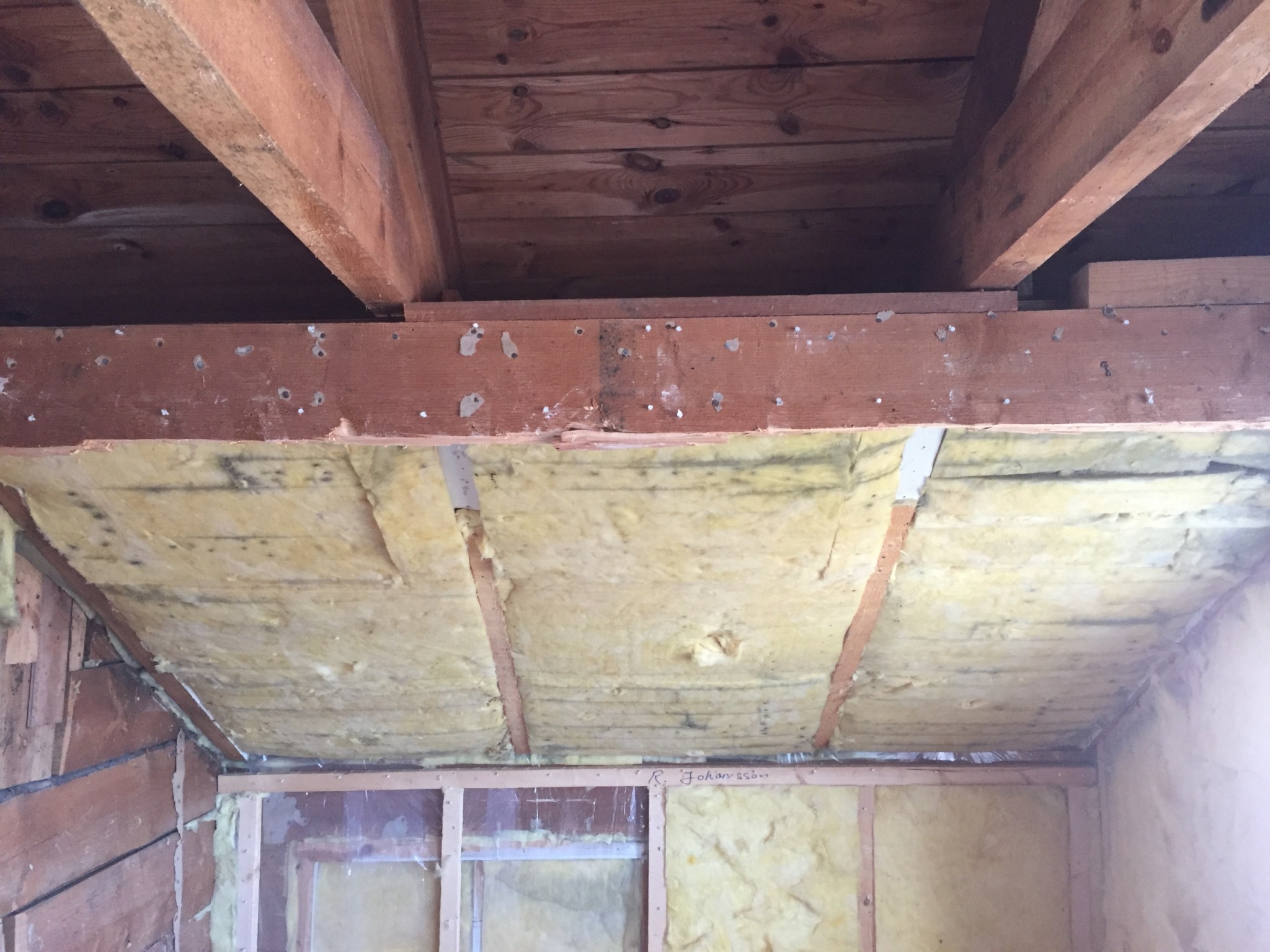
In principle, you can remove the crawl space and the beam. This assumes that the outer walls are load-bearing, which they reasonably are in a house from 1916. The outer walls likely consist of standing planks or horizontal logs. Then the rafters must have somewhat reasonable dimensions. The roof pitch of only 28 degrees is unusually low for a house from 1916 and contributes to a greater bending moment in the rafters than is usual.
the upper one is part of the truss and the lower one holds the walls together, maybe it won't collapse immediately but there is a risk that it will buckle...
No, the hanbjälken and upper arms should remain, it's the support (kattvind/storage) that should be removed. The question is whether to leave the top beam in the current storage wall.
First, a word of caution: Old houses are not as systematically built as modern houses (most built after 1950). One cannot assume that everything looks the same all the way through. Theoretical knowledge along with knowledge of older building techniques combined with practical experience is a good foundation for addressing this issue. The collar tie (the horizontal beam) is intended to prevent the outer walls from bowing out. It does not bear any vertical loads and can be replaced with a rod or a steel wire. The rafters (the sloping roof truss beams) bear the loads that the roof is subjected to and transfer these loads to the outer walls, which in turn transfer them to the foundation. The load on a rafter is mainly determined by the roof's own weight and the snow load present. (In Mölndal, they account for 1.5 kN/sqm, approximately 150 kg/sqm for snow load). The load on the rafter is also affected by its slope. The greater the slope, the more of the load becomes a normal force acting in the direction of the rafter, which can be disregarded in this case. You also need to know the distance between the roof trusses. There are roof truss variants that also have braces, but then it looks a bit different than what the drawing shows. Your rafters are probably cut in the dimension of 3x7 inches, possibly a bit undersized, which was a very common dimension in the past. My conclusion is that you can remove the wall to the attic space without any problem. However, it is not a bad idea to have a competent person look at the conditions.
I can calculate strength and I would never consider removing the rafters. The top beam in the knee wall is namely a rafter that should support the roof. If you remove it, the wall plate presses out and the truss tie beams bend... no, it's not possible.
If the rafters are too weak to support between transverse partition walls, they need to be replaced with thicker ones.
And the question is then what dimension the åsar should be. Right now, there is not much left of 2 of the 4 former kattvindar, of which one is not adjacent to the roof truss.
One can see quite clearly in the pictures that the "åsarna" were added later than the roof truss itself. They don't even function as supports. The attic floor is also not designed to handle the vertical loads that would result if the roof trusses rested on the "åsarna". The dimensions of the roof trusses are so substantial, and the c/c distance between them so short, that they should be able to support the roof. I would bring in an older architect who has experience with old houses. There are quite a few of those in your area.
Vi vill skicka notiser för ämnen du bevakar och händelser som berör dig.


 . Right now I don't know what to do, remove everything or leave a bjälke as support.