
4,342 views ·
12 replies
4k views
12 replies
Should the loads on the entire shed construction be recalculated for a green roof?
We will build a shed (3*4.8 meters) with a sedum roof that we will plant ourselves. This means that the roof weight will increase significantly, and I will base the calculation of the rafters on kn 5.5, according to the approximate value in the Green Roof Handbook. So far, I know how to proceed.
The question is whether I need to calculate further down into the structure's walls, floors, and foundations, or if a proper standard pile foundation and frame (studs 45*95) are sufficient for the downward load.
I have tried to get an idea of approximately how much weight a pile can withstand but haven't succeeded in finding a good reference point.
The question is whether I need to calculate further down into the structure's walls, floors, and foundations, or if a proper standard pile foundation and frame (studs 45*95) are sufficient for the downward load.
I have tried to get an idea of approximately how much weight a pile can withstand but haven't succeeded in finding a good reference point.
E Elitost said:We are going to build a shed (3*4.8 meters) with a sedum roof that we will plant ourselves. This means that the roof weight will increase significantly, and I will use kn 5.5 for the calculation of the roof trusses, based on approximate values in the Green Roof Handbook. So far, I know how to proceed.
The question is whether I need to further calculate down through the construction's walls, joists, and footings, or if a footing foundation and a frame in solid standard (studs 45*95) are sufficient for the downward load.
I have tried to get an idea of approximately how much weight a footing can bear, but I can't find any good reference points.
Does that include snow load?
I can't imagine that the wall or foundation construction would need to be reinforced due to the vertical load increase,
45x95 cc 120 supports our roof in tile in Stockholm.
Yes, in my estimation of the roof's weight, I have taken that into account. I might place myself at an even safer distance considering the margins of error when I make the final construction drawing of the trusses. It involves so little timber that it doesn't hurt to be on the completely safe side.Ulltand said:
No, I think that much larger buildings handle greater weights on walls and pillars, without needing to scale up as a result. But as a novice, I don't have much personal experience to draw conclusions from, and there's always the risk that I might do something wrong if I freestyle too much.
Yes, I'm fully aware of that

What I'm concerned about is that I lack the knowledge of what weights are required to risk breaking a load-bearing wall, or how a reinforced footing with a 19 or 20 diameter handles weights.
Sedum/herb roof would be around 0.9-2.5 kn/sqm (if it’s not rolled out). Then I thought I could just add 2.5 which is the snow zone. And then I added a bit extra to be completely sure. But if I've got it wrong, I'd only be happy.W witten said:

The capacity of the standing rules to support the roof loads primarily depends on how they are braced in the weak direction. With 45x95 directly under each truss attachment, it is suitable to have a row of noggings at half height.
I was planning to frame according to the same principle as in construction descriptions for garages but scale down the length and width. The height of the build is not critical as I live outside the zoning plan.J justusandersson said:
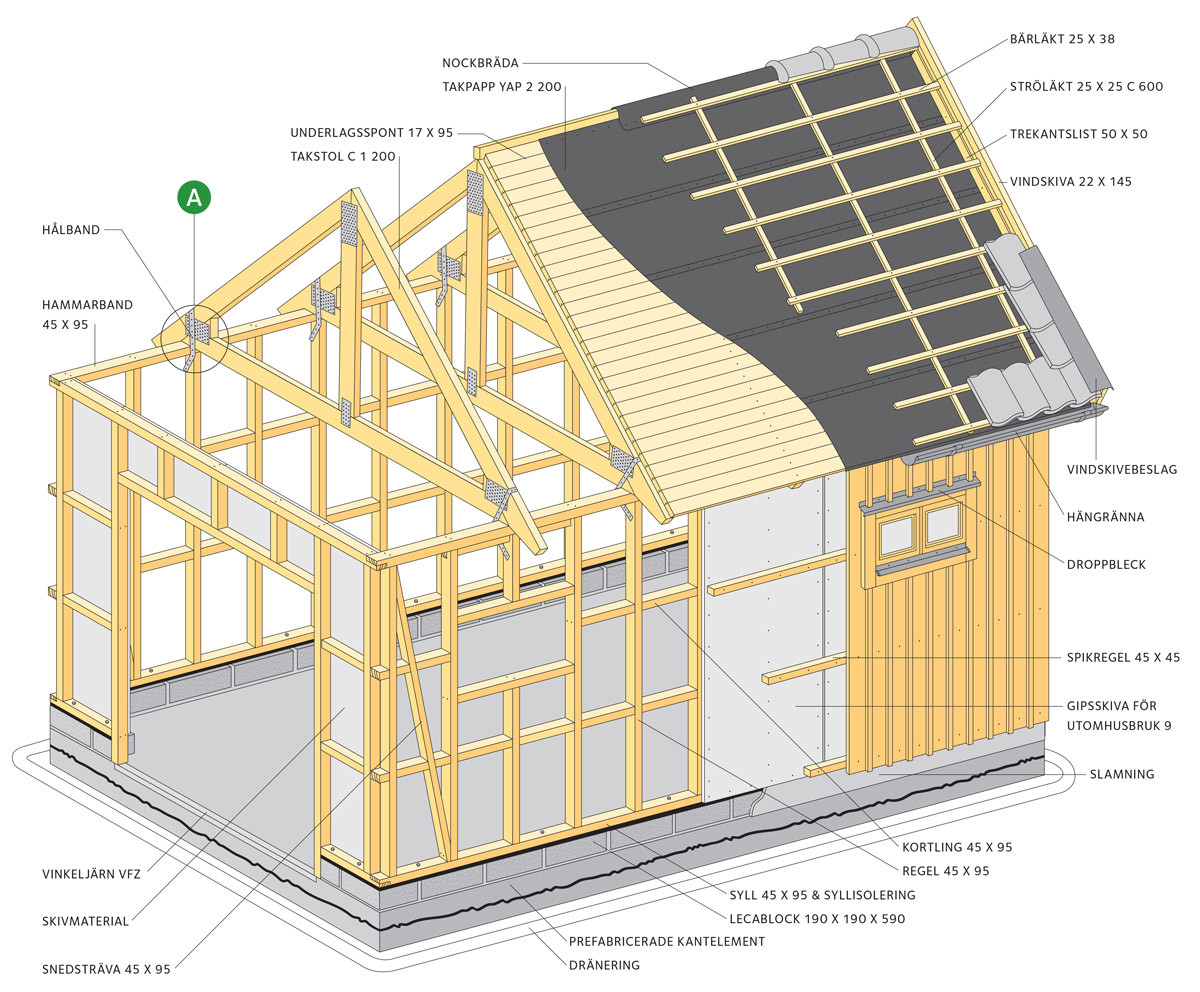
Follow that description and it will be good!
Good to hear!J justusandersson said:
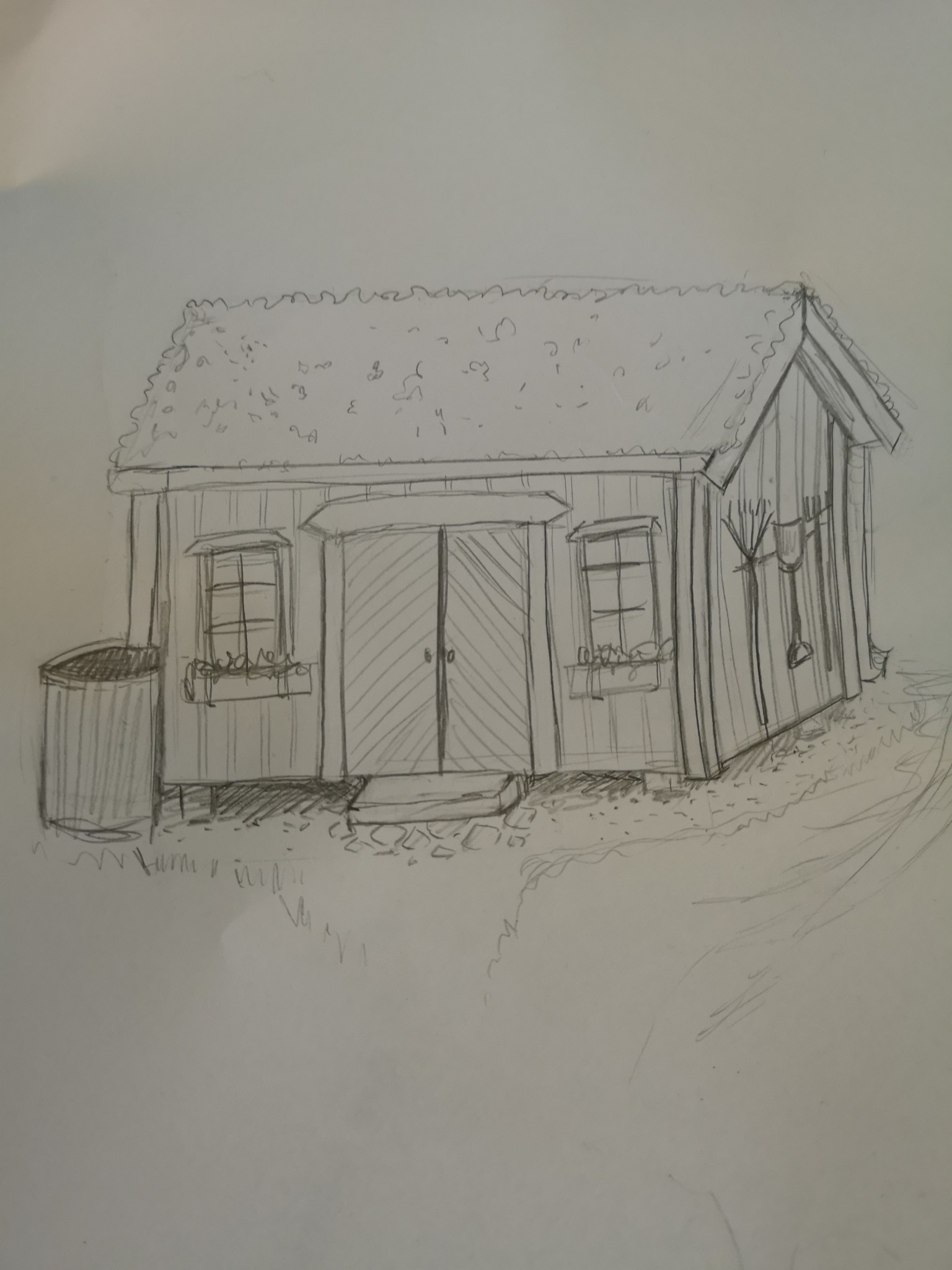
The major differences are that I'm using a post foundation. Considering whether to use 220*45 on one section (cc60) across the width of 3 m, or to place a load-bearing beam in the middle. But it would be so convenient to avoid that. I will continue to calculate and look at what's sensible in that choice.
And we are going with a 14-degree roof with sedum and other beneficial roof plants.
Here's what the concept image looks like, but it's only a guide for the drawing I'm working on now.
Click here to reply
Similar threads
-
Pooldäck runt glasfiberpool - såga bort hela eller delar av kanten?
Pool -
Hur får jag bort stackmyror som finns på HELA tomten?
Trädgård allmänt -
Bör man värma upp hela huset eller räcker det med dom större ytorna?
Värme allmänt -
Kan jag få bort fläcken utan att slipa om hela bordseländet?
Möbelsnickeri -
Drywall anchors - how to remove the entire anchor from the wall (drywall)
Building Materials and Construction Technology