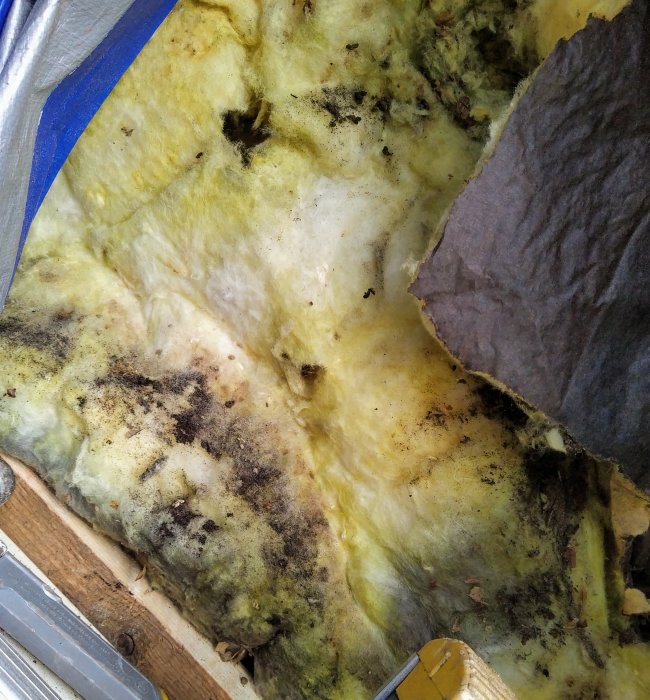
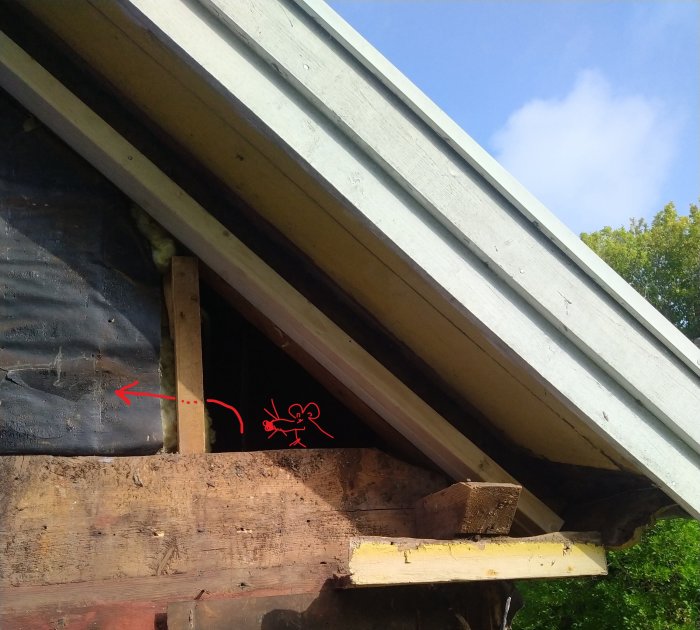
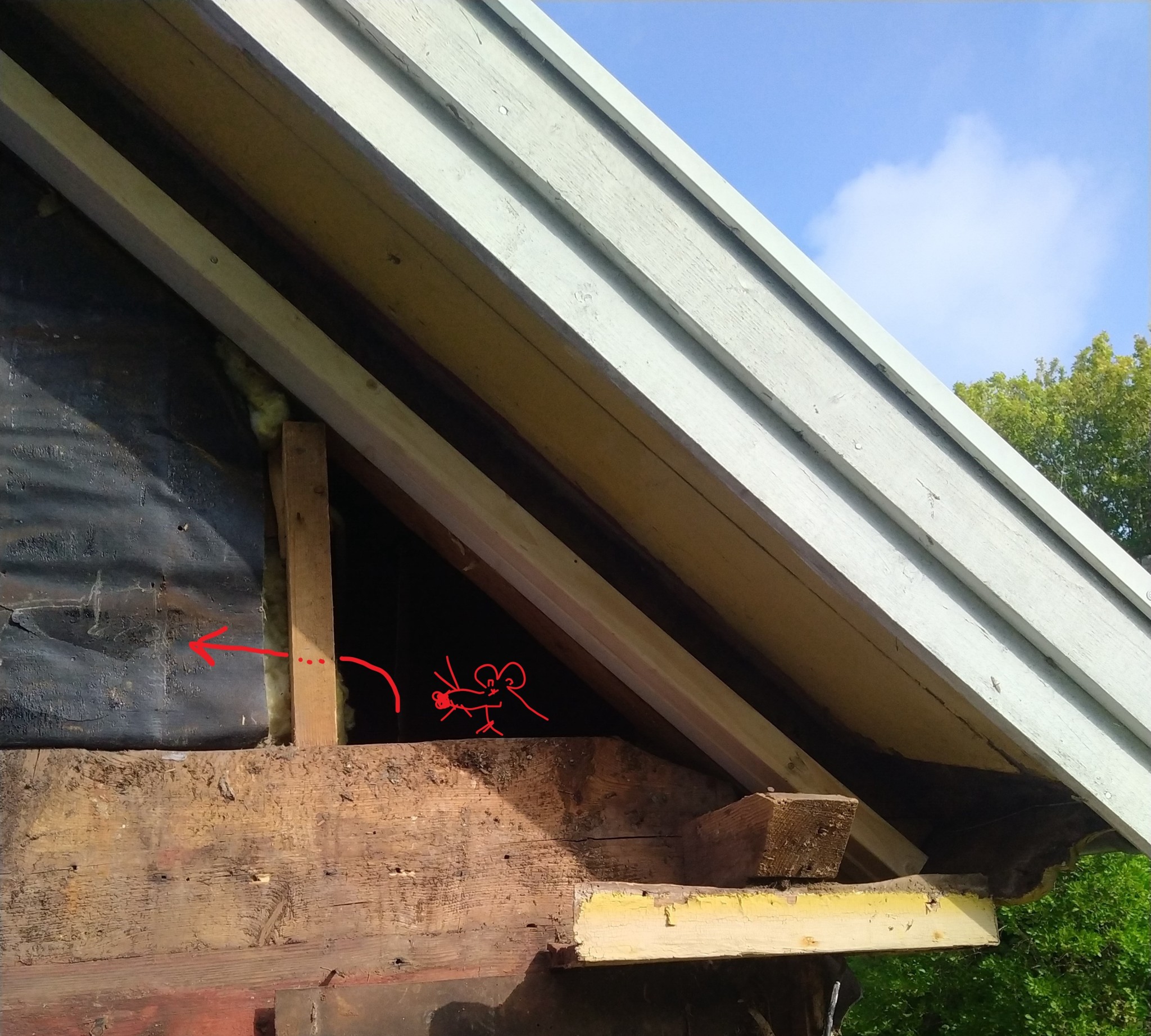
I have an old house where I am in the process of replacing the cladding on one gable side. When I removed the existing cladding at the eaves, it is open right into the space under the roof (attic?), see attached image. Nothing strange. But I also see that the insulation that is very carelessly placed on the wall beside it is full of mouse droppings and what I assume are mouse holes. See attached image. I was thinking of placing new insulation there, but then I have to close off the "eaves gable" to have something to attach the new insulation to. And I don't want the mice running around and eating my new insulation. So my question is if it is, for ventilation reasons, okay to completely close off the eaves gable with, for example, tongue-and-groove boards or similar?
They don't enter through the eaves, although they are good climbers, they probably go up behind the siding at the foundation where there's often a gap between the boards, or it's a ventilation gap there. There are so-called mouse stops that can be attached at the bottom, or you can use insect mesh made of copper/steel to seal where there are holes of max 1 cm and larger. Mouse traps on the outside are good under a box with two 5x5 cm holes at the bottom near the ground, to prevent a cat or especially great tits from getting caught.
They don't enter through the eaves; although they climb well, they probably go up behind the panel by the foundation, where there is usually a gap between the boards, or it's a ventilation gap there. There are so-called mouse stops to attach at the bottom, or you can use an insect net of copper/steel and seal where there are holes that are a maximum of 1 cm and above. Traps on the outside are good under a box with 2x 5x5 cm holes at the bottom, to avoid catching a cat or especially great tits.
Yes, somehow they find their way in anyway. I will install mouse bands and such where needed, but here I'm mainly wondering if it's okay, for ventilation reasons, to completely seal off the eaves gable?
Nothing wrong with that. It's normal for the gable to be tight and the eave itself not to be sealed. Air should be able to flow into the attic through sparse gaps with insect netting above. No flying insects should get in there.
Click here to reply
Vi vill skicka notiser för ämnen du bevakar och händelser som berör dig.