A bit unsure what you mean.
The floor structure, the one against the ground, consists first of 150mm surface-stabilized leca, on top of the leca, 100mm reinforced concrete slab.
If the asfarock, the wall, goes down into the leca, then moisture can migrate up; the air gap is meant to prevent moisture from creeping, but ground moisture is always a bit tricky, especially if the construction is not executed correctly.
This is how my house from 71 is constructed.
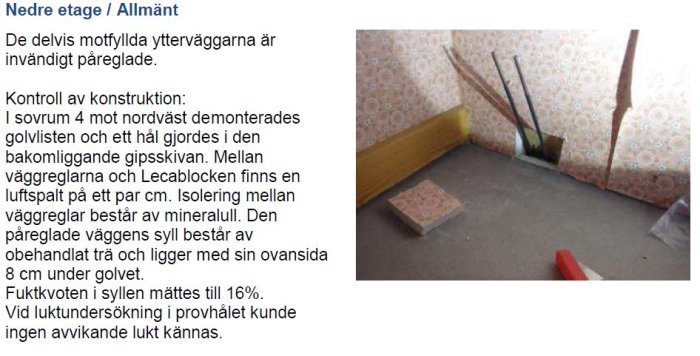
Cast over the basement, as well as an angle section with lightweight concrete floor. First, the inner walls were erected and then each room was insulated and cast separately.
Thus, the rooms do not need to have the same height on different sides of the wall, which has made layout changes tricky.
A room on the "lower floor" is a bathroom that will soon be renovated, and then the walls will be opened up anyway.
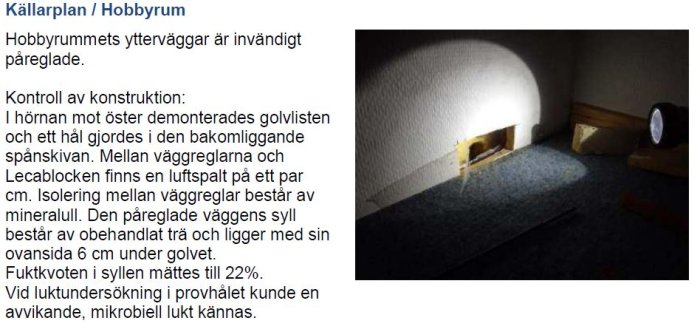
In the "hobby room" there are signs of moisture and possibly mold. The idea here is to gradually take down the studded walls, but maybe it's unnecessary?
A room on the "lower level" is a bathroom that will soon be renovated and the walls will be opened up anyway.
In the "hobby room" there are signs of moisture and possibly mold. The idea here is to gradually take down the mounted walls, but maybe that's unnecessary?
Without having seen how the entire building is constructed, it's almost impossible to answer whether you need to address anything other than drainage. Unfortunately, I can't give you a detailed answer on whether you should demolish or not.
Who did the inspection, can you take another company, maybe through the insurance company?
If I were to take down the studded walls in the hobby room, a gap would appear between the concrete floor and the lecablock walls.
How do I best fill it?
Common if it's a risk construction, you remove the timber studs, install metal studs and ventilated skirting boards.
What you should check is that no organic material is wet, damp, which indicates that water is penetrating the construction in some way.
In some cases, a ventilated floor can be a solution, after solving moisture problems, if you have too much, that is.
Is the foundation properly drained, has the previous owner planted close plants, what do the gutters and downpipes look like, is the house on a slope and water creeps into a corner...
As you can see, it's hard to answer without knowing more information about the overall condition of the house and the surroundings.
But as I wrote earlier, is it a problem or are you more worried?
Is the foundation properly drained, has the previous owner planted nearby plants, what do the gutters and downpipes look like, is the house on a slope and water is seeping into a corner...
No problems with the drainage, it seems. The house is on sandy soil. Large plants are around the entire house but we will remove them. The house is on flat ground. Dry and nice in the basement.
PPagno said:
But as I mentioned earlier, is there an issue or are you just worried?
We are not experiencing any issues and do not feel worried. The house has stood for 40 years and looks fine. However, since we are renovating anyway, it feels like we might as well do it properly to avoid future problems. I'm mostly trying to get an idea of how much extra work this would entail.
If I try to write what I mean, any basement with organic materials in the floor and walls is a risk for future issues.
In fact, all ground constructions with cast slabs can be seen as an increased risk for moisture movement; our climate is not the best for houses directly on the ground, and many people who build do not adapt the house structure for cast foundations, hence my opinion on risk construction.
A cast slab in itself is not a risk, and similarly, a basement with properly built walls is not a risk either. Unfortunately, many foundations poured in the late 60s and 70s have wooden frames cast in them, which rot....
Now I have strayed from your question. I think if you're planning to stay in the house for a long time, it might be a good idea to invest in ventilated floors, frames, walls, and ventilated skirting boards in the "basement level." The rest of the house does not seem to have elevated humidity, and as you mentioned, removing nearby vegetation is very good, as it will save future problems.
To all who think I mean that cast slabs are a risk construction, I neither say nor mean that.
To ts! I probably wouldn't remove the walls in the basement level if there is no sign of mold; however, I would rebuild the floor.
The original question I want to clarify: you don't have a sandwich construction in the basement level, but you do between the basement and the first floor.
In the basement level, I agree with @Pagno. If you are going to renovate anyway, at least have a ventilated floor.
22% moisture in the wood is enough for growth (I believe the limit is over 17%).
Har du lust att utveckla detta lite? Är det inte bättre att ta bort det organiska materialet istället för att försöka hålla det friskt genom ventilation?
På tal om mögelanvisning; är inte den mikrobiella lukten besiktningsmannen funnit en indikation på att mögel kan dölja sig i konstruktionen?[/QUOTE
Nnorfre said:
Har du lust att utveckla detta lite? Är det inte bättre att ta bort det organiska materialet istället för att försöka hålla det friskt genom ventilation?
På tal om mögelanvisning; är inte den mikrobiella lukten besiktningsmannen funnit en indikation på att mögel kan dölja sig i konstruktionen?
Helt rätt, det kan vara men behöver inte vara mögel.
Om det är dränerat så finns troligtvis inget mögel i väggen men i golvet där det är förhöjd fukt är det troligtvis redan ett mindre angrepp.
Klart att du byter väggen samtidigt om du ändå skall byta golvet, men med ventilerat system, inga träreglar mot plattan. Att bygga med plåtreglar är dyrare kortsiktigt, men det lönar sig i längden.
Mikrobiell lukt har troligtvis inte besiktningsmannens näsa möjlighet att bestämma om det är från röta, bakterier eller svampangrepp, man klassar allt som luktar som mikrobiell lukt, kan även vara från tryckimpregnerat, vi människor känner lukten men kan inte tala om var den kommer ifrån och vad det är som luktar.
Jag hade personligen sparat väggen, förutsatt att dräneringen är intakt, rivit golvet, i med distansklossar för rätt nivå på reglarna samt att luften behöver cirkulera, därav ventilerat system, inga fläktar alltså, bara ett övertryck räcker.
Om grunden är fuktig måste orsaken åtgärdas samt grunden måste torka riktigt, 17 -18% eller lägre fuktkvot i organiskt material behövs för att inte ge grogrund till mikrobiella angrepp.
The floor currently consists of wall-to-wall carpeting directly on the concrete slab. There are no floor joists. The carpet looks fresh (if a wall-to-wall carpet can look that way?) and shows no signs of moisture, smell, or mold.
Any potential problems are probably in the sill, and I'm not entirely sure how a ventilated floor could address that?
Did this thread die of shock?
If you've read the posts up to this point, you'll understand the question in the first post better...
It doesn't sound optimal (understatement) to have a sill with concrete on 3 sides.
Vi vill skicka notiser för ämnen du bevakar och händelser som berör dig.