
2,124 views ·
30 replies
2k views
30 replies
Rounded wood screw 4.0x20 mm does not fasten in untreated panel 22 mm.
Hello!
What am I doing wrong? The wood screw is not fastening properly in the panel, and when I screw it all the way down, it just spins around. I made a pilot hole of 3 mm, about 1 cm deep. I've tried filling the hole with toothpicks and glue - but I have the same problem again. Do I have the wrong type of screw? It's by the brand Heco Skruvspecialisten. Thread length 19mm. Head diameter 7.7mm. Thread: HG. The head is flat, which is the way I want it.
My scenario is that I need to attach a pulley to the panel. The pulley extends about 3mm. So the screw should go about 16 mm into the wood.
Ideally, I want to attach the pulley directly to the ceiling, but it's plaster. That's why I'm using the panel to place the pulley in exactly the right spot. And if I understand correctly, it's a bad idea to use a longer screw that goes through both the panel and the plaster. I am attaching the panel in several other places on the ceiling joists, so the panel is very secure. And the plan is to place the pulley in the right spot on the panel.
What am I doing wrong? The wood screw is not fastening properly in the panel, and when I screw it all the way down, it just spins around. I made a pilot hole of 3 mm, about 1 cm deep. I've tried filling the hole with toothpicks and glue - but I have the same problem again. Do I have the wrong type of screw? It's by the brand Heco Skruvspecialisten. Thread length 19mm. Head diameter 7.7mm. Thread: HG. The head is flat, which is the way I want it.
My scenario is that I need to attach a pulley to the panel. The pulley extends about 3mm. So the screw should go about 16 mm into the wood.
Ideally, I want to attach the pulley directly to the ceiling, but it's plaster. That's why I'm using the panel to place the pulley in exactly the right spot. And if I understand correctly, it's a bad idea to use a longer screw that goes through both the panel and the plaster. I am attaching the panel in several other places on the ceiling joists, so the panel is very secure. And the plan is to place the pulley in the right spot on the panel.

Thanks, I'll know for next time. But how do I solve the situation I'm in? Tips?E etompau said:
Is it true that I shouldn't use a longer screw that goes through both wood and drywall? I asked chatgpt for help, and that's the information I got. But I think that I might be able to use a drywall anchor through both wood and drywall, and that it would be very stable.
Yes, it should support a wooden frame I've built in 45x45 that should, in turn, be able to hold a lot of wet laundry. Could you write in more detail what you're thinking? Glue both the screw and talja? But why both epoxy glue and construction adhesive?Spikbjörn said:
I need to fasten the pulleys directly above the corners of the laundry rack, so that it can be hoisted straight up. Therefore, I'm attaching a wooden panel to the ceiling joists in the ceiling. That way, I can place the pulleys exactly in the right spot.E etompau said:
When you mention screw size, do you mean the width and/or the length? If the screws become longer, they will go up into the drywall. Should I then switch to drywall expanders instead?
Yes, then you need to consider the strength of the ceiling, it probably won't hold with that screw size even for an empty wooden rack, much less wet laundry.
My answer was just two alternatives for glue, on how to fix an oversized hole where the screw spins, but your issue with the screw needing to hold for hoisting heavy laundry doesn't solve it, hardly even with lots of such screws.
My answer was just two alternatives for glue, on how to fix an oversized hole where the screw spins, but your issue with the screw needing to hold for hoisting heavy laundry doesn't solve it, hardly even with lots of such screws.
Use screws as large as the holes in the block allow. The fact that the screws go into the drywall doesn't matter.K kia2 said:I need to attach the blocks directly above the corners of the laundry rack, so that it can be hoisted straight up. Therefore, I'm attaching a wooden panel to the ceiling joists. This way, I can place the blocks exactly in the right spot.
When you mention screw size, do you mean the width and/or length? If the screws are longer, they go up into the drywall. Should I then switch to drywall anchors instead?
No drywall anchors should be used, stated without having seen how your stuff looks.
Panel? Is it a single panel board?
And how have you attached it to the drywall?
I think some pictures could be helpful.
In other words. You need to find out what there is to screw into upwards.
Ideally, it would be something like rafters or a cast ceiling if it’s an apartment.
The drywall is screwed into battens that are attached to these.
The battens cannot support any heavy loads.
And how have you attached it to the drywall?
I think some pictures could be helpful.
In other words. You need to find out what there is to screw into upwards.
Ideally, it would be something like rafters or a cast ceiling if it’s an apartment.
The drywall is screwed into battens that are attached to these.
The battens cannot support any heavy loads.
Here, I've attached with screws straight through the ceiling panel and directly into a truss, using narrow French wood screws about 70 mm long.
So, find the trusses if you want to achieve something secure and strong.
My attachment has been tested with two guys doing push-ups.
So, find the trusses if you want to achieve something secure and strong.
My attachment has been tested with two guys doing push-ups.
Thank you for the help.
This is in the laundry room. What I know about the ceiling is that it consists of boards spaced at 60 cm centers. The boards are almost 3 meters long and painted. They are drywall, as I have drilled and white powder comes out. The boards are about 1 to 1.5 cm thick. I have also drilled where the boards meet each other. Here I assumed it's a 45x45 wooden stud, but when I drilled, the drill goes through after about 3 cm. I tried driving a wood screw there and pulled as hard as I could by hand on the part of the screw that was sticking out - and it doesn't give way.
It is a one-story house built in 1968.
My plan is to attach 22x195x1100 panels to the studs. I intend to use wood screws and attach the panel at 3 points on each stud. Then the panel should be fixed really well to the ceiling.
After that, I plan to mount the pulleys in the correct place on the panel. This is where the problem arose. But if I understand you correctly, I should use thicker and longer wood screws and fasten the pulleys through both the panel and the drywall.
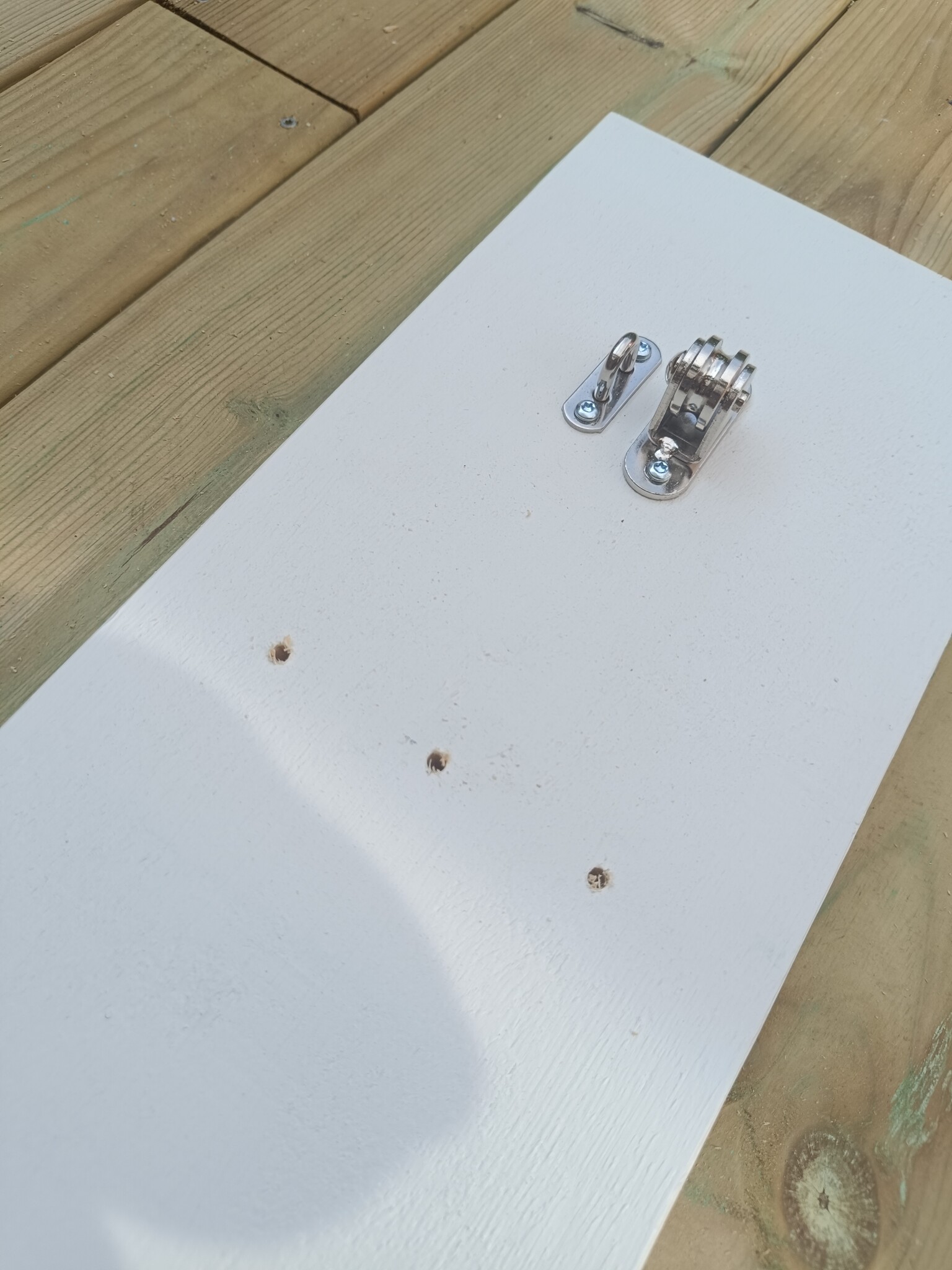
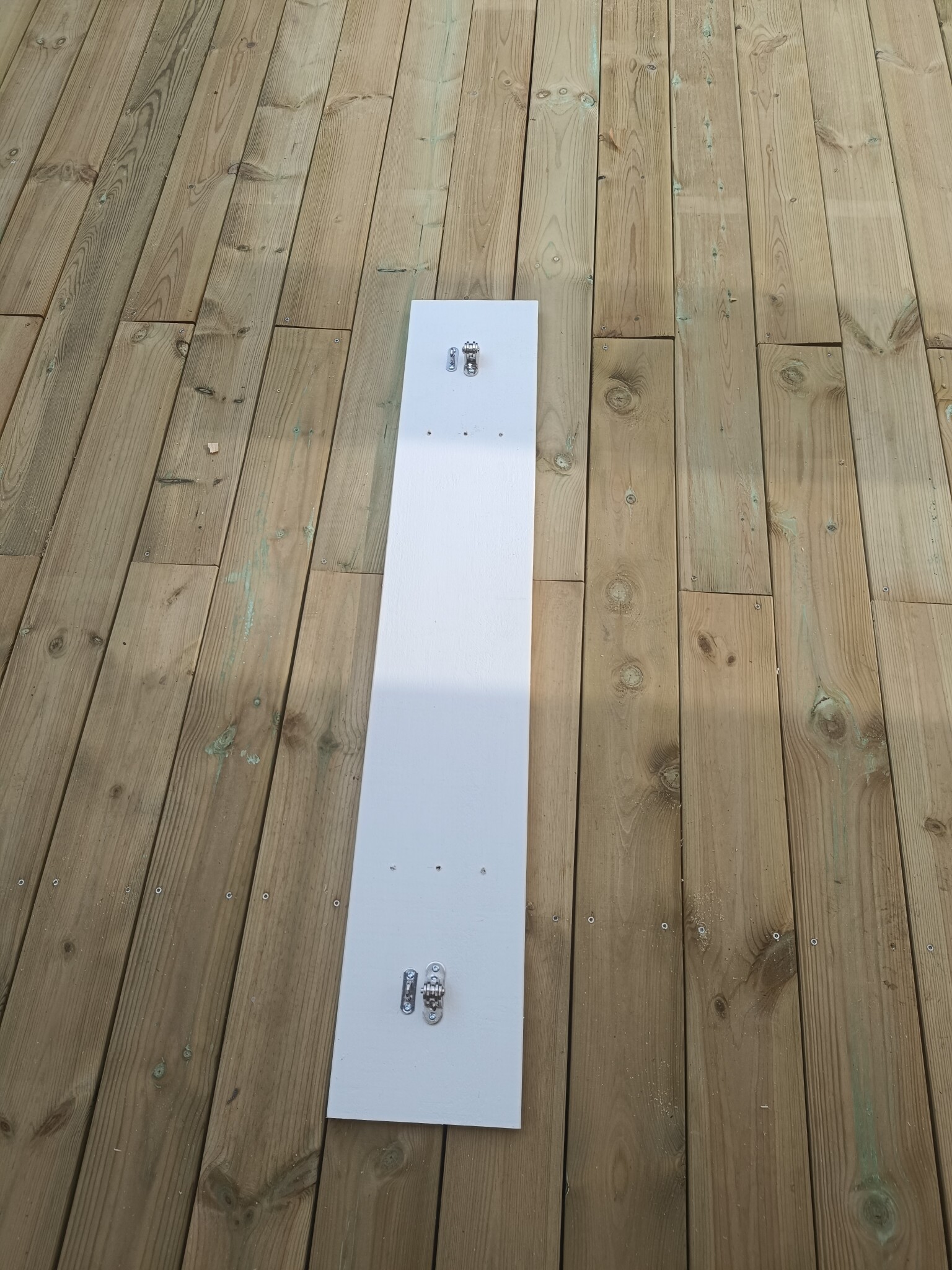
Attached is a photo of one of the two panels that I have sanded, painted, and predrilled where I will screw into the ceiling joists spaced at 60 cm centers.
So the only thing I think I need help with is if I can use thicker and longer wood screws so that it goes through both the panel and the drywall ceiling.
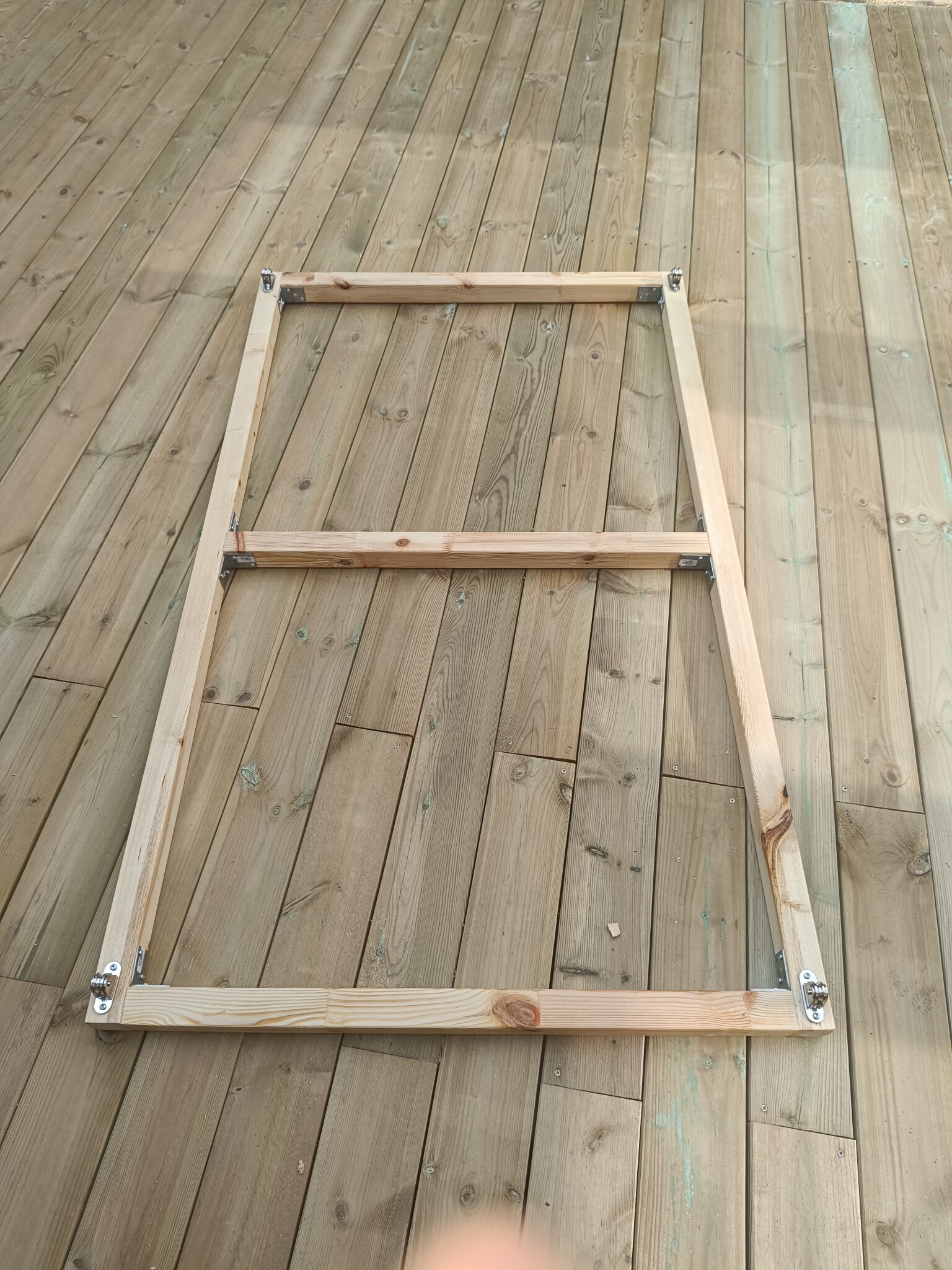
Also attached is a photo of the drying rack I have built (it lacks a drying line so far. It is 90x150 cm. As you can see, the pulleys are at the corners, which is why it's important that the pulleys in the ceiling are directly above. I'm not an expert - but the plan is to get a mechanical advantage so it becomes easy to raise and lower the laundry. I got inspiration from this video:
This is in the laundry room. What I know about the ceiling is that it consists of boards spaced at 60 cm centers. The boards are almost 3 meters long and painted. They are drywall, as I have drilled and white powder comes out. The boards are about 1 to 1.5 cm thick. I have also drilled where the boards meet each other. Here I assumed it's a 45x45 wooden stud, but when I drilled, the drill goes through after about 3 cm. I tried driving a wood screw there and pulled as hard as I could by hand on the part of the screw that was sticking out - and it doesn't give way.
It is a one-story house built in 1968.
My plan is to attach 22x195x1100 panels to the studs. I intend to use wood screws and attach the panel at 3 points on each stud. Then the panel should be fixed really well to the ceiling.
After that, I plan to mount the pulleys in the correct place on the panel. This is where the problem arose. But if I understand you correctly, I should use thicker and longer wood screws and fasten the pulleys through both the panel and the drywall.
Attached is a photo of one of the two panels that I have sanded, painted, and predrilled where I will screw into the ceiling joists spaced at 60 cm centers.
So the only thing I think I need help with is if I can use thicker and longer wood screws so that it goes through both the panel and the drywall ceiling.
Also attached is a photo of the drying rack I have built (it lacks a drying line so far. It is 90x150 cm. As you can see, the pulleys are at the corners, which is why it's important that the pulleys in the ceiling are directly above. I'm not an expert - but the plan is to get a mechanical advantage so it becomes easy to raise and lower the laundry. I got inspiration from this video:
Last edited: