
12,628 views ·
66 replies
13k views
66 replies
Rotten roof?

I have never stated that. You choose the roof's lifespan from the start, partly through material selection but also through the building's design. Cheap materials provide lower investment costs but higher annual costs. If the roof is at a high altitude, the cost for replacement becomes extra high due to expensive scaffolding. In my view, 40 years is a poor lifespan for a roof. Then there's the wildcard factor that many roof replacements are done by people without skills and competence. It's common, as one can see daily examples of this on Byggahus.harry73 said:
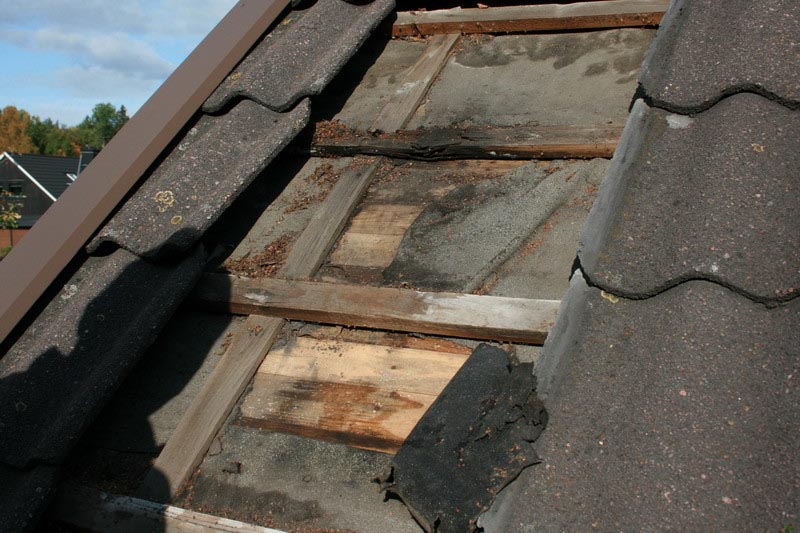
Now feel free to explain a bit, maybe those who liked your post (Nils82 and MagHam) have some input too.J justusandersson said:It is certainly the case that if you repair the damage, the roof as a whole can last a few more years. However, the installation had flaws from the start. If you don't address them soon, there's a risk that the re-roofing, when it has to be done, will be much more expensive. The battens, which are rough boards, seem weak and are too wide. The plywood lacks a waterproof layer. Everything must also be assessed with regard to a relatively low roof pitch.
The construction may have had flaws from the beginning according to today's building techniques BUT the roof has been there for 48 years, and during that time there have not been any problems at all? Can you explain how that's possible?
What exactly are the problems and risks that you see? A tile slipping down can happen for many reasons; in this case, it is not due to wear on the roof. It's natural that you would get moisture damage when you expose untreated wood to rain, isn't it?
Suppose we kept the roof for a few more years and then saw that the tiles need to be replaced, why would it be more expensive to install a new roof then compared to doing it now?
A roof has a purchase value that is spread over the number of years it is expected to last before a new one must be laid. That should mean that the longer the roof lasts, the more economical it is, not the other way around as you seem to suggest.
I do agree that if it starts leaking, it can be more costly, but if you see that as an actual risk here, please explain why.
The only downside to not replacing it now, as I see it, is really that I have to keep a closer eye on the roof.
Last edited:
M
Marcussjogren
Member
· Västra Götaland
· 3 081 posts
Marcussjogren
Member
- Västra Götaland
- 3,081 posts
It is probably what Justus is referring to, that his opinion is that there will be more damage that will cost more.
A modern roof can handle all the tiles falling off without anyone noticing for 25 years. Of course, it holds up better.
I myself have a shingle roof with battens, counter battens, and clay tiles, without any underlay. It can take quite a bit of a beating before anything happens, as long as the problem is fixed and it is allowed to dry out.
If I were you, I would replace the bad wood and leave the rest for now. But I would also be aware of the problem and therefore inspect it particularly often, especially during heavy rain.
A modern roof can handle all the tiles falling off without anyone noticing for 25 years. Of course, it holds up better.
I myself have a shingle roof with battens, counter battens, and clay tiles, without any underlay. It can take quite a bit of a beating before anything happens, as long as the problem is fixed and it is allowed to dry out.
If I were you, I would replace the bad wood and leave the rest for now. But I would also be aware of the problem and therefore inspect it particularly often, especially during heavy rain.
M
Marcussjogren
Member
· Västra Götaland
· 3 081 posts
Marcussjogren
Member
- Västra Götaland
- 3,081 posts
As a questioner, you must be aware that, as a responder, it is always more comfortable to be able to nod and say "I told you so."
Therefore, it is significantly safer to dismiss something and say it needs to be redone.
At the same time, there is the other half who don't think it's such a big deal if things slip through here and there.
So, as a questioner, you need to consider what you yourself are capable of and can keep track of. Perhaps you need to read up a bit on the risks, for example.
But remember that this is a forum where people with different expertise give different advice, and none of the answers you receive need to be right or wrong.
Therefore, it is significantly safer to dismiss something and say it needs to be redone.
At the same time, there is the other half who don't think it's such a big deal if things slip through here and there.
So, as a questioner, you need to consider what you yourself are capable of and can keep track of. Perhaps you need to read up a bit on the risks, for example.
But remember that this is a forum where people with different expertise give different advice, and none of the answers you receive need to be right or wrong.
Considering that the roof design was a budget solution, TS should be grateful that it has lasted 48 years. Even when it was new, it did not meet the then-existing building code requirements for tightness and definitely not what can be described as good building practice. One should never lay battens directly against other flat wood in this way without some form of insulation in between, especially not uncut tongue and groove boards. Leaky roofs are the biggest threat to all buildings. Reviewing the entire roofing solution in time is the best investment one can make.
There is no one who disagrees that TS's roof is of poorer quality than it should be and that it was already so since the construction.
What is interesting for TS is what precautions he should take if he does not replace the roof immediately. And at which warning signs should he replace the roof as soon as possible?
What is interesting for TS is what precautions he should take if he does not replace the roof immediately. And at which warning signs should he replace the roof as soon as possible?
Regardless of which one of you is right, I would rather just change it, it's not fun to walk around wondering how the roof is doing and having to inspect it all the time. Plus, you never know if the rot-avdrag might disappear or something similar.
Grateful if you can answer my questions instead of rephrasing what you already wrote.J justusandersson said:Considering that the roof design was a budget solution, TS should be grateful that it has lasted for 48 years. Even when it was new, it didn't meet the building code requirements for sealing at the time and definitely not what can be described as good building practice. One never places battens directly against other flat wood in this manner without some form of insulation in between, especially not uncut tongue-and-groove boards. Leaky roofs are the greatest threat to all buildings. Reviewing the entire roof solution in time is the best investment one can make.
I understand that, but I would appreciate it if people could point out the actual risks? The roof has been in place for 48 years without any problems, why should it be replaced right now? What is about to happen?S johd01 said:
There are some risks/deficiencies that a roof shouldn’t really have to be considered a good roof.S snowjim said:
1 The battens are wide and low.
2 The underlay has no waterproofing. Since it is also made of boards, the underlay is even more sensitive.
3 The concrete tiles are worn and have developed a rough texture that accumulates water, dirt, and growth to a greater extent.
All these "faults" do not mean the roof will collapse tomorrow, but considering the deficiencies and that the roof has been in place for 48 years, there are no arguments for keeping the roof longer than necessary. Plan and finance a roof replacement within a timeframe that is feasible for you.
The solution relies on the outer roof with its interlocking concrete tiles being extremely tight. It works up to a certain point but no longer.S snowjim said:
A roof structure should be able to withstand a tile slipping down or breaking.S snowjim said:
I believe there's a significant risk that the entire sub-roof construction would then need to be replaced.S snowjim said:
You need to distinguish between technical and economic lifespan. Once the technical lifespan is over, you must replace it.S snowjim said:
You just need to look at your pictures of the tiles. Full of moss both in valleys and along seams where water can remain. Concrete is not waterproof. The tiles have already exceeded their lifespan.S snowjim said:
But it has been like that for 48 years? How can this suddenly be a higher risk than before? What do you see has become so bad that it needs to be replaced now?N Nils82 said:
As long as the tiles are doing their job, this isn't a problem? Or have I missed something?N Nils82 said:
I would be much more worried if there was broken felt on the roof like this:
Since the felt is meant to protect the material underneath, I would assume that if water gets in under it, it won't be fun to dry out again.
I agree that you can see clear wear on the concrete tiles, but there is still a lot of material left.N Nils82 said:

The moss is probably in large part due to a large tree hanging over the roof (now trimmed). From what I've been able to read, you should consider tiles as expired when they start breaking, e.g., getting frost damage and the like. In this case, we don't have any broken tiles, and especially none that leak as long as they are in place.
My understanding is that concrete tiles generally last much longer than 50 years, perhaps closer to 70 years, and in this case, the construction cannot be blamed.
So what do you see (think away from the moss) that makes you want to replace these tiles now? Do you see any broken ones?
Where do you see the damage on the roof? Do you replace the track rod on your car just because it's a little rusty? No, you replace it when it starts to be a problem, like when it becomes loose.N Nils82 said:
It feels like you're taking the "boring" advice as personal attacks, Snowjim. You don't need to do that. You also don't need to do any of the things mentioned in this thread. If you want to let the roof stay for another 20-40 years, you can absolutely do that.
Just note that eventually, the roof will reach a point where it's more expensive to delay the replacement than to keep the old one, so to speak.
Just note that eventually, the roof will reach a point where it's more expensive to delay the replacement than to keep the old one, so to speak.
If you had a house with a steep roof and a waterproof underlay, the discussion about concrete tiles would mostly be an aesthetic issue. They could have stayed up until they fell down on their own or your wife gave an ultimatum. I haven't seen any 70-year-old concrete tiles that are still in use.
snowjim seems to be a stubborn person. I don't think a continued discussion would yield much more.
snowjim seems to be a stubborn person. I don't think a continued discussion would yield much more.
Seems obvious, yes, but what has significantly deteriorated in the structure that necessitates replacement now?J justusandersson said:
I agree it's a poor design, but as I've said probably 100 times now, it's worked for 48 years, what do you see has significantly worsened now? Why couldn't it last another 5-10 years?J justusandersson said:
So just because 1 tile has slid down in 48 years, it's now likely that multiple will somehow leak to the extent that the sub-roof and rafters become completely destroyed? This in such a short time that we wouldn't notice even though we go up in the attic a few times a year!? Well, I suppose it's possible but highly unlikely.J justusandersson said:
What do you see that makes this risk have increased so significantly?
Yes, of course, but what indicates that the technical lifespan is over? Where's the wear? The moisture? The damage? Is it the wear on the tiles you're referring to? What other wear do you mean?J justusandersson said:
The moss is largely due to a large tree nearby, from what I understand, it makes a big difference for the buildup of moss.J justusandersson said:
I've posted a lot of pictures, most show the damage caused by a tile that slid down, but there are some pictures showing what it looks like under other tiles as well. Can't you point out where you see these leaks? What suggests that the tiles are leaking through?