Plywood works just as well as the metal stuff, you get quite a few panels out of one sheet and can also custom shape them! plywood + glue + anchor screws/nails
"In the past," ridges were placed on the log-timbered exterior and partition walls, and then boards were laid from the topmost ridge to the top log of the long walls.
But guys, of course they made roof trusses similar to those made today.
But the difference was that the timber was as thick as it was tall, which allowed for "half-lap" joints, or you could notch together the timber at the tie beams. Wooden dowels in "half-lap" joints.
But since today the timber has been optimized, there is nothing to join in a joint, so instead, you have to use boring metal connectors.
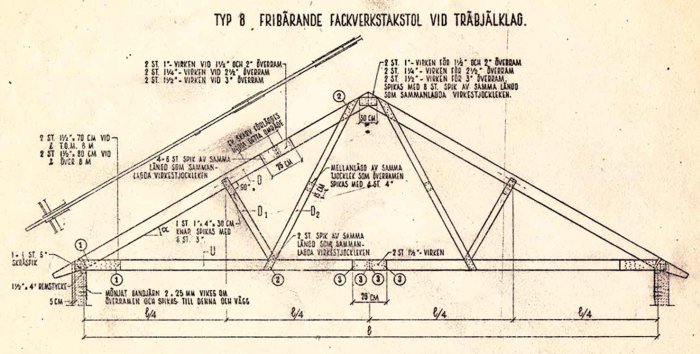
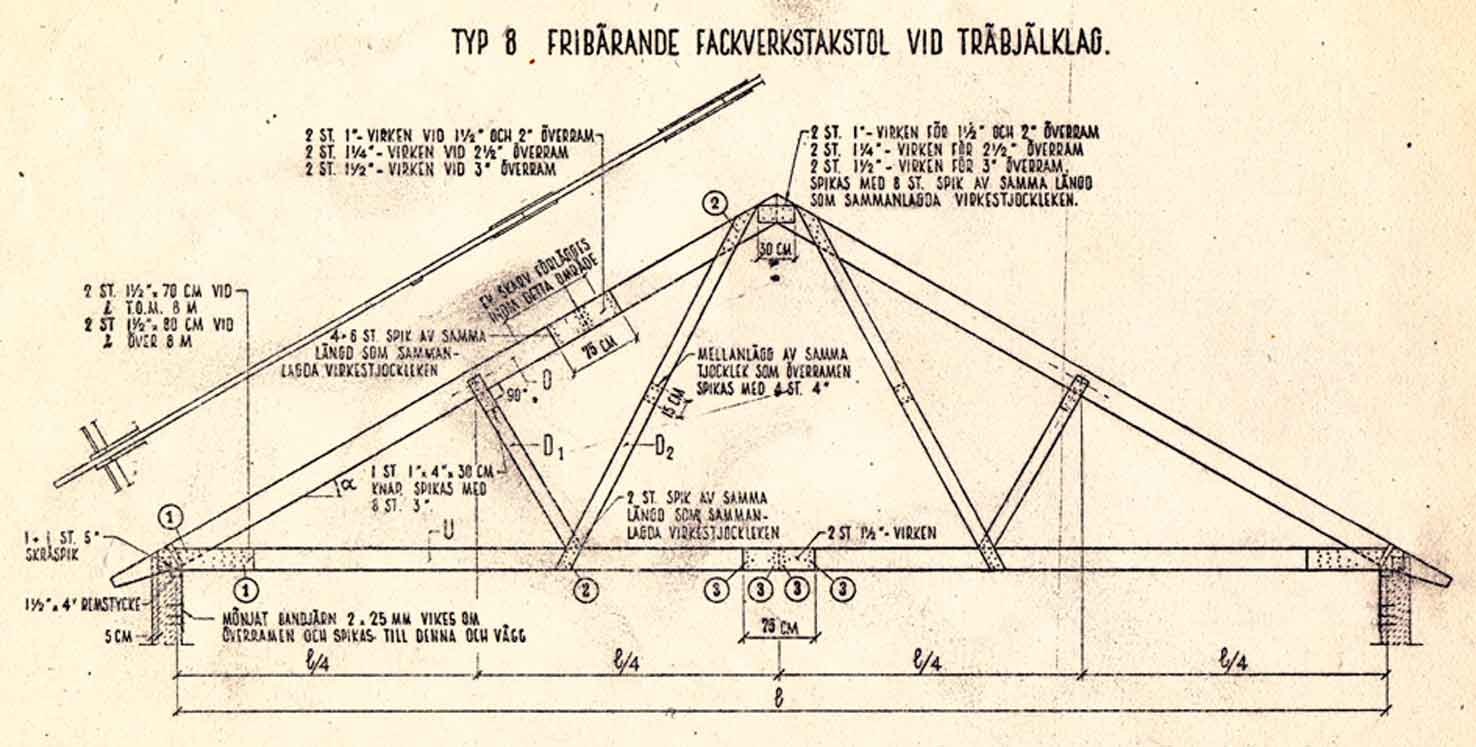
Lapping boards or splice boards are the boards used to join timber. The same function as today's nail plates but a bit larger and coarser. In the 1980s, plywood lapping was often used. See the details on the following typical drawing from around 1960:
Image from Wale, Harald: Wood Roof Trusses for Residential Buildings (2nd ed. Stockholm 1961)
I have made trusses with boards as tie beams from the ridge down to the collar beam. The boards function as splice plates for the brace. Doesn't look so "patched."
So you need something...how did they make trusses in the past?
There are certainly several different variants, at my parents' farm the trusses in the barn and parts of the house are constructed in a similar way to this image (unfortunately, I don't have my own picture).
My grandfather and his neighbor helped each other build their new barns in the late 30s (if I remember correctly). They cut timber in the winter and built the barn in the summer. In addition to managing the farm, which is not exactly a 9-5 job. I think they managed to build both barns in 2-3 years. The largest nails used were 12 inches.... At that time, it was "sticketak" or spåntak as it was also called. I can't even imagine how long it took to make all the shingles for a barn measuring 30x10 meters.
When I think about it, it makes most of the projects here on byggahus pale in comparison....
I have made trusses with boards as tie rods from the ridge down to the collar beam. The boards function as a splice plate for the support. Doesn't look so "patched".
Plywood or nail plates look equally dull if you imagine having exposed rafters. Then you have to look a bit further back in time and see how real carpenters joined wood. Look a bit at old boat building because you often find fine joints there, but also in old rafters from the beginning of the century, you find fine joints.
The 1980s are the present day, and by then, they were no longer training the type of carpenter that existed until presumably the 40s-50s, but had moved on to construction carpenters who increasingly became installers of plasterboards.....
NB, no offense meant by this, just an observation that the construction industry had shifted from expensive materials and low wages to cheap materials and high wages, which completely changed the nature of building.
Oh, so many responses... I agree, it used to take time to build, but it was done properly! The reason I'm asking is a trifle compared to stables and barns, but what I'm pondering is the farstu (forstun).
There used to be a balcony above, but now it will just be the farstutak, and I don't want an "inner ceiling." I want it open to the ridge (if that expression can be used in this minimal context), and since the house is a turn-of-the-century villa, I think it looks bad with fasteners and other doodads when you look up!
But what kind of method would suit a farstutak?
Vi vill skicka notiser för ämnen du bevakar och händelser som berör dig.