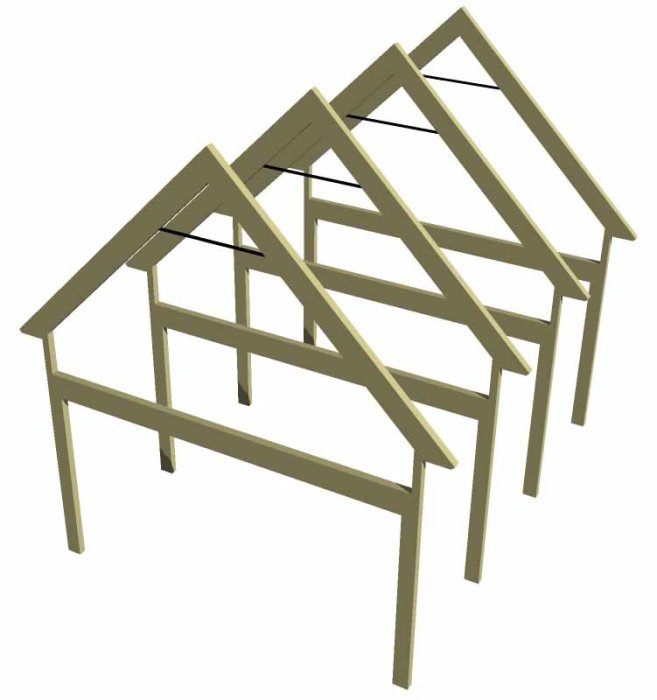
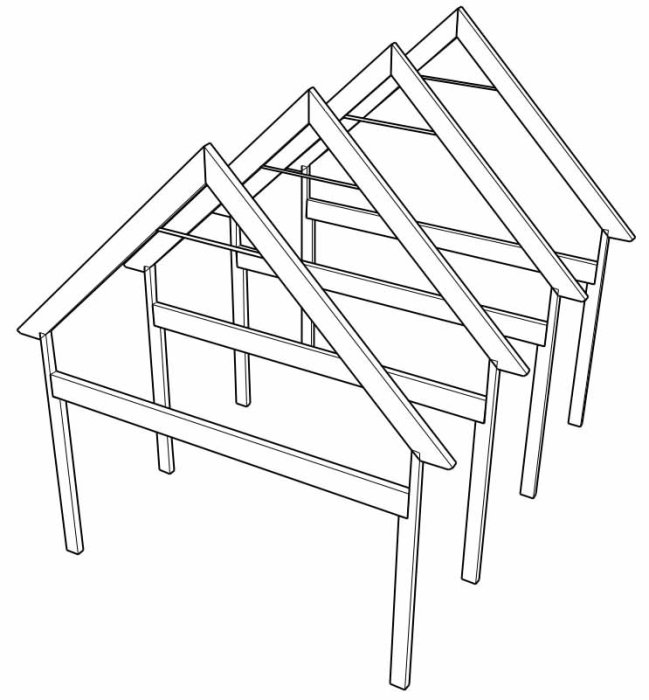
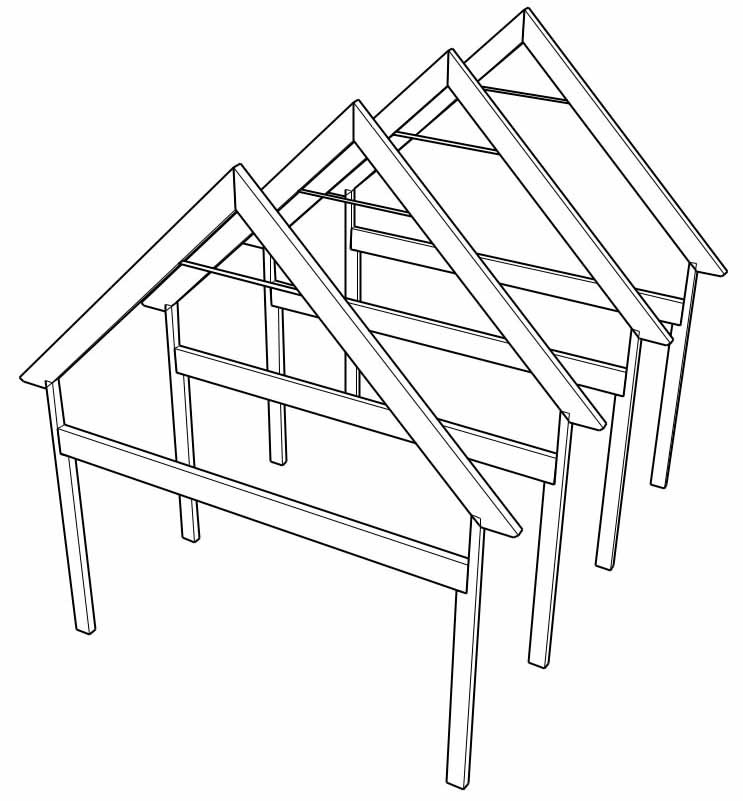
approximate dimensions.
width 5.5m
length 7m
height to intermediate floor 2.8m (must accommodate a loader tractor for manure removal) and then approximately 0.6m raised wall plate up to the tie beam.
It is thus a relatively small building.
I would invest in four glulam frames, placed at a suggested distance of 2.4 m. The roof, walls, and floor are created using standard construction timber running along the length of the barn. This way, no remarkable dimensions are needed. You avoid having pillars in the middle of the floor and beams along the outer walls.
If you want to work with an elevated wall structure, are there any disadvantages to having the wall frame run unbroken all the way up to the eaves? Or what are the advantages of placing a top plate and then building a new frame on top of this a half meter up, besides having a support for the in-between floor? Spontaneously, it feels simpler/more stable to let the wall construction run unbroken all the way and then create a fastening for the intermediate beams in another way, for example, by attaching a support beam where you want the floor up to the loft. Of course, you must ensure the fastening of this since the intermediate floor will help hold the walls together to some extent, so they don't push out.
The only way to make an elevated wall life function well is if it connects with the wall all the way. That's how I drew it on my sketch (though it's not very visible). I have used extra deep pillars that have been notched to provide support for the intermediate floor's beams. The dimensions of the trusses are just roughly sketched since I lack information about the snow load zone, among other things. They can probably be made significantly lighter than what the image shows.
Ahh. Now I understand your drawing better. Seems like a simple and stable solution. Thanks for that! Strangely enough, when I google it, it seems common to build as I described before. That is, to place a new floor structure on top of the lower one. In my view, it feels unnecessary with a joint along the way. But there might be other aspects that I'm not considering.
Not everyone is a pro when it comes to designing houses, especially utility buildings. However, one can assume that older barns are often correctly built from a structural point of view. Both in the 19th and 20th centuries, there were competently written handbooks with principle drawings that were widely distributed. If you tell me your snow zone, I can look into the roof truss dimensions as well. If you want to increase the wall height starting from an existing floor, a supporting structure that takes up space is required.
justusandersson In passing, I forgot to mention that the wind load can become significant, sometimes greater than the snow load when the angle is increased. (I understand that justusandersson has this knowledge, but it's information for others.)
Click here to reply
Vi vill skicka notiser för ämnen du bevakar och händelser som berör dig.