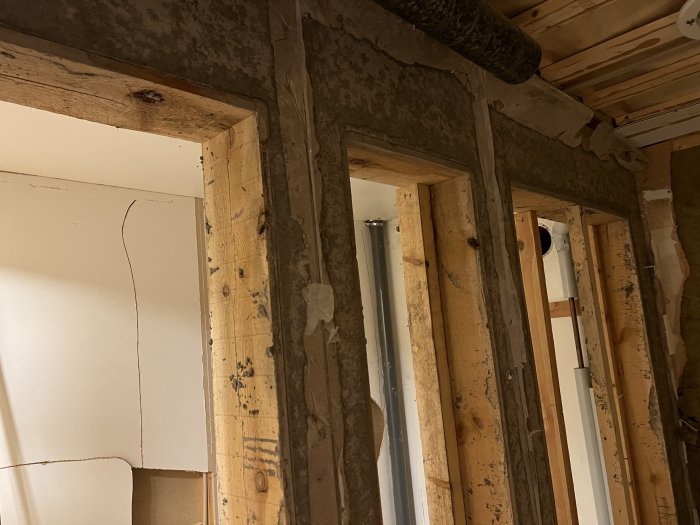
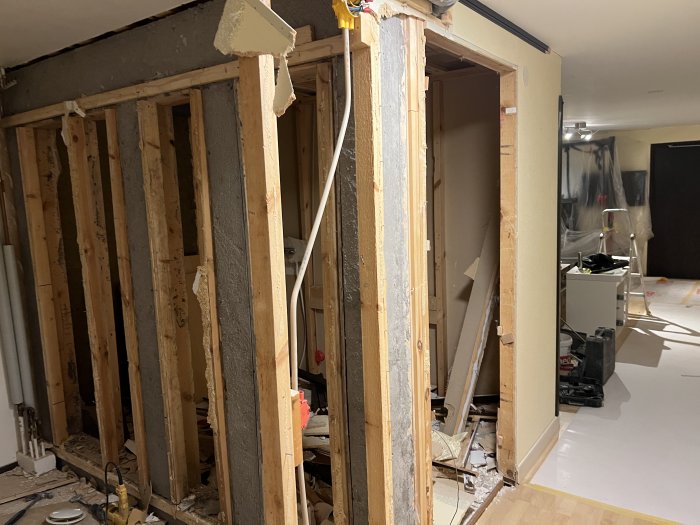
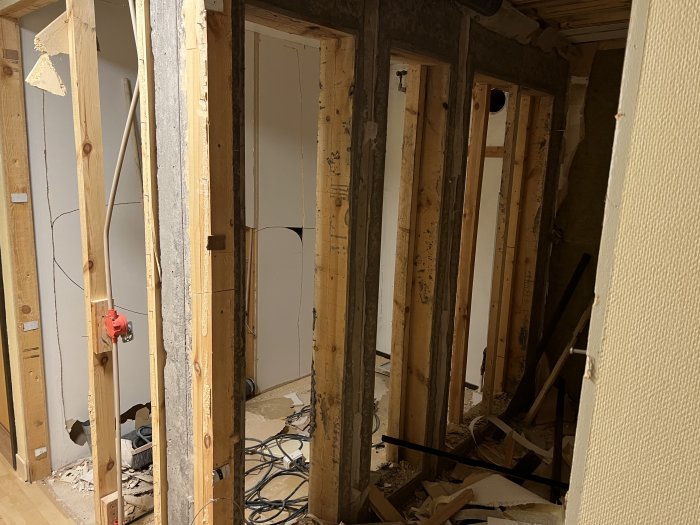
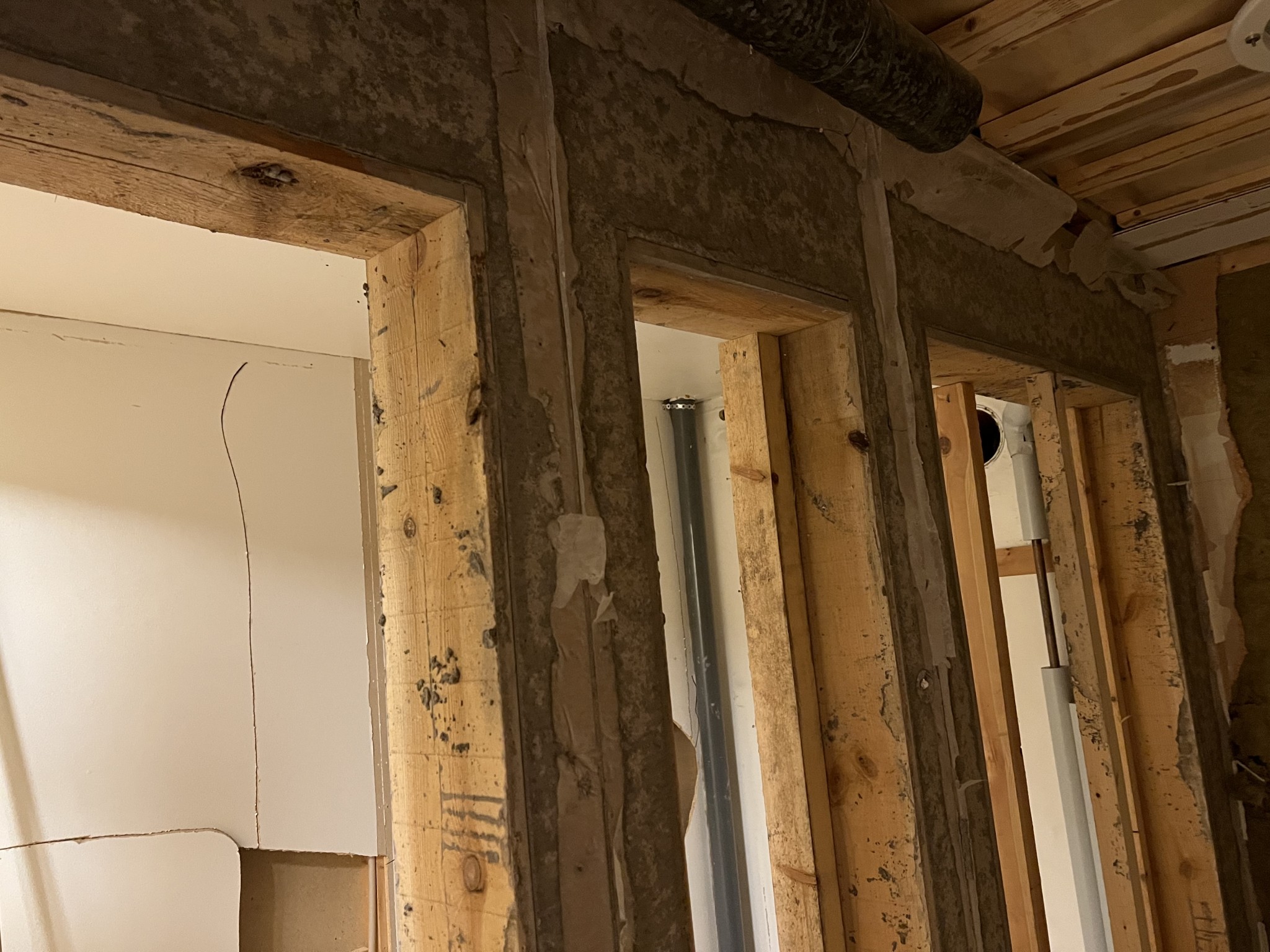
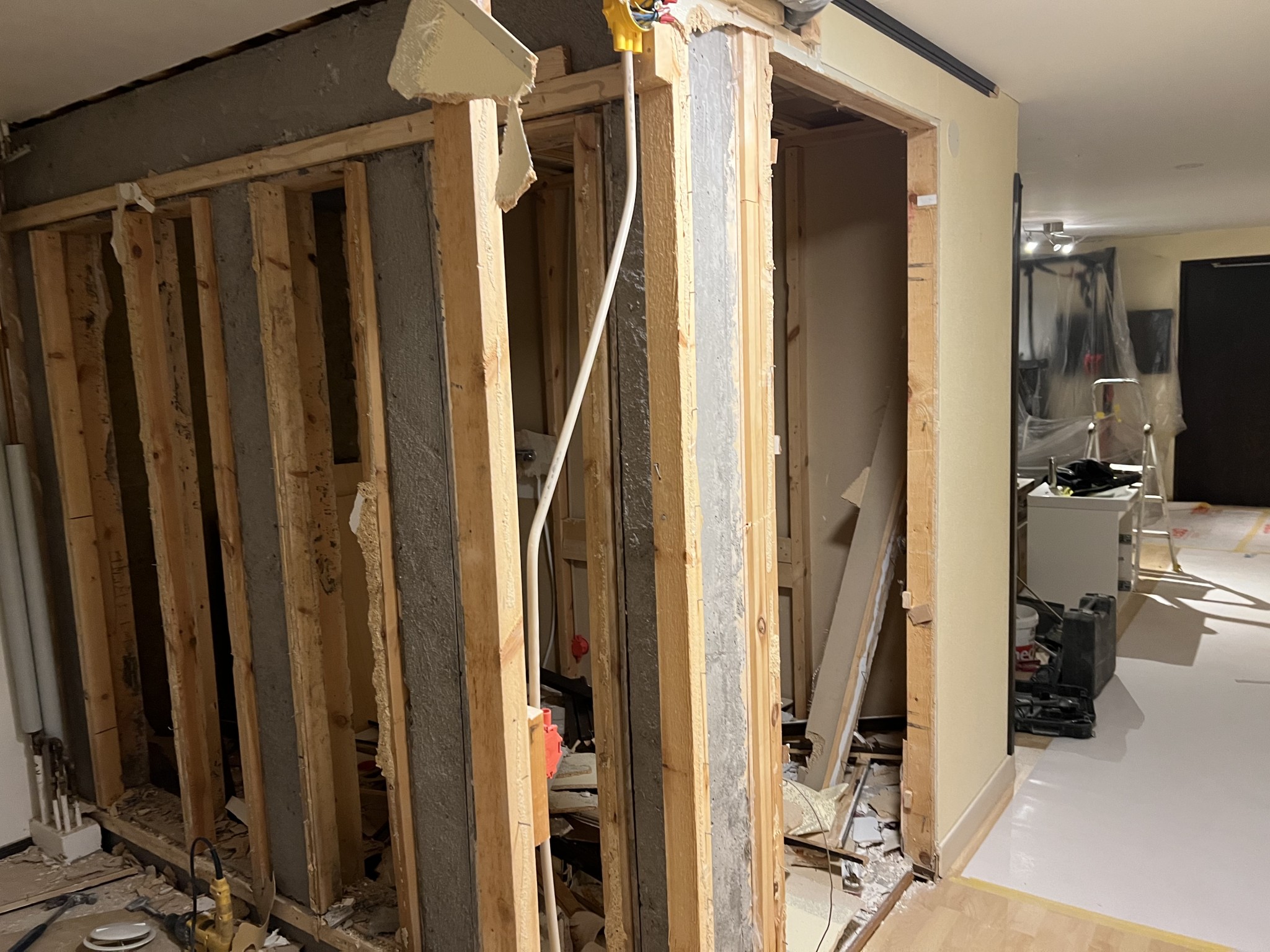
We have just started a bathroom renovation where we will expand the bathroom by tearing down a wall to the adjacent closet. Both rooms are on the ground level and are against an external wall that is below ground.
When we looked at the floor plan, the wall on the other side of the bathroom (which we intended to keep) appeared thicker than other walls, so we thought it might be load-bearing.
But today when they started tearing down, we realized that there are concrete columns cast in the wall we want to tear down and a concrete beam up by the ceiling along the entire wall.
What does this mean for the renovation? Will we be able to support it in another way?
It is not supporting the upper floor but stabilizing for the outer wall. The two drawings with that wall show two different placements. I am not a structural engineer, so it would be good if someone with that expertise could also respond here.
Yes, it doesn't seem to be load-bearing for the upper floor. We are now considering reconfiguring the layout in the bathroom and placing the sauna inside the pillars. So that we can retain 3 pillars, tile around them, and place glass in between. But we would need to remove one pillar to make room for other things in the bathroom, so we should probably bring in a structural engineer to take a look.
From a construction standpoint, it is almost crazy to place three concrete columns so close to each other. To find out why it has been done this way, you need access to a construction drawing. With light concrete slabs, you shouldn't need a concrete beam and columns standing in that direction from a load-bearing perspective. But you don't just cut away a concrete column easily. Could there be something on the upper floor that justifies the arrangement? The municipality should have a construction drawing, even if it may not be digitized.
It is not load-bearing for the upper floor but is stabilizing for the outer wall. The two drawings with that wall show two different placements.
I'm not a structural engineer, so it's good if someone with that expertise also answers here.
I guess the same thing. It resists so the earth masses won't press in the long rear outer wall that is entirely underground.
Do you think it's possible to move the load-bearing wall so that instead it is the one that appears to be load-bearing in the drawing? It's perhaps 1.5m between the walls.
The concrete wall between the shower/WC and storage has a stabilizing function. The combination of beam + column has much poorer rigidity and is not suitable for it.
It is the wall between the WC/Shower and the cloakroom that we want to demolish, and it is the one with concrete pillars (the drawing is incorrect as it looks like the wall between WC/Shower and storage is load-bearing). Our consideration now is whether it would be possible to make the wall between the WC/Shower and storage load-bearing instead (as it appears on the drawing). But you don't think that's possible?
We went down and looked again now, and what was interesting was that the pillar closest to the outer wall had a cavity between it and the chipboard running along the outer wall.
I understand that it is the wall between the WC/shower and the KLK that has the pillars. According to the drawing, the wall between the WC/shower and the storage is made of concrete. Is that correct?
Exactly, there is an error in the drawing. But if possible, I would like to have it as in the drawing, because we are going to merge the wc/shower and walk-in closet into a large bathroom, but right now there are 4 concrete pillars in the middle.
If there is no concrete in the wall between the WC/shower and the storage room, can't you expand the bathroom towards the storage room? Without a construction drawing, you should not touch the other wall.
The walk-in closet that was there was quite poor, so we preferably want to include it in the bathroom instead, to optimize the floor plan.
I went down to talk to the bathroom renovators, and they find it very strange that this entire concrete block doesn't seem to be in contact with anything else. It isn't connected to what's above, so it isn't load-bearing upwards. And it also doesn't have contact with the outer wall. You can slide a ruler behind the innermost pillar. And behind there, there seems to be a standard 45-rule. Could it be that they built it wrong? Or that they initially planned to build in another way, so they put this wall there but then decided to do it differently? Is the wall really load-bearing if it has no contact with the outer wall or ceiling?
Vi vill skicka notiser för ämnen du bevakar och händelser som berör dig.