
13,774 views ·
12 replies
14k views
12 replies
Risers for open staircase, safety strip in the way
I think I have read most about stairs on the internet and especially here on BH (fantastic forum that truly inspires!)
Now, I have an open L-shaped birch staircase that I want to fit risers on to build storage underneath. There are child safety strips under each stringer step on the staircase. Unfortunately, they are positioned differently in relation to the steps below, and they don't fit if risers are to be mounted. I think I'm considering a solution mentioned in another thread with 4 mm plywood, white-stained, as risers.
To what I believe is the first challenge: Removing the child safety strips. They seem to be glued and possibly installed as part of each stringer step. I can think of several ways to remove them but would prefer not to damage the rest of the staircase too much.
Has anyone done something similar before, or maybe has better ideas? Grateful for any feedback, high and low. I am attaching a picture of the child safety strip.
Now, I have an open L-shaped birch staircase that I want to fit risers on to build storage underneath. There are child safety strips under each stringer step on the staircase. Unfortunately, they are positioned differently in relation to the steps below, and they don't fit if risers are to be mounted. I think I'm considering a solution mentioned in another thread with 4 mm plywood, white-stained, as risers.
To what I believe is the first challenge: Removing the child safety strips. They seem to be glued and possibly installed as part of each stringer step. I can think of several ways to remove them but would prefer not to damage the rest of the staircase too much.
Has anyone done something similar before, or maybe has better ideas? Grateful for any feedback, high and low. I am attaching a picture of the child safety strip.
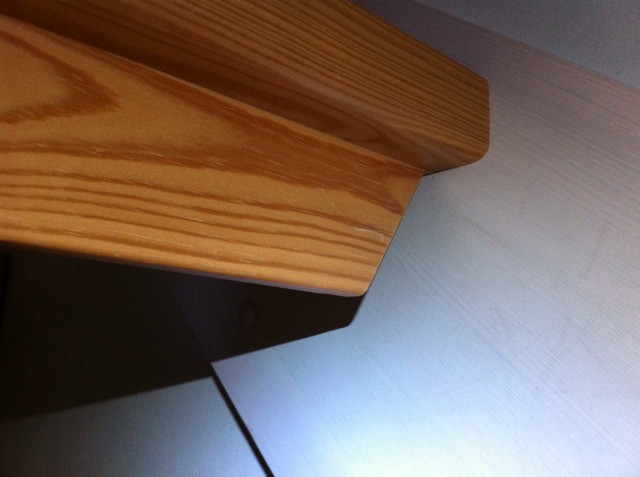
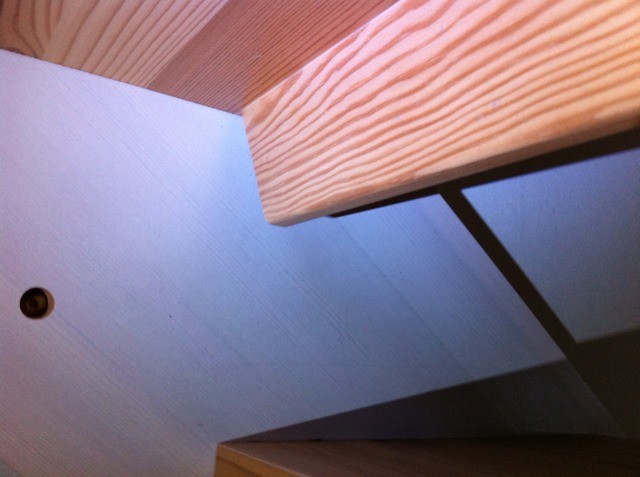
But isn't the strip the same distance from the stair nose on all the steps? The strip would have been perfect for mounting risers against. The height of the riser is thus the distance you have between the steps. Before you order plywood, your staircase is made of pine, not birch. Then I think you should go for thicker than 4 mm, for example 7 mm.
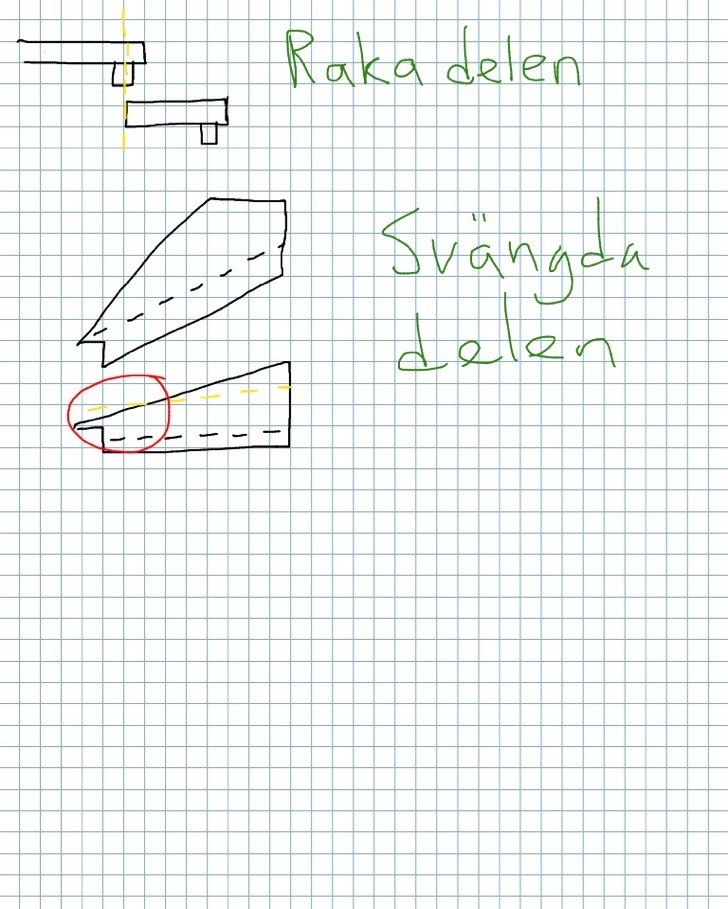
In the straight part of the stairs, it would probably work well as you say if a custom list is built for the lower part (they don't align with each other). The problem occurs in the 90-degree turn where the child safety lists don't align at all. Isn't there a big risk that the vangstycken will also feel too short?
If you go for 7 mm, is it available in plywood or should we choose another board?
I thought birch since the upstairs flooring is that and there doesn't seem to be much difference, but I'm not sure. Did you decide based on the knots or the color? The photo was taken with a mobile camera and it doesn't always seem reliable for colors...
If you go for 7 mm, is it available in plywood or should we choose another board?
I thought birch since the upstairs flooring is that and there doesn't seem to be much difference, but I'm not sure. Did you decide based on the knots or the color? The photo was taken with a mobile camera and it doesn't always seem reliable for colors...

S
sinuslinus
Träskalle
· Östergötlands län
· 6 121 posts
sinuslinus
Träskalle
- Östergötlands län
- 6,121 posts
100% that's pine. The color, grain, summer/winterwood.
Birch is lighter and barely noticeable grain.
There is pine veneered plywood. Usually 4,6,9 mm but can differ a bit when they add a surface veneer so it becomes 7 mm. If you don't have access to a good rip saw, I would advise you to order strips from a joinery. Then you can cut the length yourself after each step.
How do the child guards relate to the back edge of the step below?
Birch is lighter and barely noticeable grain.
There is pine veneered plywood. Usually 4,6,9 mm but can differ a bit when they add a surface veneer so it becomes 7 mm. If you don't have access to a good rip saw, I would advise you to order strips from a joinery. Then you can cut the length yourself after each step.
How do the child guards relate to the back edge of the step below?
The grain and color reveal that it is pine. I guess you want to attach the risers to the back edge of the underlying stairs and up to the underside of the next step, and this molding is in the way. But as I interpret what you write, the back edge of one step is not parallel with the front edge of the next step? If that's the case, I don't think it will work well. Risers should be parallel with the stair nosing, and judging from the pictures, it seems feasible to set the risers against the molding and still get an overlap on the steps. But I haven't seen the entire staircase; it might take up too much step depth to do it as I suggest.
S
sinuslinus
Träskalle
· Östergötlands län
· 6 121 posts
sinuslinus
Träskalle
- Östergötlands län
- 6,121 posts
There is plywood with finer surface veneer, even knife-cut pine.
I find it strange that the child rail doesn't follow the back edge of the step below. Aren't the back edge and the next front edge parallel?
I find it strange that the child rail doesn't follow the back edge of the step below. Aren't the back edge and the next front edge parallel?
Thank you for your commitment and clarification regarding the vangstyckena. You're absolutely right, I was talking nonsense.
In the straight section, as I mentioned, I believe the molding can be used without violating the staircase formula (L+2H~63 cm).
As I've tried to show with the attached sketch, the problem arises at the bottom with the L-turn. I hope my sketch is understandable.
Do you think it's possible to remove the molding without affecting the rest of the staircase?
In the straight section, as I mentioned, I believe the molding can be used without violating the staircase formula (L+2H~63 cm).
As I've tried to show with the attached sketch, the problem arises at the bottom with the L-turn. I hope my sketch is understandable.
Do you think it's possible to remove the molding without affecting the rest of the staircase?
S
sinuslinus
Träskalle
· Östergötlands län
· 6 121 posts
sinuslinus
Träskalle
- Östergötlands län
- 6,121 posts
I would have cut away with a Fein saw (multi-tool) or, if not available, gradually split with a chisel.
Remember to set the riser with a small gap at the top to prevent the stairs from creaking.
Remember to set the riser with a small gap at the top to prevent the stairs from creaking.
Click here to reply