
9,091 views ·
19 replies
9k views
19 replies
Right screw in door casing insert for hollow brick?
Page 1 of 2
Hello,
I am about to install an interior door and have removed the previous door. For some reason, I assumed that the basement was built with leca blocks just like the garage, but after test drilling, it can be concluded that it is some form of hollow brick. When I made the test hole, I drilled without a hammer drill which was a bit slow, but it wasn't really an issue, so it's probably a bit stronger than siporex? This is what the brick looks like:

The screw I bought is for leca blocks and looks like this:
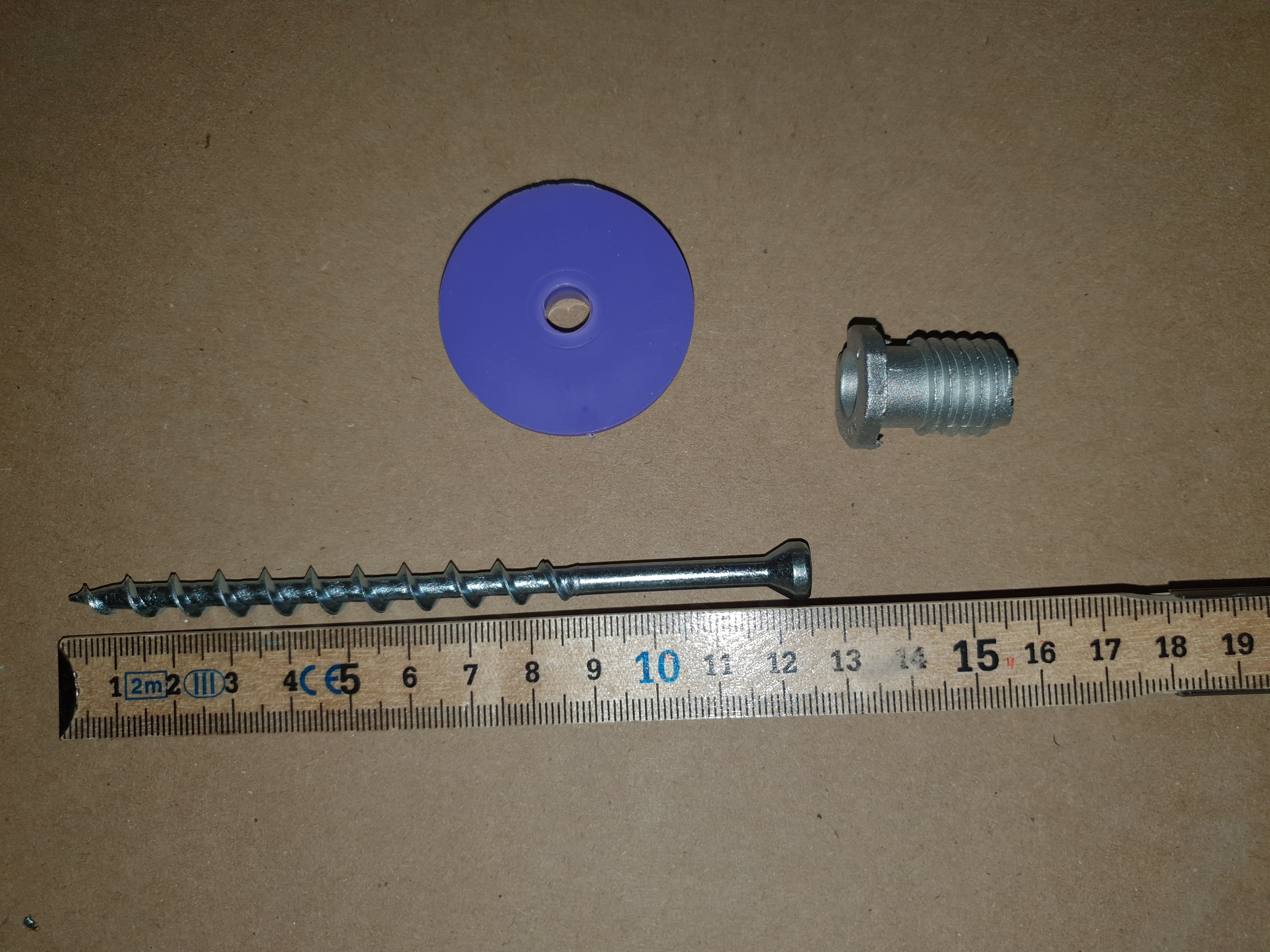
I suspect that such a screw won't work in hollow bricks, at least not without a plug? Would it be enough to buy some kind of plug, or should I change the screw entirely and if so, to what?
I am about to install an interior door and have removed the previous door. For some reason, I assumed that the basement was built with leca blocks just like the garage, but after test drilling, it can be concluded that it is some form of hollow brick. When I made the test hole, I drilled without a hammer drill which was a bit slow, but it wasn't really an issue, so it's probably a bit stronger than siporex? This is what the brick looks like:
The screw I bought is for leca blocks and looks like this:
I suspect that such a screw won't work in hollow bricks, at least not without a plug? Would it be enough to buy some kind of plug, or should I change the screw entirely and if so, to what?


You need heavier items like 140 mm long frame screws and to insert several blue plugs in succession (it's suitable to cut off the last part which functions as a stop to prevent the plug from going further into the hole), to ensure a secure fastening. Sometimes they hit in between the holes, and it can be difficult to insert the screw. In this case, a frame screw key is needed to be able to turn it, and then everything can be adjusted with the same key.
The previous frame was attached with 4 sturdy nails on each long side going straight into the brick without plugs or wooden pieces. This door frame was as solid as a rock, so you'd think the screws I have should do an at least equally good job?
What you can do is drill a test hole of 6 mm, screw in a screw, and then see how well it holds using a crowbar; maybe this will be enough?
Otherwise, it's a trip to the store to look for plugs, I guess.
Keep in mind that this is not the usual kind of frame screw, so the majority of the screw, which is about 120 mm, will go into the wall.
What you can do is drill a test hole of 6 mm, screw in a screw, and then see how well it holds using a crowbar; maybe this will be enough?
Otherwise, it's a trip to the store to look for plugs, I guess.
Keep in mind that this is not the usual kind of frame screw, so the majority of the screw, which is about 120 mm, will go into the wall.
Yep, in the past, frames for windows and doors were always nailed, but back then you knew what you were doing and didn't damage the frames. Not many are left who can nail, all methods are good for fastening, and there are many who do it differently. Just use the method you are proficient with.

The screw for the frame sleeve only needs to be 0.5-1cm longer than the plug + leveling washer + the thickness of the frame sleeve where the screw sits. In practice, that's 1-1.5 cm longer than the plug.
Previously, some frames were installed simultaneously with the construction of the walls. One would brick 1-2 layers, then drive nails into the frame so that the nails went into the mortar holding the next layer of stone, and so on.
Previously, some frames were installed simultaneously with the construction of the walls. One would brick 1-2 layers, then drive nails into the frame so that the nails went into the mortar holding the next layer of stone, and so on.
Self-builder
· Stockholm
· 10 395 posts
Concrete screws can work. There are quite long ones available.
Tried drilling 6 mm and screwing in the screw and sure enough, it's in, but at the end, it wobbles more than I want. So I went out to try to get plugs, but it wasn't easy to find plugs that go through the sleeve. The store staff suggested putting the plug in first, but from what I understand from videos, the plug should go into the wall through the sleeve.
I guess one could have clamped the frame in place, marked the holes, taken down the door, drilled and placed plugs, and then put the frame back up.
I bought a whole bunch of different plugs; we'll see what comes of it, but I'm aiming to get the plug through the sleeve anyway so I don't have to take down the frame after fitting it.
I guess one could have clamped the frame in place, marked the holes, taken down the door, drilled and placed plugs, and then put the frame back up.
I bought a whole bunch of different plugs; we'll see what comes of it, but I'm aiming to get the plug through the sleeve anyway so I don't have to take down the frame after fitting it.
These plugs I bought:


The last one is somewhat larger and was the one the store considered correct, but it is too large to go through the casing, so you have to fit the frame, lower it, and install the plugs before putting up the frame again.
Any opinion on which one to choose?
The last one is somewhat larger and was the one the store considered correct, but it is too large to go through the casing, so you have to fit the frame, lower it, and install the plugs before putting up the frame again.
Any opinion on which one to choose?
You have an adjufix sleeve. In that case, it's plugs and screws from adjufix that apply. The plug can be pressed through the sleeve. The screws do not need to be long since it is concrete hollow block. It's only 15mm concrete, then air.
Yes, I know, but I don't have access to such a plug locally, so I hope to find another solution.V verktygsgurun said:

The image shows a concrete screw. Drill with a 6mm drill bit and screw directly into the concrete hollow block.
Exactly right, I managed to find the screw I have here: https://www.itwconstruction.se/sv/p...etong,-haltegel-och-Leca_pSE_153428sharp0.htmV verktygsgurun said:
It states that it is for lättbetong, Leca AND hollow brick. When installing it in hollow brick, you should pre-drill 6 mm, nothing more. If it works in hollow brick, it should also work in concrete hollow block. However, the question is why the screw I tested could be slightly ricked? Could that be a problem? Otherwise, it was solid as a rock, it couldn't be pulled out, and outside of the slight play, it couldn't be moved.
I suppose it's just a matter of testing; if it doesn't work, you can use some kind of plug. You can always make the hole larger if needed.