
5,800 views ·
12 replies
6k views
12 replies
Replacing drainage in the basement, casting concrete
I have dug up the old cast iron sewer pipes in the basement to be able to replace them. The house is built on a sandy base and the pipes are laid directly on the sand, then it's backfilled with the same sand along with stone and concrete rubble. Thus, the floor casting is not directly on the pipes except next to the wells.
Should I refill with sand and backfill materials or should I just fill with concrete? Or up to half of the pipes?
If I'm only using concrete, it'll require a lot more of it, and I don't have a concrete mixer.
Should I refill with sand and backfill materials or should I just fill with concrete? Or up to half of the pipes?
If I'm only using concrete, it'll require a lot more of it, and I don't have a concrete mixer.


It looked the same at our place, a house from -57, and I backfilled with the old gravel and a bit new up to just under the old concrete.
Then I reinforced a bit and cast with coarse concrete mixed in a wheelbarrow.
Has worked well.
Then I reinforced a bit and cast with coarse concrete mixed in a wheelbarrow.
Has worked well.
T Testarn said:
OK, so the concrete didn't come on the pipes (except at the floor drains)?T Testarn said:
What is meant by rulle?
Ah, OK, thanks!T Testarn said:
Yes, I was thinking of using one like that, just afraid it will take a whole lot of bags.
Did you reinforce only at the well(s)?


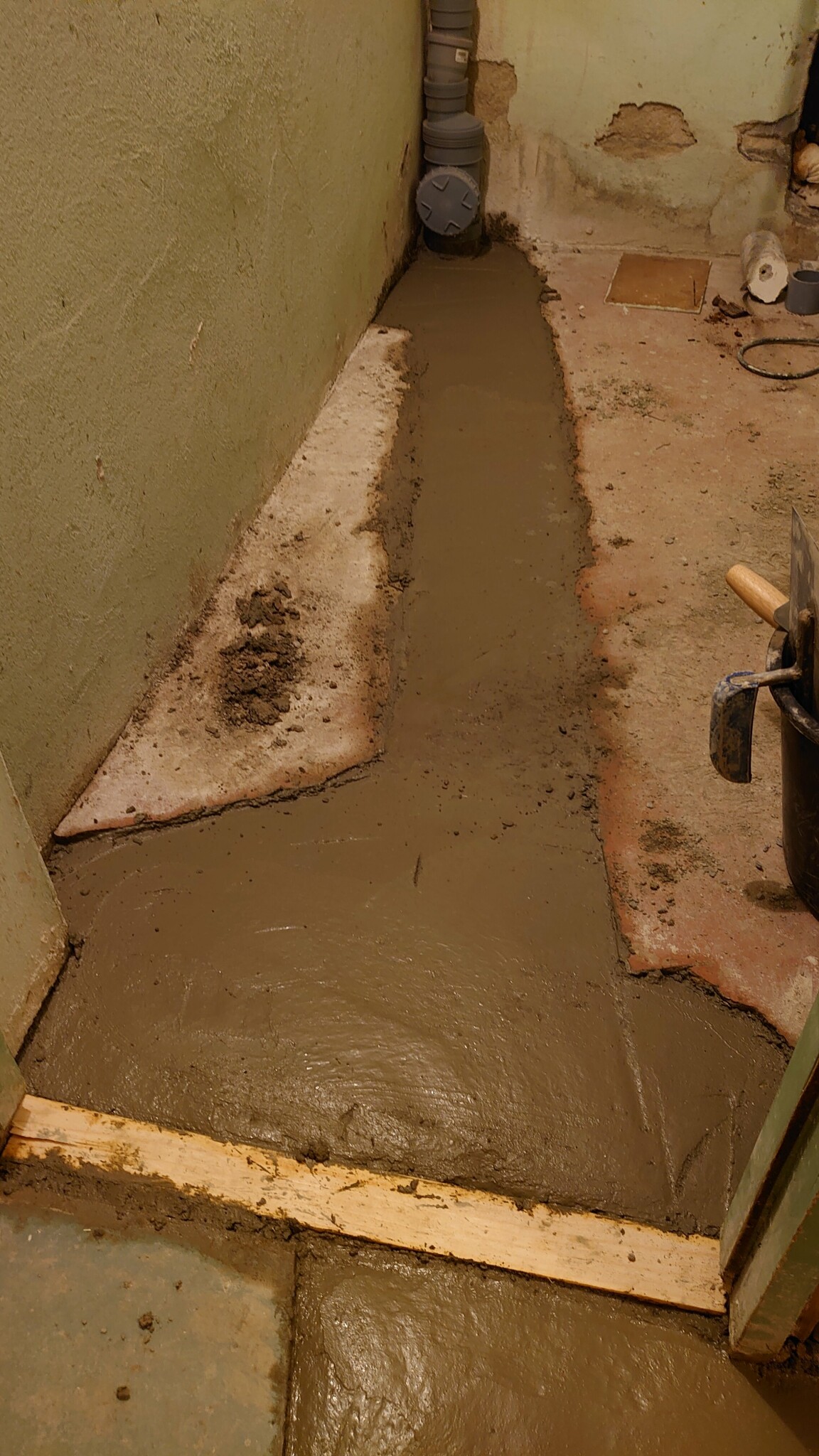
There is a well out of the picture. I reinforced the entire ditch, but not so closely. It's at least better than before...
A bag of concrete that is just mixed with water becomes about 12-14 liters, so it probably took about ten bags. I don't remember exactly, but one bag at a time, and it takes 5-10 minutes per bag to mix.
A bag of concrete that is just mixed with water becomes about 12-14 liters, so it probably took about ten bags. I don't remember exactly, but one bag at a time, and it takes 5-10 minutes per bag to mix.
OK, pretty rough then. Is it under the pipes as well?T Testarn said:
Approximately how many bags were used for the room shown in the last picture?

Yes, the reinforcement was sparse, no reinforcement under the pipes. There will be no concrete there. Backfilling that I tamped a bit before placing the pipe and then around it. Took a piece of reinforcement bar as a "poke stick" around the pipe to get the gravel down a bit. The old gravel was mixed sand and coarser, maybe up to 32 mm. The new was 8-16 crushed stone.A aweste00 said:
A little unsure about the number of bags but 6-7 for that room and 3-4 outside. You can calculate it if you measure your hole in decimeters. That will be in liters and each bag provides about 12 liters of concrete.
T Testarn said:Yes, the reinforcement was sparse, no reinforcement under the pipes. There will be no concrete there.
Refilling that I tamped a little before the pipe was placed and then around. Took a piece of reinforcement bar as a "poking stick" around the pipe to get the gravel down a bit. The old gravel was mixed sand and coarser, maybe up to 32 mm. The new one was 8-16 crushed stone.
A bit unsure about the number of bags but 6-7 for that room and 3-4 outside. You can calculate it by measuring your hole in decimeters. Then it will be in liters and each bag gives about 12 liters of concrete.
Sorry, I meant gravel/fill materials! That is, if you have that under the pipes too or if the pipes lie directly on what is the natural foundation.T Testarn said:Yes, the reinforcement was sparse, no reinforcement under the pipes. There will be no concrete there.
Refilling that I tamped a little before the pipe was placed and then around. Took a piece of reinforcement bar as a "poking stick" around the pipe to get the gravel down a bit. The old gravel was mixed sand and coarser, maybe up to 32 mm. The new one was 8-16 crushed stone.
A bit unsure about the number of bags but 6-7 for that room and 3-4 outside. You can calculate it by measuring your hole in decimeters. Then it will be in liters and each bag gives about 12 liters of concrete.
Anyway, if I've managed to tear up the stuff, I should be able to cast it again too!
Aha!
There is sand/gravel under the basement floor, and they had placed a mixture of sand and gravel before the floor was cast, which is 5-6 cm thick. I put back some of the excavated material and tamped it down with a piece of 95x95 before the pipe was placed with slope. Then I filled around it with some of the old material before I took 8-16 crushed stone and filled the rest around and 3-4 cm over. That's when I poked around the pipe with a piece of rebar and packed gently with the 95x95 piece before reinforcement and concrete.
I drilled the reinforcement in from the side into the old floor, you can see the picture of it.
You'll manage this, it's okay. If you have a few more bags than calculated, you can return what's left over, and if you don't reach the exact level, you can use some self-leveling compound.
I had some existing high spots on the floor that I ground down with a grinding cup. Dusty but convenient.
There is sand/gravel under the basement floor, and they had placed a mixture of sand and gravel before the floor was cast, which is 5-6 cm thick. I put back some of the excavated material and tamped it down with a piece of 95x95 before the pipe was placed with slope. Then I filled around it with some of the old material before I took 8-16 crushed stone and filled the rest around and 3-4 cm over. That's when I poked around the pipe with a piece of rebar and packed gently with the 95x95 piece before reinforcement and concrete.
I drilled the reinforcement in from the side into the old floor, you can see the picture of it.
You'll manage this, it's okay. If you have a few more bags than calculated, you can return what's left over, and if you don't reach the exact level, you can use some self-leveling compound.
I had some existing high spots on the floor that I ground down with a grinding cup. Dusty but convenient.
OK, thanks for the tips! I've been considering reinforcement at least at the wells. The surface layer doesn't need to be very pretty, I'll put tiles on at some point when everything else is finished.T Testarn said:Aha!
There is sand/gravel under the basement floor and they had laid a mix of sand and gravel before casting the floor, which is 5-6 cm thick. I put back some of the dug-out material and tamped it down with a piece of 95x95 before placing the pipe in position with slope. Then I filled around with a bit of the old before I took crushed 8-16 and filled the rest around and 3-4 cm over. That's when I poked around the pipe with a piece of rebar and packed carefully with the 95x95 piece before reinforcing and concreting.
I drilled the reinforcement in from the side into the old floor, you can see the picture of it.
You're going to handle this, it's okay. If you have a few more bags than calculated, you can return what's left over, and if you don't reach the exact level, you can levelling compound a bit.
I had a few existing peaks in the floor that I ground down with a grinding cup. Dusty but convenient.
Click here to reply