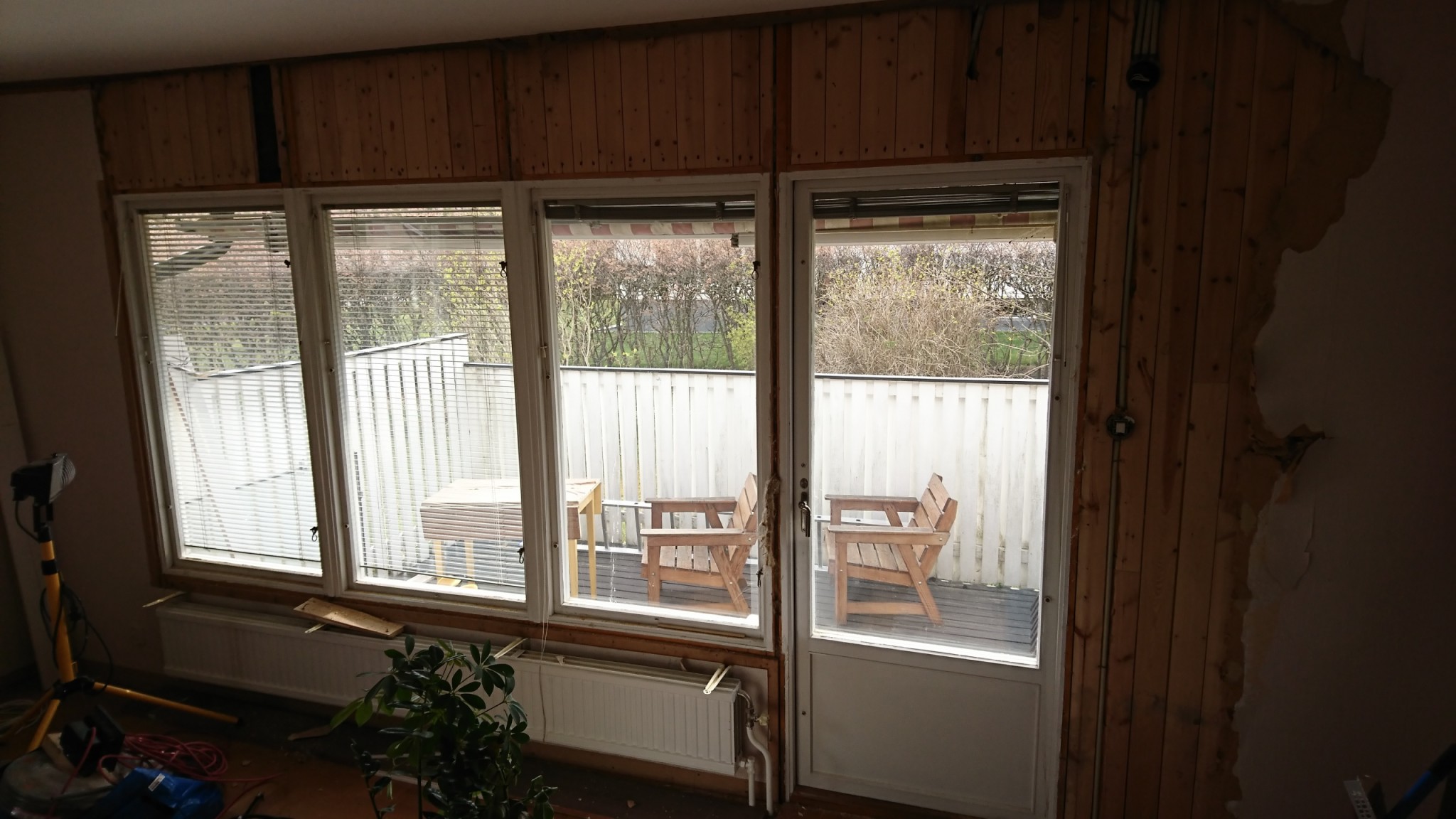
Hi! This summer I will be replacing a window section in an exterior wall (house from -64). The windows are bearing type with vertical frame pieces that go from floor to ceiling.
I will remove one window at a time and replace the frame pieces with standing studs. The space above and below the window opening I will need to fill in, and I am considering how this wall should be constructed to best match the older adjacent wall.
The older wall measures about 129 mm in depth and consists of, from inside out:
Standing planks (about 35 mm)
Thin wind barrier paper
Insulation/thin studs
Tretex
Thin wind barrier paper
Panel (no air gap against the underlying paper and Tretex).
The plan for the new wall is from inside out (130 mm):
10 mm OSB
Wind barrier fabric
120 mm insulation/stud
Wind barrier fabric.
On the outside of the existing and new wall, standing battens and new horizontal paneling.
Do you have any comments on this? Have I missed anything, or does it seem okay?
I have difficulty understanding both how it looks today and how you envision it should look. The windows can hardly be load-bearing. There must be studs between each window frame. The sentence
Outside existing and new wall, standing battens and new horizontal cladding.
I can't see from the pictures if that's the case here, but houses have been built where window and door frames are load-bearing. Wall stud and window frame are the same part.
I don't really understand what the wind barrier is supposed to add. OSB is much denser. I would have used plastic in the new wall sections. But it works fine to do as you plan. What are you going to have on the inside?
I find it difficult to understand both what it looks like today and what you envision it should look like. The windows can hardly be load-bearing. There must be studs between each window frame. The sentence
Utanpå befintlig och ny vägg stående läkt och ny liggande panel
I don't understand at all.
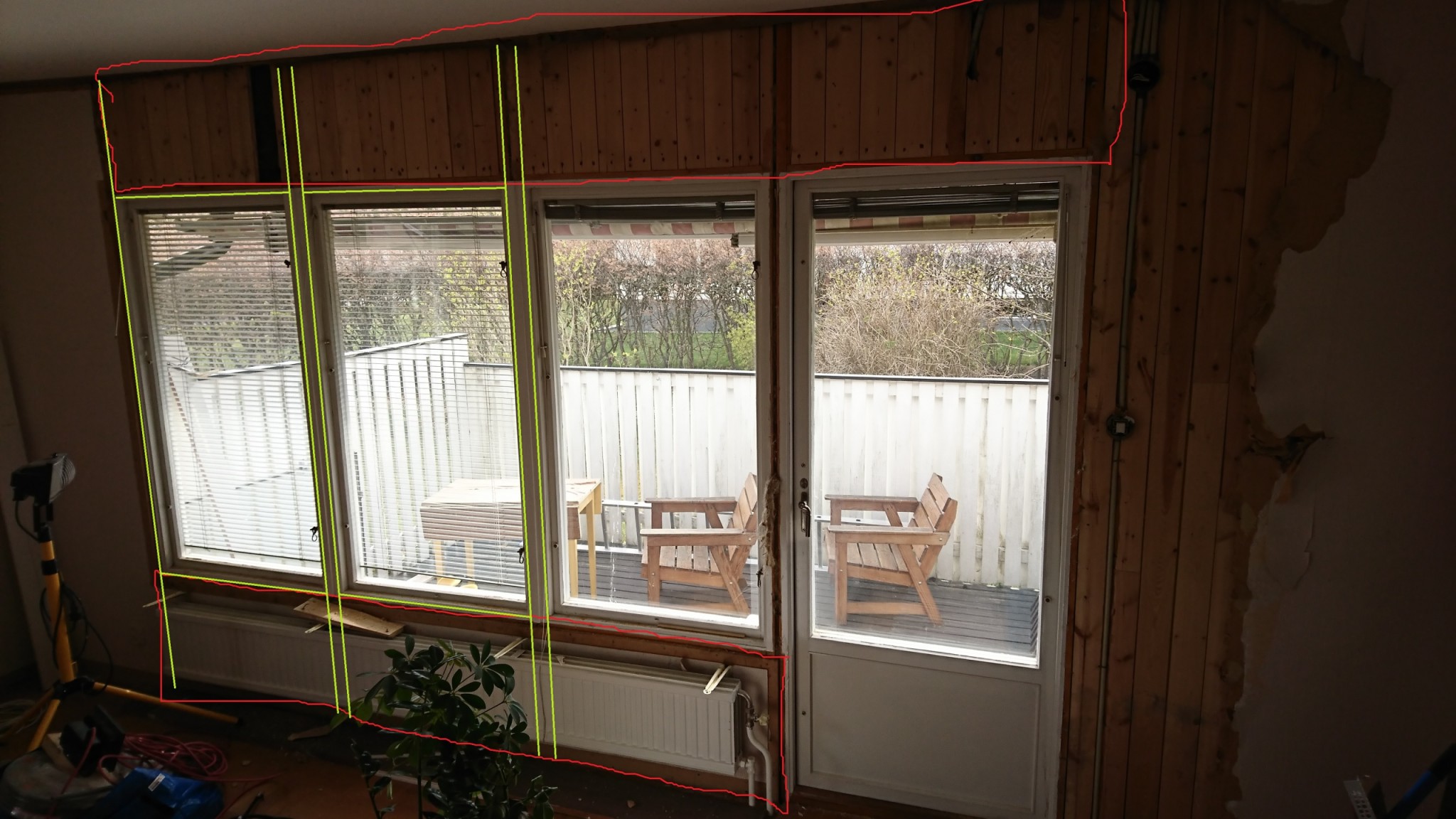
Apologies if I was unclear, I've attached a simple paint below. The red circled areas above and below the windows are where I will need to build a new wall. If you click and zoom on the image and look at the area between the patio door and window, you might be able to see how the frame also acts as a stud in this case and continues upwards. Marked with yellow lines on the two lowest windows how the frame looks.
The old panel is, in my opinion, not particularly attractive, so I will add new paneling on top of the adjacent old walls and the new wall parts above and below the windows. It will be horizontal paneling nailed against vertical battens. The battens are nailed directly to the old wall and the studs in the new wall sections.
I can't see from the pictures if that's the case here, but there have been houses built where window and door frames are load-bearing. Wall stud and window frame are the same part.
I don't really understand what the windbreaker is supposed to contribute. OSB is much denser. I would have used plastic in the new wall sections. But it works well to do as you plan. What will you have on the inside?
That's exactly how it's built today as you mention.
Thanks for the feedback!
Indeed, the internal windbreaker doesn't really contribute anything directly, maybe I should skip it?
Inside, it will be gypsum.
That would have been the dream! Unfortunately, the radiator in front and a relatively tight budget currently put a stop to it. But of course, the glulam beam provides opportunities for this in the future
After sleeping on it, I realize that it is probably a prefabricated type house you have. If you want to renew the window section, you need to take a comprehensive approach and replace the existing elements with a restructured frame construction. Designing and building this is unfortunately not for cheerful amateurs. Among other things, you need to make a temporary support during the construction period. A glulam beam will likely be needed over the windows. If you do it wrong, there is a risk that the house may partially collapse. Since the building seems to have a diffusion-open solution, it is inappropriate to use plastic sheeting in the new wall. Use wind barrier fabric and hygroscopic insulation materials such as cellulose fibers.
After sleeping on it, I realize it's likely a prefab type house you have....
Thanks for the feedback, Justus. Leaning more towards glulam to gain greater freedom in the design of the window section. It's been a few years since I studied strength and load-bearing structures, so I'll leave the sizing to professionals. Using supports during the construction period has been my thought all along. Good to get agreement on my thoughts regarding a breathable construction.
What would be the advantage of that wall section being without plastic just because the rest is? I have a hard time seeing the advantages of skipping it.
You live in Småland and Hultsfredshus built houses with fiberplank in the 60s where wall panels and window sections were load-bearing, so they had no load-bearing framework and, as noted earlier, you must construct frameworks or larger interventions with glulam beams.

 This summer I will be replacing a window section in an exterior wall (house from -64). The windows are bearing type with vertical frame pieces that go from floor to ceiling.