
9,635 views ·
18 replies
10k views
18 replies
Removing floor chipboard
I'm tearing out the chipboard flooring in my bathroom to replace it with moisture-resistant panels according to current regulations and to move the drain, but I've encountered a small problem.
It turns out that the chipboard from the hallway/closet extends under the chipboard in the bathroom and they are glued together. Should I just cut off both chipboards flush with the wall, or is there a risk of weakening that makes the partition wall less stable? Under the wall, there is a floor joist (220x45). On the floor joist, there is also a reinforcement nailed on that is 35x45 and as long as the bathroom. I have 2 pictures showing what it looks like.
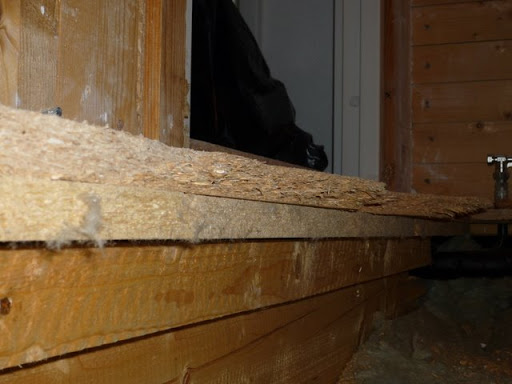
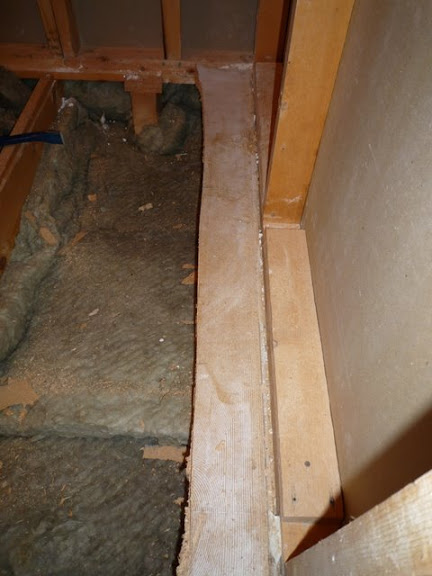
If it's okay to cut off the boards, what would be the best tool to cut with to reach properly?
It turns out that the chipboard from the hallway/closet extends under the chipboard in the bathroom and they are glued together. Should I just cut off both chipboards flush with the wall, or is there a risk of weakening that makes the partition wall less stable? Under the wall, there is a floor joist (220x45). On the floor joist, there is also a reinforcement nailed on that is 35x45 and as long as the bathroom. I have 2 pictures showing what it looks like.
If it's okay to cut off the boards, what would be the best tool to cut with to reach properly?
I'm going to continue with floor chipboard, but switch to moisture-resistant (v313). The existing floor chipboard was partially moisture-damaged and I need to move the plumbing, which means I had to remove 50-60% of the old floor (small bathroom, so a lot of floor has to come up to access all the pipes), so I'm changing the whole thing.
To try and clarify, I've made a nice picture in paint of what the cross-section seems to be.
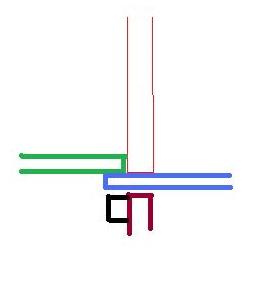
Green is the chipboard from the bathroom, blue is the chipboard from the hallway/closet, red with narrow lines is the wall, brown is the floor joist, and black is the reinforcement. I plan to cut flush with the wall/floor joist (if that's okay, that is). I have access to a reciprocating saw (and a hand saw )
)
And the other floor joists are level with this floor joist, so there will be no problem with that, except that elevations had been nailed to them to bring them level when the house was built.
To try and clarify, I've made a nice picture in paint of what the cross-section seems to be.
Green is the chipboard from the bathroom, blue is the chipboard from the hallway/closet, red with narrow lines is the wall, brown is the floor joist, and black is the reinforcement. I plan to cut flush with the wall/floor joist (if that's okay, that is). I have access to a reciprocating saw (and a hand saw
)And the other floor joists are level with this floor joist, so there will be no problem with that, except that elevations had been nailed to them to bring them level when the house was built.
Last edited:
Tiles, so it should be leveled with fiber-reinforced compound etc. to reinforce according to all the rules of the art when the new floor is laid. Underfloor heating is still under discussion, I think it is not needed on the second floor as heat rises from the ground floor, but the government wants it... it will be electric underfloor heating if it happens.
And to clarify further, I'm thinking of, after cutting away the floor chipboards, adding new reinforcement and noggings. If it can't be weakened anyway, since the chipboard doesn't seem to be directly on the floor joists but only on the noggings/reinforcements on this outer side of the bathroom.

I have now measured and thought a little more and I was wrong about how it was constructed.

It turns out that this floor beam is 70x220 instead of the others which are 45x220. So now I am very curious if I can cut along the black dashed line? Or is it better to just try to remove the "green" floorboard and lay the new floorboard on the "blue". The "red" wall stands 35 in on the floor beam, so if you can cut off the blue floorboard along the wall, it will sit on 35mm of the floor beam, and 35 of the floor beam will be free.
It turns out that this floor beam is 70x220 instead of the others which are 45x220. So now I am very curious if I can cut along the black dashed line? Or is it better to just try to remove the "green" floorboard and lay the new floorboard on the "blue". The "red" wall stands 35 in on the floor beam, so if you can cut off the blue floorboard along the wall, it will sit on 35mm of the floor beam, and 35 of the floor beam will be free.

I had bent away the 35*45 and cut straight through both chipboards along the edge of the 70*220, then as others suggested, screwed/nailed (nail/screw glued) a better rule as support for the new chipboard. (I actually did this exact operation a little over a month ago, with the difference that I didn't realize the water pipe was under the chipboard until I heard it rushing.... it cost an extra 3500 crowns to have it fixed by a plumber.)

Bringing life to this old thread. I'm in the same situation as the original poster. How should one splice the new floor chipboard if cutting the existing one as close to the wall as possible? Difficult to get it perfectly straight.

I'm in the same boat
How did you solve it?
I'm thinking of using a circular saw as close to the wall as I can, i.e. about 2cm next to the wall, but then it will be straight.
Just need to check that my new chipboards are as thick as the old ones from the 60s.
How did you solve it?
I'm thinking of using a circular saw as close to the wall as I can, i.e. about 2cm next to the wall, but then it will be straight.
Just need to check that my new chipboards are as thick as the old ones from the 60s.