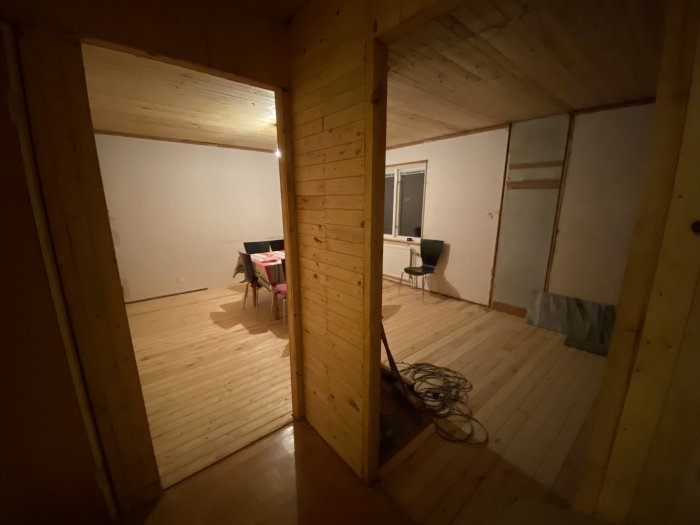
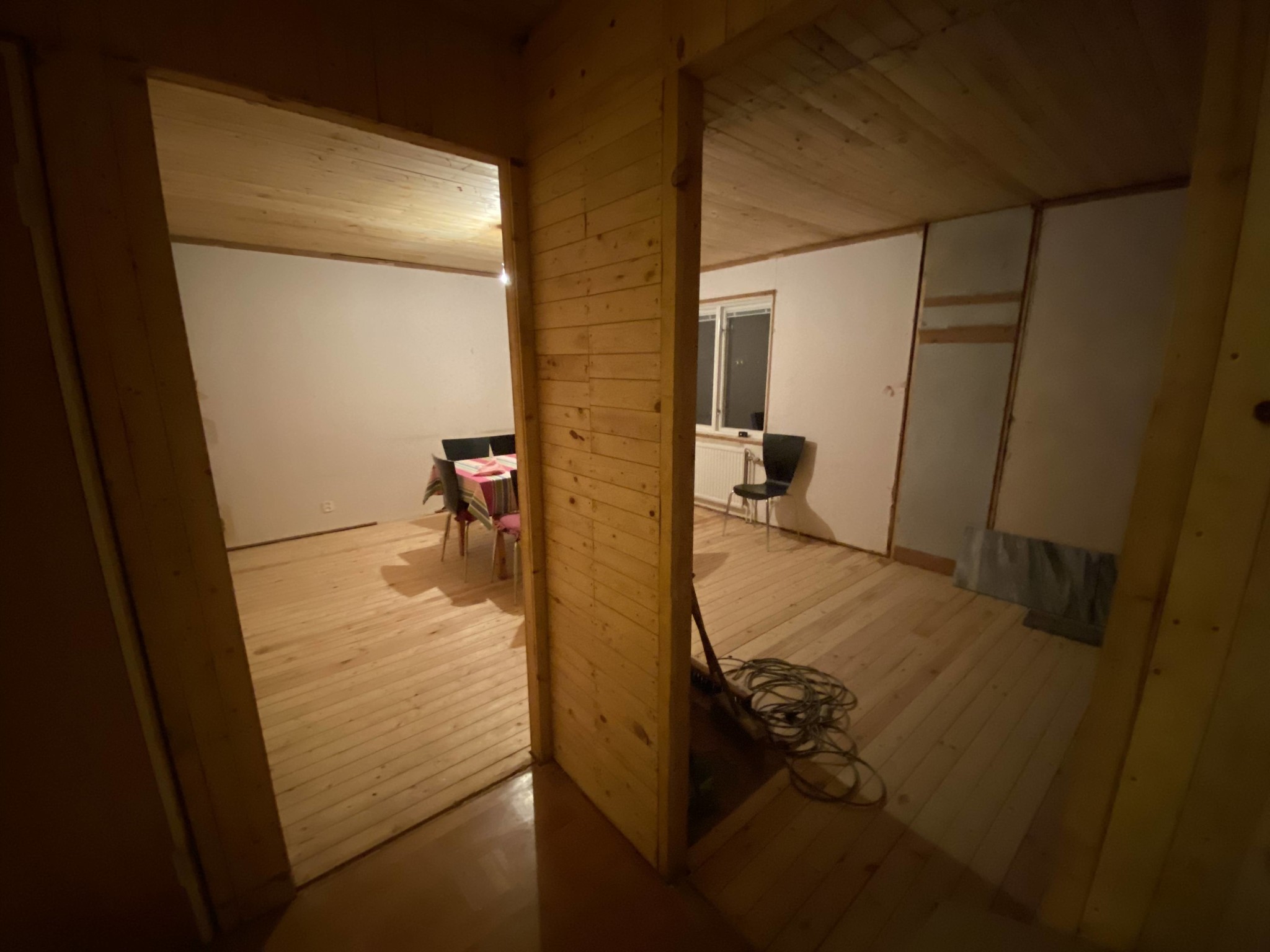
I am completely renovating a single-story brick villa built in 1960.
The house has a heated basement through water radiators. The floor structure between the basement and the upper floor consists of raw planks in the floor and ceiling, wind paper, and cuttershavings as insulation.
The plan is to lay underfloor heating and oak parquet on top of the raw planks.
Yes, just as you mention, my basic idea is to let it be as it is. But then I've seen several cases where they've removed it and added new insulation instead, which has made me uncertain.
Are there any disadvantages to leaving it as is, and are there any significant advantages to replacing it with modern insulation?
The only downside I can think of is that it burns well, and it's probably possible to get better soundproofing. But for heating's sake, it doesn't matter at all as long as both floors have some form of heating. And if you turn off the heat completely in the basement, it's an advantage if enough heat leaks from the upper floor so that it doesn't easily drop below freezing down there. (I have the same construction in my house, but I economize on the heating down there.)
I have a 70s house with a basement and floor similar to what you describe. This flooring is also filled with spån. We have started renovating the floor but will eventually start with the basement. When we do, I plan to run some electricity in the flooring and lighting in the flooring, and in connection with that, I will remove the spån and replace it with other insulation. Why? Somehow it feels uneasy with spån from a fire safety perspective. At the same time, the flooring is also wood. But still.
Renovated a small home office; around 4m2, here on the lower floor. Did the same thing then by running electricity in the flooring and removed the spån. There is an unbelievable amount of spån - just in this small area. I can hardly imagine how much spån there will be when we do the family room of 30 square meters...
Shavings have higher density and, like mineral wool compared to glass wool, should dampen sound better.
Additionally, it buffers moisture!
I only see advantages compared to modern insulation if one does not have significant needs for thermal insulation.
Wood shavings have a higher density and should, like rock wool compared to glass wool, dampen sound better.
Additionally, they are moisture buffering!
I only see advantages compared to modern insulation if you don't have large needs for thermal insulation.
Huddingebo, I am also a Huddingebo. Just a little fun coincidence
Do you mean that rock wool is better than glass wool?
Huddingebo, I'm also a Huddingebo. Just a small fun coincidence
Do you mean that rock wool is better than glass wool?
What do you mean by moisture buffering?
https://hallahus.se/renovera/stomme...produkt från,ett alternativ främst i bjälklag.
It has the ability to absorb and release moisture and makes the structure more resistant to yearly variations in moisture in basements or attics.
If your basement is always dry, you won't have much use for that property.
Rock wool is said to have slightly better sound-insulating properties due to higher density.
I have it in all the interior walls and glass wool with better lambda values in the exterior walls.
I have a 70s house with a basement and floor similar to what you describe. This joist is also sawdust-filled. We have started renovating the floor and will eventually start with the basement. When we do that, I plan to install some electricity in the joist and lighting in the joist, and in connection with that, remove the sawdust and replace it with other insulation. Why? Somehow, the sawdust feels unsettling from a fire safety perspective. Even though the joist is similarly made of wood. But still.
I renovated a small home office; about 4m2, here on the lower floor. Did the same thing by installing electricity in the joist and removing the sawdust. My goodness, there is a lot of sawdust—just in this small area. I'm almost afraid to think about how much sawdust there will be when we do the 30 square meter family room...
I renovated a kitchen this past spring, installed waterborne floor heating among other things. The joists were leveled/reinforced before I laid grooved chipboard. All the chipboard in the joists was temporarily moved to be able to run electricity and water, but all the chipboard was then put back. Under the kitchen is the laundry room, and it's quite nice that the washing machine can spin down there without being heard in the kitchen.
So, I advise you to keep/reuse the chipboard as insulation.
Shavings do not burn very quickly as they are quite compact and no oxygen gets to them. If it were to burn so thoroughly that it has burned through the chipboard floor and started to glow in the shavings, the house is probably quite lost. Keep the shavings as they are quite soundproof.
I join the group that says keep the spån. Possibly the spån has settled a bit over the years, creating an air gap between the floor and the insulation, so if you have the råspont ripped up anyway, it might be better to buy more kutterspån and fill it up. Otherwise, leave it as it is.
@Daaaaaniel You have no idea. I tore out an entire trossbotten in a house from '29, about 70 sqm (due to extensive damage). I stopped counting after about 30 garbage bags of spån. Spån in the clothes, in the hair, in the EARS. Spån that remains after washing the clothes... Then it's said to be much nicer when it's planer or kutterspån. Not like here, where it was coarse sawdust mixed with mouse nests. I've replaced it with loose-fill cellulose...
Click here to reply
Vi vill skicka notiser för ämnen du bevakar och händelser som berör dig.



Huddingebo said:


