
Hello!
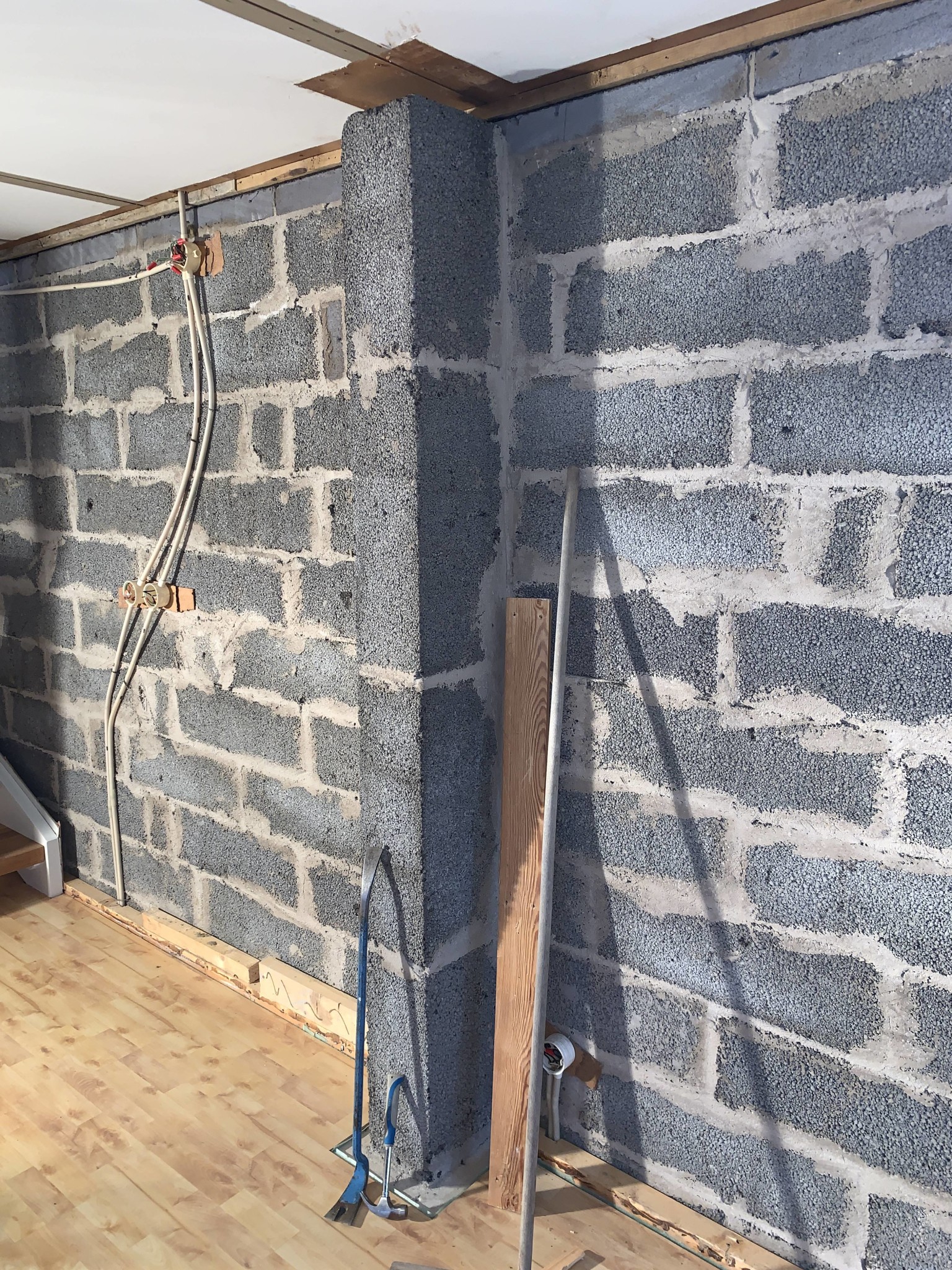
We have started to remove the studded wall in the basement and have come across this pillar. In a dream world, we would want to remove it. The question is, what do you think about it? The pillar doesn’t support anything from above as there is about 5cm to the ceiling. What it might be supporting is so that the wall doesn’t collapse. But there is a proper wall just three meters away that supports much more. Could it have been there for when the house was built and the foundation was filled in before building the entrance level?
Regards
We have started to remove the studded wall in the basement and have come across this pillar. In a dream world, we would want to remove it. The question is, what do you think about it? The pillar doesn’t support anything from above as there is about 5cm to the ceiling. What it might be supporting is so that the wall doesn’t collapse. But there is a proper wall just three meters away that supports much more. Could it have been there for when the house was built and the foundation was filled in before building the entrance level?
Regards


Hello
You see a square in the color above the column, indicating that the column has previously reached that point in some way. There has been some form of support, and I would think that you should add something rather than remove something in that place. It's not something anyone here wants to delve into because matters related to construction can have significant consequences and must be evaluated by someone who takes responsibility for giving advice. We cannot do that here.
You see a square in the color above the column, indicating that the column has previously reached that point in some way. There has been some form of support, and I would think that you should add something rather than remove something in that place. It's not something anyone here wants to delve into because matters related to construction can have significant consequences and must be evaluated by someone who takes responsibility for giving advice. We cannot do that here.
Since the corresponding square exists in the floor, it can be assumed that the pillar was clad. Without knowing anything about the construction otherwise, it is of course reckless to advise you to remove the pillar; someone with knowledge should probably see this on-site.
The pillar has been encased with studs and then paneling outside of that. The reason it's not painted there is precisely because of that.N Nylenskavillan said:Hi
You see a square in the color above the pillar indicating that the pillar has somehow reached up there previously. There has been some form of support and I would think you should add something rather than remove something in that location. It's not something anyone here wants to delve into since matters related to construction can have major consequences and must be assessed by someone who takes responsibility for advice. We can't do that here.
One sees a plate at the bottom, and there should probably be one at the top too. In the post above, it sounds like someone should go out and look at it. First preserve it, and then maybe not.
From Wikipedia: Buttress or kontrefort is an external, sometimes freestanding, structural element mainly in Gothic architecture, intended to absorb the horizontal pressure from, for example, a vault inside a church, often via a flying buttress. Through buttresses, the wall is relieved, allowing it to be made thinner or even completely replaced with windows.
From Wikipedia: Buttress or kontrefort is an external, sometimes freestanding, structural element mainly in Gothic architecture, intended to absorb the horizontal pressure from, for example, a vault inside a church, often via a flying buttress. Through buttresses, the wall is relieved, allowing it to be made thinner or even completely replaced with windows.
How old is the house?
If it has been working for 30-40 years without the column having contact with the roof, you might as well remove it completely now.
However, the standing studs around the column may have been load-bearing even if it doesn't seem likely.
If it has been working for 30-40 years without the column having contact with the roof, you might as well remove it completely now.
However, the standing studs around the column may have been load-bearing even if it doesn't seem likely.
The house was built in '72.P para said:
It's hard to believe that the studs were load-bearing. But sure, they probably provided some support. Yes, I have spoken with two masons who visited to give a quote for plastering the wall. Both have stated that it should be possible to remove it.
A buttress should have been "embedded" in the masonry and not attached "on the outside" as it appears to be here. However, there may be reinforcement extending into every third joint, but we do not know that. As it looks now, the safest bet is to leave it in place. For a better answer, an on-site inspection is needed to determine if it can be removed.L largab said:

TS: Bring someone who can take a look is my advice. There's so much you can't see in a picture.
(NOTE: My opinion: But, if you look at what's in the picture and think a bit, there's no possibility that it's a load-bearing wall/buttress meant to take any loads. If that's what it's supposed to be, it's done completely wrong and is of little use. NOTE, opinion based on what's in the picture)
(NOTE: My opinion: But, if you look at what's in the picture and think a bit, there's no possibility that it's a load-bearing wall/buttress meant to take any loads. If that's what it's supposed to be, it's done completely wrong and is of little use. NOTE, opinion based on what's in the picture)
Click here to reply