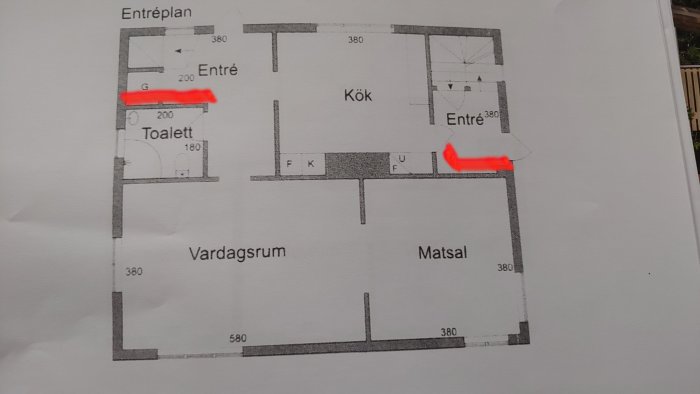
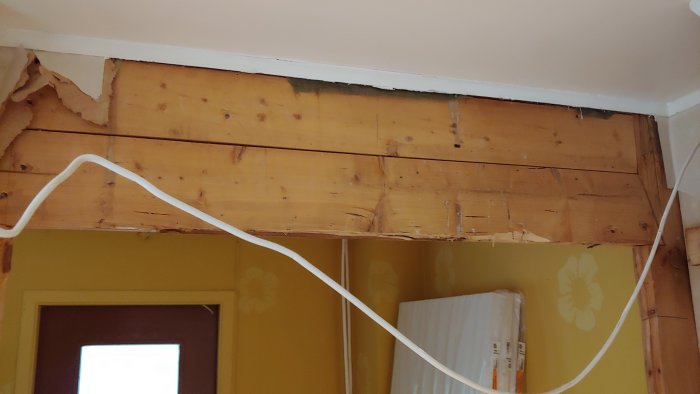
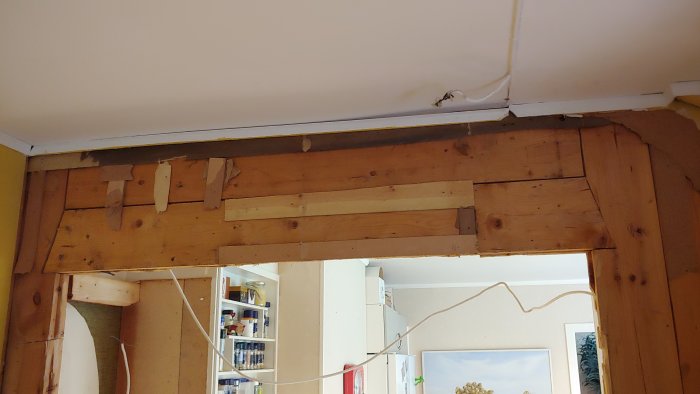
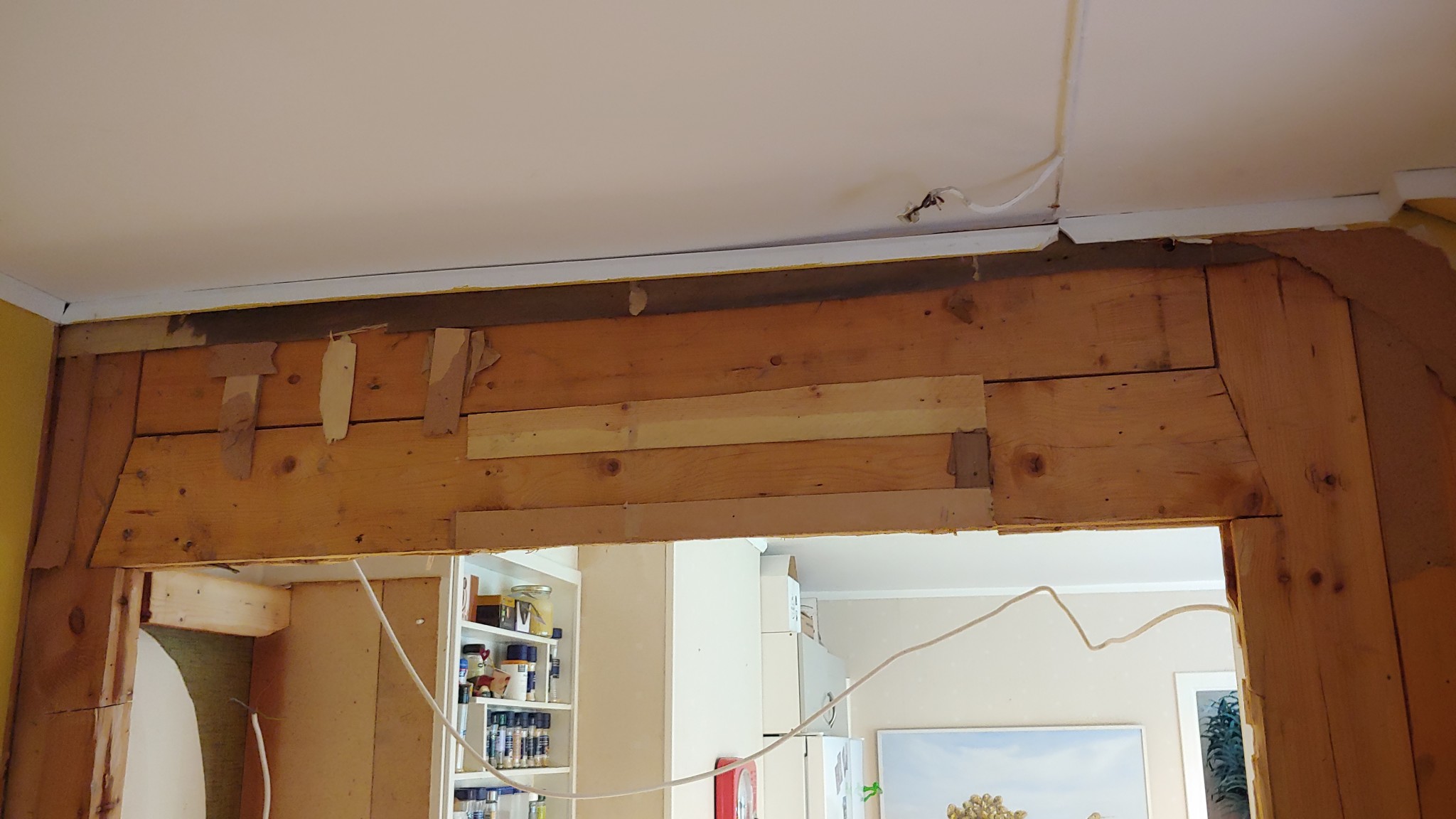
The wall between the kitchen and entrance has started to be torn down 170 cm (perpendicular to the marking on the drawing). There was previously a door opening that I have now widened. As the other two pictures show, there are two horizontal tongue and groove boards there. I was quite sure that the wall is not load-bearing but became uncertain with these horizontal planks. Or is that how a door opening was built into a plank wall? I have seen pictures of other renovation projects where all the door openings have these planks with a "hook" above. Is it okay to remove these on my wall, so that I can have an opening all the way up to the ceiling, do you think?
Have you checked with the municipality if they have any drawings?
No. That thought hasn't occurred to me. Maybe it's worth a try.
But if you look at the drawing, it seems certain that the wall running through the living room and dining room is load-bearing, right? Are "side walls" also typically load-bearing?
A characteristic of a plank house is that it lacks the systematic construction that the transition to stud frames around 1950 enforced. Therefore, all walls can potentially be load-bearing and also have a stabilizing function. The lintel over the door opening in the picture is a standard solution found above all openings in plank walls, regardless of their function. It may also be the case that there is no floor beam above this lintel, and this task is performed by the upper part of the wall. The best tool for analyzing the structural system is an original drawing combined with studies of the joist directions. Realtor drawings like the one above are worthless to the point of being harmful. The best approach is not to create any large openings at all, but to accept that plank houses and open floor plans are not entirely compatible entities.
Typically, a plank house lacks the systematics in construction that the transition to frame structures around 1950 necessitated. Therefore, all walls can potentially be load-bearing and also have a stabilizing function. The beam above the door opening in the picture is a standard solution found above all openings in plank walls, regardless of their function. It may also be the case that there is no floor beam above this beam and that this task is fulfilled by the upper part of the wall. The best tool for analyzing the structural system is an original drawing combined with studies of the direction of the joists. Realtor drawings like the one above are worthless to the point of being harmful. The best is not to make any large openings at all but to accept that plank houses and open floor plans are not entirely compatible entities.
Thanks and bow for that answer. I will check with the municipality to see if there are any drawings; otherwise, it's probably safest to leave this as an "arch."
Click here to reply
Vi vill skicka notiser för ämnen du bevakar och händelser som berör dig.