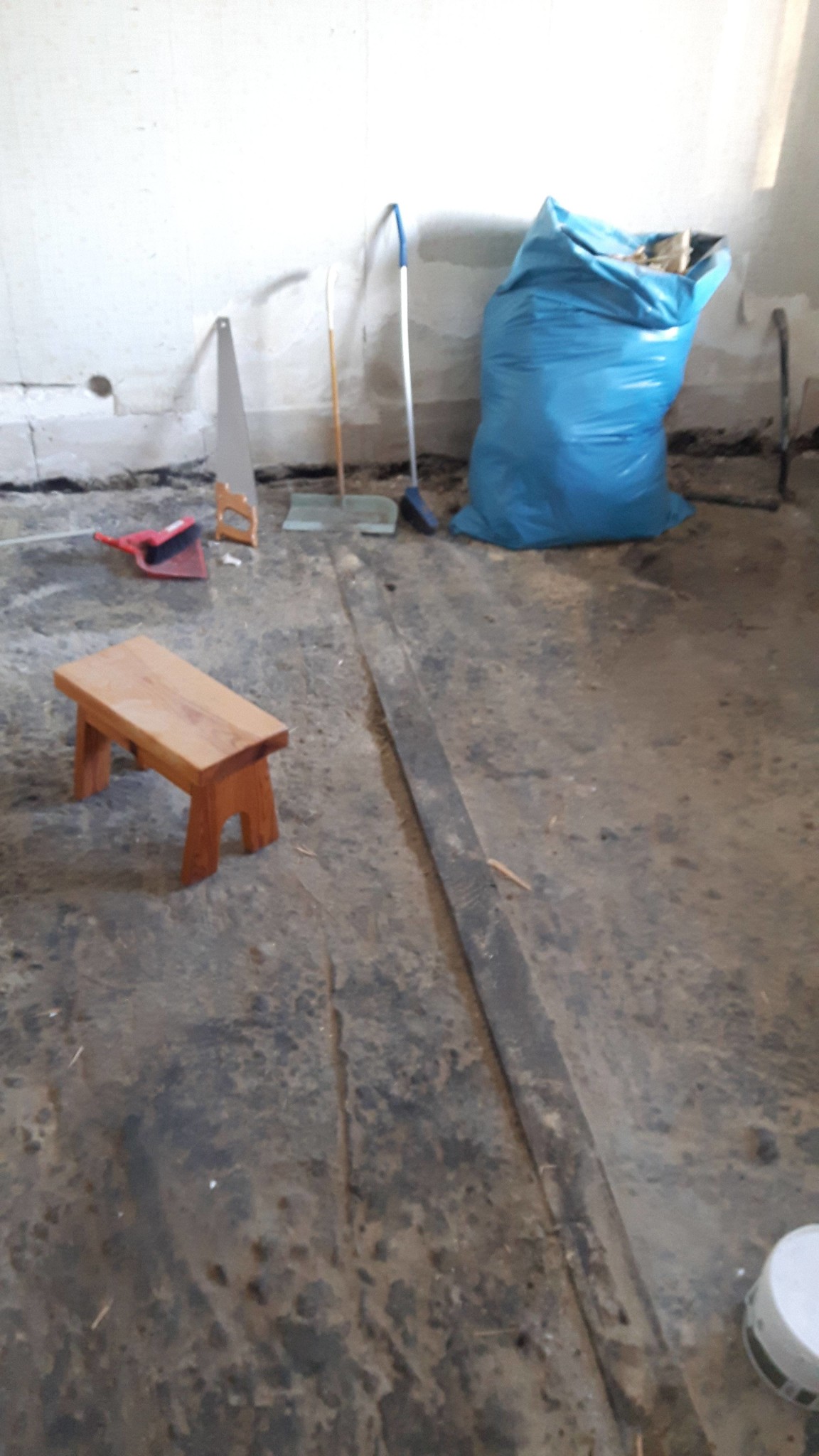
I wanted to ask what the gathered expertise suggests about this. I am lifting the raised wooden floor in the basement to replace the wooden joists resting on concrete with metal or another solution. When I finally lift the floor, I'm met with asphalt/tar covering the entire slab in the room! They have cast in 3 sills (I think that's the right name?) to level the floor (very sloppily cast and an enormous amount of tar, so it's very uneven overall). The idea is to chisel up the pressure-treated sills (which probably aren't doing well after over 50 years), but what should I do about the tar? There has been moisture before; you can see salt efflorescence at the bottom of the walls, along with plaster coming off in some places. I assume this is because the moisture couldn't pass through the slab due to the asphalt, so it has gone up into the walls instead.
I have done drainage, so it is much drier now, but I assume I should remove some of the tar at least? If you're going to self-level the slab, I assume you have to remove all the tar??
Tar, asphalt in that way is a moisture barrier and should be there to prevent the overlay from rotting, so there is nothing wrong with it. If you remove it and plan to install a new floor, you will need to install some other type of moisture barrier instead. The best is hot asphalt, but it is not commonly used in houses. It smokes quite a bit and smells bad for a while during installation and is hardly something you can do on your own.
Tar, asphalt in that way is a moisture barrier and should be there to prevent the overfloor from rotting, so there's nothing wrong with that. If you remove it and are going to lay a new floor, you will need to install a different type of moisture barrier instead.
The best is hot asphalt, but it's not commonly used in houses, it smokes a lot and smells bad for a while when applied and is hardly doable by oneself
This sounds strange to me, having a waterproofing layer on an uninsulated slab is generally classified as a risky construction, right? However, it's clear that any potential moisture that comes up should be ventilated, especially if you're going to lay wooden floors. Passive ventilation might be sufficient.
If I were to lay tiles, would I need to self-level, and if so, would I need to remove all the tar beforehand?
Had exactly the same problem, (though not with embedded studs). There are different solutions depending on what the room will be used for and what the expected final result is. Personally, I went with the "nivell variant," allowing the rough-cast and messy slab to remain as it was. However, if you're going to use self-levelling compound, I am very doubtful if cold asphalt is a good substrate. I would have opted for breaking up and insulating the slab and doing it right from the start if I were to redo the job with higher demands.
Had exactly the same problem, (though not with embedded sill beams). There are different solutions depending on what the room will be used for and what final result is expected. I went with the "nivell variant" and let the rough-cast and smeared floor slab be as it was. But if you are going to use self-leveling compound, I am very doubtful that it's a good base with cutback adhesive, I would have chosen to break up and insulate the slab and do it right from the start if I were to do the job again with higher requirements.
With or without mechanical ventilation under the floor? Did everything turn out well, no smell?
I drove without active ventilation, thought it was enough with ventilated baseboards. No noticeable smell, there was significantly more smell before when there was fiberglass insulation. Removed all insulation, there is a certain "empty" sound as a disadvantage, but I'd rather have that than how it was. There are certainly several improvements I would have made if I started over. But I'll take that on the next occasion.
I thought the leveling system was too expensive, so I went with my own variant that's reasonably okay. Showing a picture of the adjustment screw below. It's basically a machine foot with an M8 thread (+ drive-in nut in the beam), it was quite cheap if you ordered 500 pcs. C/C400mm between all "feet," and a few extra lag bolts here and there (in old drill holes).
Improvement measures:
-more bracing of the framework between beams, like a truss
-some type of insulating board attached between beams (reducing footstep noise)
-use threading tape on the screws for tighter adjustment, (some minor noise may occur now)
Thanks for the detailed answer! I'm leaning towards "taking a chance" with passive ventilation. I think I'll go with something like a Platon mat at the bottom and pulling it up over the intended floor, laying insulation on the Platon mat, and then frame it to adjust the height and level differences. Then ventilate through skirting boards just like you described. Does that sound sensible?
Platonmat is well-proven for this purpose so I don't think there are any issues. But you should first clean the slab thoroughly and chip away embedded beams and fill these holes with concrete, A-mortar or similar. Maybe someone with Platonmat in their basement can provide additional information to consider?
Click here to reply
Vi vill skicka notiser för ämnen du bevakar och händelser som berör dig.