This question has been asked before, but I'm not getting the details I need to understand.
My house from '36 consists of plank walls on a basement foundation, 1 ½ floors. I want to make an opening, 150 cm, in a load-bearing exterior wall. No windows in the immediate vicinity. The question is how I can/need to relieve the opening.
The neighbor, whose house was built at the same time, tore down his facade last year and it showed that the floor joists between the floors rested directly on the plank wall, i.e., no horizontal beam, so I assume it's the same for my house.
I guess I therefore need to relieve before I start sawing. But how? Notching and embedding are usually the recommendations, but what does that mean in practice? And does it have to be done from both sides? The facade consists of asbestos cement on old paneling, so I can open that up, but inside it has been renovated, so I would like to keep the damage there as low as possible.
Or make the hole + space for posts and embed a beam in these? Meanwhile, relieve with props in the ceiling to support the floor joists? The plank wall is nailed at an angle so it should hold together well.
Do you have a picture of the section/facade/house?
The load-bearing beam (or equivalent) depends on the weight it needs to support. For instance, if a roof truss descends in the middle of the span, it will carry a certain load. Are there any load-bearing/stiffening interior walls nearby?
If the loads are moderate, you might, for example, nail a 2"x8" onto the plank wall above the opening. Or partially recess a 4"x8", etc.
The load should be distributed to the wall beside it, so reinforcing the outermost planks for greater stiffness might be appropriate.
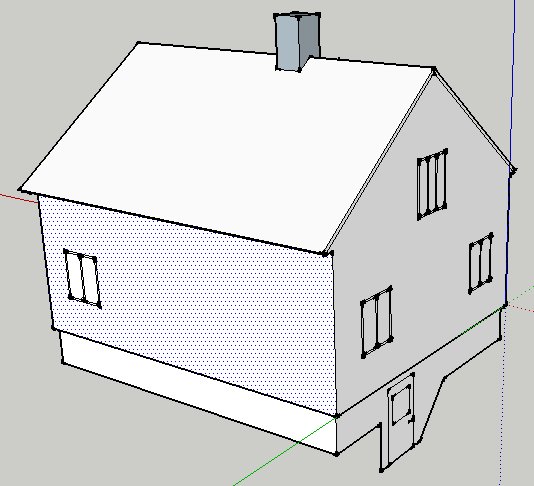
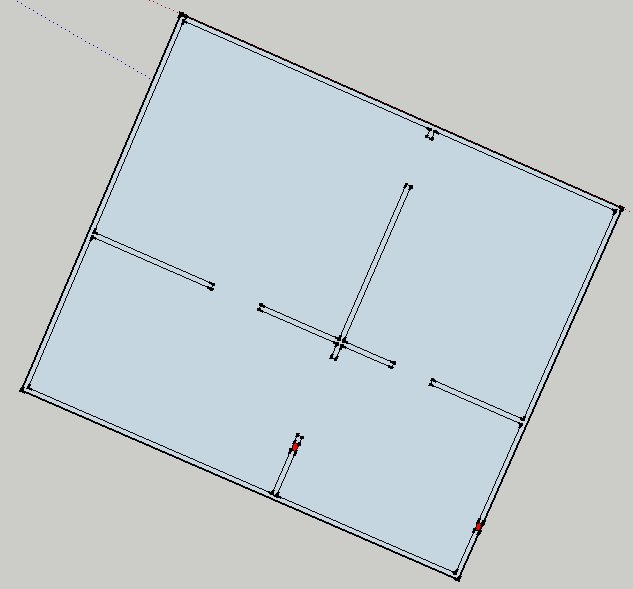
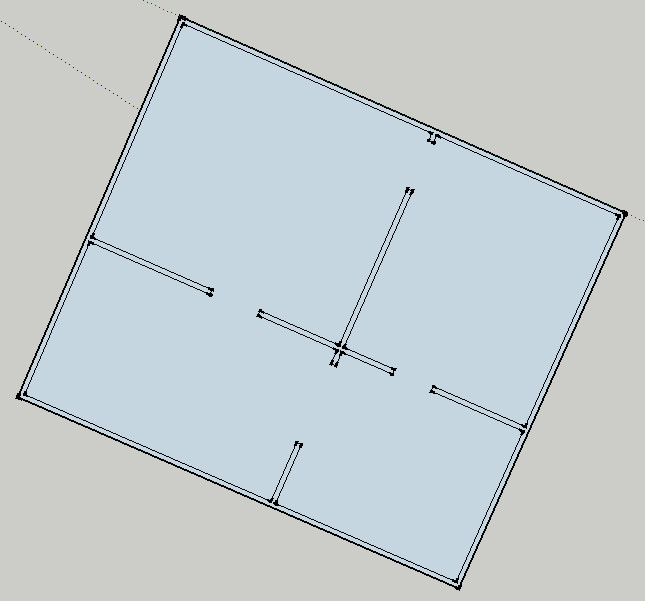
Thank you for the reply. I made a simplified sketch in SketchUp. The intended opening is where it looks like something is missing. That's where we have our dining room, and it would be nice to get more light and possibly also build an outdoor room there. There will probably be at least one roof truss over the intended opening.
The room above the dining room is the master bedroom. There used to be a wall where the roof trusses rested (attic space behind). This is gone and relieved with a glulam beam so the force goes down into the gable wall and the inner wall, both resting on the basement wall. Marked in red on the picture.
How do you best fit a plank? Can it be enough to do it from the outside?
How is it best to recess a plank? Can it be enough to do it from the outside?
It should be enough to do it from one side (e.g., the outside).
How thick are the planks in the wall?
If they are e.g., 3", then it might be reasonable to recess a stud/beam 1" so you have 2" left to nail/screw into.
Does that recess really add that much extra to the load-bearing capacity? After all, it's a bit of a hassle to remove 2-3 cm of material from an existing wall.
How do you get the rule itself to take the load if it's on the outside, just through the screws?
Isn't it possible to prop up in the basement and then the floor where you want to make a hole in the wall? And then "just" cut out above the opening and extend it 50cm on each side and place a glulam beam there on the standing plank (calculated by something like Moelven's program) or a steel beam calculated by someone knowledgeable.
Or can't you place something up in the rafters in the old attic, like making a hole in the wall and sliding in a glulam beam that distributes the load on the surrounding rafters?
I chose to install new posts because the existing wall consists of modules that mostly contain sawdust. If you have a plank wall, you can use it, but it's probably easier to expand the opening a bit and install new posts.
My opening already existed (old outer wall) but lacked a beam to support the roof truss that rests in the middle of the opening.
No idea about dimension. I have the opportunity to buy glulam 42 x 180 quite cheaply. Will it be too weak? I'm only thinking of covering 1.5 meters and it's a tongue and groove nailed plank wall.
I used 90x225 on a 2.5m span. I would definitely use glulam and I would not go down in size from what I've used. When you are unsure, you should over-dimension. My beam seems correct in size as it has shown the expected deflection after a few years in place.
Talked to a carpenter over the weekend who thought glulam was overkill. The new suggestion was to screw and glue together 2 45x195.
A side question but oh so relevant: I suspect I won't have time to cut the hole and install the door in the same day. Any tips on covering up so I don't wake up to frost on the kitchen table in the morning?