Questions .:
- Which courses should be reinforced?
- Is treated bistål required (in background 1 and 2 below)?
- Does the wall need to be reinforced in any way other than reinforcement?
Description
Since 12m x 8mm reinforcing bars can be used, waste is reduced by 1m/joint by using regular reinforcing bars instead of bistål. My concern is what difference in strength/function there is between 4mm bistål and 8mm reinforcing bars. When I google around, I realize that there are different strategies on how reinforcement in walls/retaining walls should be solved. This has led to uncertainty about the task of the reinforcement and the choice of reinforcement (in these cases below - background 1 and 2).
Some claim that earth pressure is the problem.
- But the only earth pressure that can arise is during backfilling (as I see it).
Once the soil is restored, the pressure against the wall will not change or be that large. Even if a vehicle is driven "close" to the wall, the load on the wall/retaining wall will not change significantly (as I see it).
e.g. A car exerts pressure directly downward at 4 points, with the same load as maybe 1m3 of sand.
That it could press the sand sideways against the wall doesn't feel correct.
Everyone recommends - Reinforce the bottom and top course. (I think that is correct)
Between the top and bottom course, the recommendation varies - every third course, every other course, or every course.
Some claim that it must be treated bistål (untreated is not sufficient).
Others suggest that 4mm bistål is required. In my cases below, 8mm reinforcing bars are not sufficient.
There are also recommendations to place stainless bistål, angled out from the wall to a stone - to further stabilize the wall. (such a solution would significantly complicate the insulation outside the wall)
Background 1
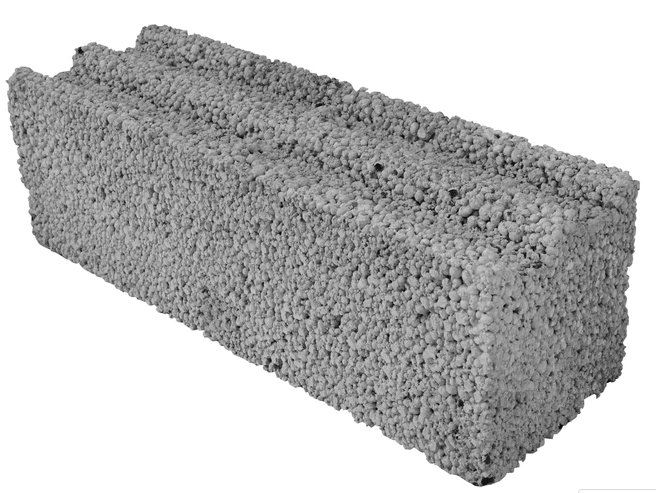
Planning to build an 8m long basement wall (built with 190x190x590mm Lecablocks), to be placed on a ground beam (400 x 250mm) - the ground beam will be reinforced with 7 pcs of 12mm reinforcing bars and supported by a - type husbygel. The wall will be about 1600mm below ground and insulated on the outside with a drainage board (e.g. Pordrän). This probably means that the built wall will be quite dry. Outside the insulation, it will be filled primarily with sand.
The wall will be loaded with several 1000kg and in the middle, a 4m long HEA160 will be placed to another wall.
Background 2
Also planning a retaining wall with the same type of Lecablocks (4m long - about 1800mm below ground), it will also be insulated on the earth side with a drainage board. (to keep it drier) - The load on the retaining wall will not be large - possibly windows and a roof.
I recommend following the supplier's instructions regarding the type of reinforcement. In the basement wall, no stainless steel bistål is needed as you describe the conditions. However, I don't quite understand how it is intended, maybe you can upload some simple sketches? The support conditions are very important for masonry structures, so for the retaining wall, I would instead consider a concrete construction over masonry.
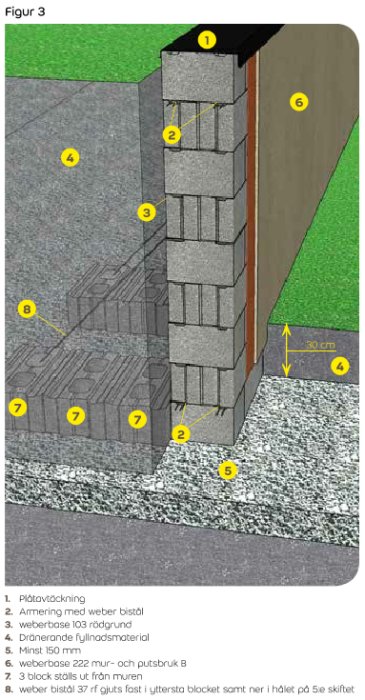
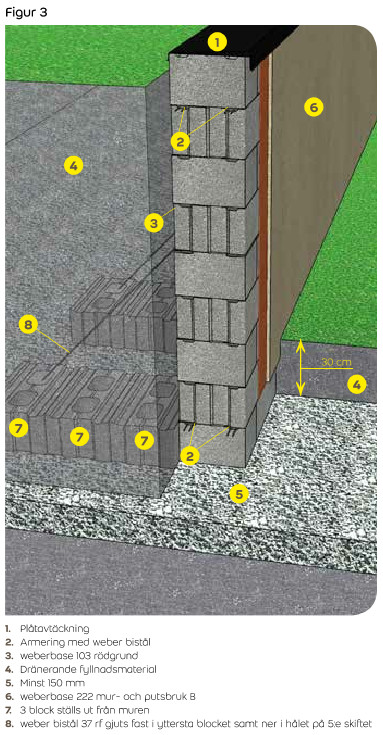
1) There are no direct guidelines at all for my case from Weber / Finja. The closest I found "To strengthen and stabilize the masonry, it can be reinforced. The reinforcement is placed between the first and second courses and between the second last and last courses. Normally reinforced between every third course as well as over and under openings." Ref.: Weber
They also don't have an example with "ordinary" rebar. (to compare potential strength with bistål.)
For me, bistål would be about 2.5 times more expensive (with the same amount of reinforcement)
2) There is no one (as far as I know) who designs the foundation as I have ("it should hold" / be intact no matter what happens)
The reason I plan an unusually wide foundation beam is to
a) Reduce ground pressure from the wall/house to the ground
b) Not easy to build a mold for the foundation beam that becomes "exactly" under the sill of the house above.
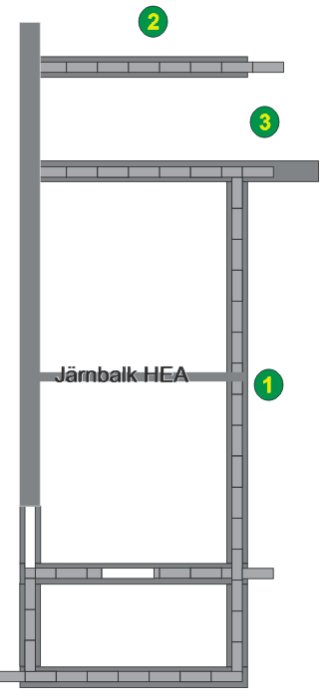
3) To meet the request for a sketch, I have tried to create one (simple).
Area1 shows the placement of the wall at about 8m
Area2 shows where the retaining wall should be placed
Area3 shows a planned driveway (about 2m wide)
No land slopes towards the house (the wall) or the retaining wall. The only force from the side is some form of earth pressure. The sand (silt) I will backfill with outside the insulation. It has a slip angle of 0 degrees (due to various reasons).
I currently don't know what reinforcement would add for me - What force it would counteract in my case?
The closest "tip" I found from Weber garden walls is this suggestion.:
- Stainless steel Bistål from the 5th course into a "stone"
But that makes it impossible to insulate the wall, to keep it dry.
Choosing to build the wall with bricks instead of casting the retaining wall is a price issue - I believe it will be significantly cheaper to use bricks.
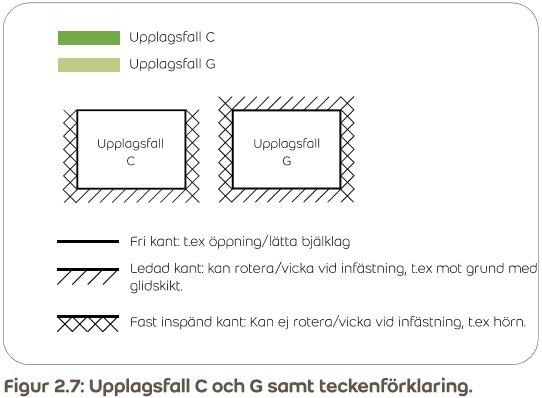
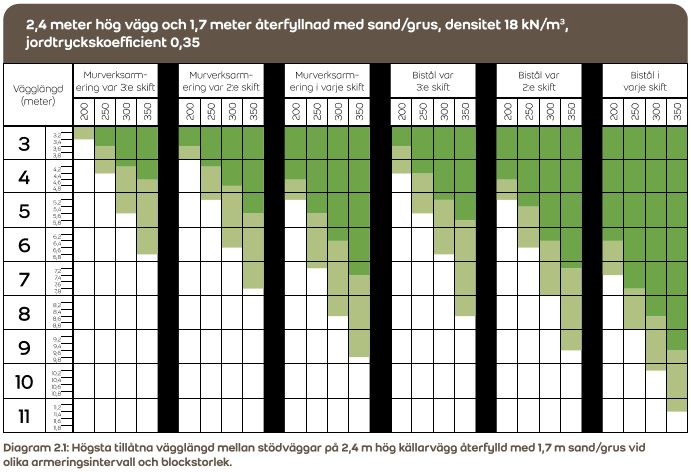
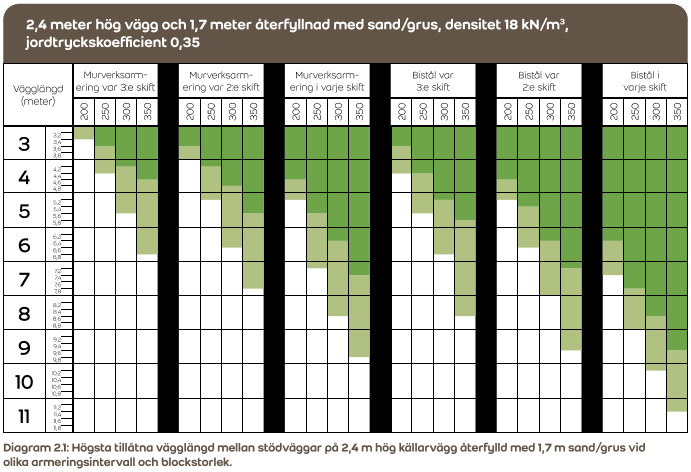
On page 11 and onwards, you will find some tables you can check out with different wall heights, wall blocks, support conditions, various backfill depths, and different backfill materials. https://www.se.weber/files/se/2020-11/projekteringsanvisning_leca_block.pdf
If you want to save on the amount of reinforcement steel, you can create suitable supports to reduce the moment in the wall. For example, you can cast a concrete column under the HEA beam and cast the top course in concrete. Assume that wall 1 is a gable wall with a wooden floor resting on the HEA beam.
Is there a floor on the retaining wall?
Another option is to revert to more suitable materials than silt as this exerts higher pressure on the wall than, for example, macadam.
Your thoughts on earth pressure are a little wrong. The earth pressure is constant and does not disappear after the filling phase. However, greater loads beyond the earth pressure may occur, for example, if the materials are compacted. Loads from vehicles are absolutely not negligible and should be taken into consideration.
Thank you for the reflections, but the questions remain...
Bbossespecial said:
On page 11 and onward you have some tables to look at with different wall heights, wall blocks, support conditions, different backfill depths, and different backfill materials. [link]
I have studied this table (which I initially thought was good) But - it is based on that the wall has no "foundation" or sulfoot, i.e., the foundation stone can "rock" (which my wall cannot do)
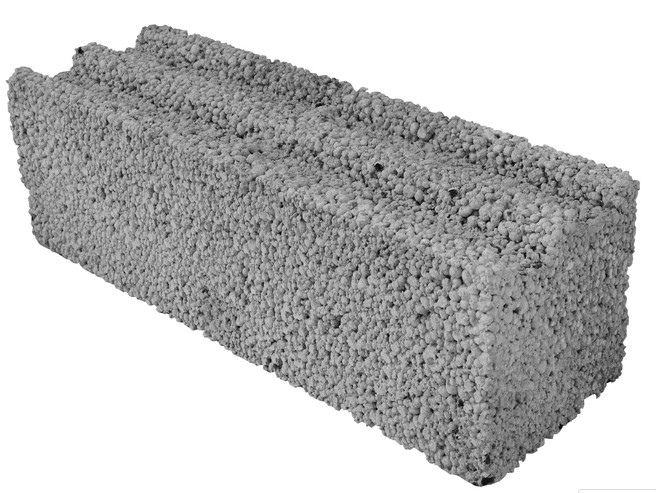
Now, the wall will not be built with Weber's stones but Finja's...
(with a different structure - Better or worse?)
The table that might be closest shows that I am working on an "impossible" project.
Not even 2 rebars in each layer would suffice.
If I start from the same "money," would 5 8mm reinforcement bars/layer be weaker than 2 rebars?
Bbossespecial said:
...create appropriate supports to reduce the moment in the wall...
Which moments are to be prevented? What is meant by "supports"?
Pouring a concrete pillar under the HEA beam is out of the question (then the HEA beam would not even need to be calculated)
Yep - "wall1" is a gable wall and will try to be "built" as compactly as possible under the sill (if that counts as a "floor structure" I do not know) - i.e., maintain the same level on the building that currently exists above the basement.
Bbossespecial said:
...Another option is to backfill with more suitable materials than silt as this exerts a higher pressure on the wall than, for example, macadam....
How can it do that?
Bbossespecial said:
The earth pressure is constant and does not disappear after the backfill phase. However, greater loads can arise beyond the earth pressure, for example, if the masses are compacted. Loads from vehicles are absolutely not negligible but something that should be considered.
Absolutely, the earth pressure is constant, but for the earth pressure to increase, doesn't something have to move?
Assume the density of silt is about 20kN/m3 - which some tons of vertical pressure will not add so much horizontal pressure. (percentage-wise) - that is my feeling.
Feel free to sketch a section through the building to simplify understanding the whole. Your "sula" is the support at the bottom. I assume you're going to build a wall on this? Your wall won't be able to transfer moments to your "sula" since this meeting can be considered as hinged. If the stones have the same strength and you use mortar and reinforcement of the same strength as weber, you can go by the table.
A support is what resists, the legs are the table top's support. The more supports, the fewer bending moments occur in the masonry wall due to earth pressure. A column is a vertical load-bearing structure and a beam is a horizontal load-bearing structure.
Since it is a gable, you reinforce and cast the top layer. This then becomes a horizontal concrete beam that braces the wall at the top. The concrete beam is in turn braced by the transverse walls and the HEA beam. It is important that the HEA beam is assembled with the floor joists.
Silt has a larger earth pressure coefficient than "makadam" and about the same density, therefore greater earth pressure. Earth pressure increases linearly with depth and is ~40% of the earth's weight (depends on soil material, of course).
Assuming you are going to brick on this? Your wall won't be able to transfer moments to your foundation as this joint can be seen as hinged.
No, it will be cast!
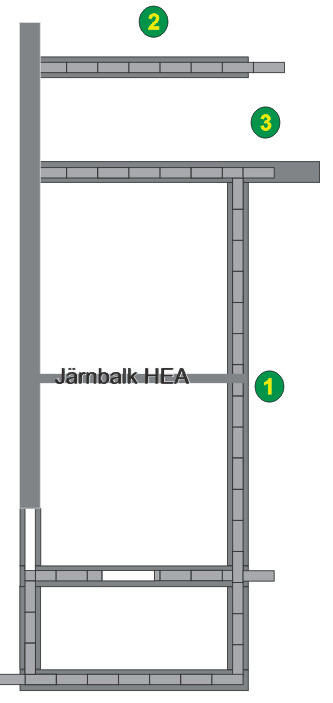
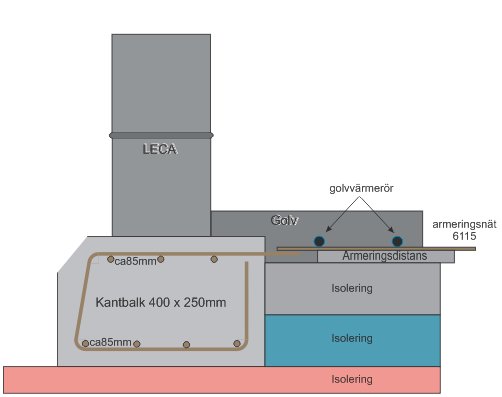
(the same sketch - not to scale - will probably be used for both wall and retaining wall)
The reinforcement (7 pieces) drawn in the edge beam is 12mm while the villa stirrup (which holds together the floor and edge beam) is 8mm and the reinforcement mesh in the floor is 6mm. In this case, there is 250mm insulation (with good lambda).
What is not visible in the sketch is that vertical "dowels" of reinforcing steel will be drilled into the edge beam to lock the bottom course.
Bbossespecial said:
Since it is a gable, you reinforce and cast the top layer.
Sounds simple, but since it is a house above - I won't succeed with the casting. However, I have the possibility for 8m (max 12m) long reinforcing bars (i.e. without joints).
Bbossespecial said:
... It is important that the HEA beam is connected to the floor joists...
How is this done? My plan is that the existing sill should just rest on the HEA beam (with sill paper between the beam and the sill) and it should also "just rest on the wall" - the outside of the Leca block - level with the outer sill edge - Preferably not all the way out = thermal bridge - The other wall is made of hollow bricks.
Bbossespecial said:
Silt has a larger earth pressure coefficient than macadam And roughly the same density, hence greater earth pressure. Earth pressure increases linearly with depth and is ~40% of the earth's weight (depends on soil material of course)
I'm trying to understand what you're writing - but don't fully get it.
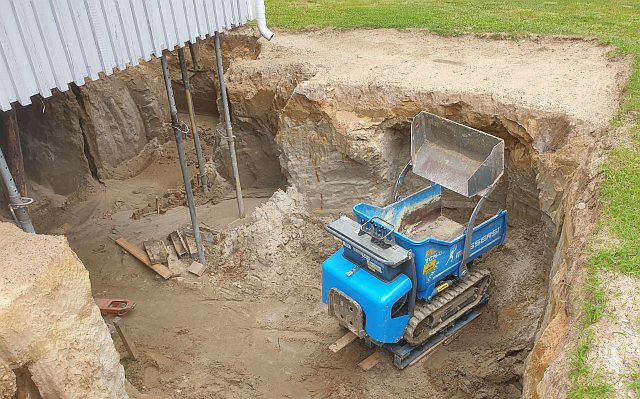
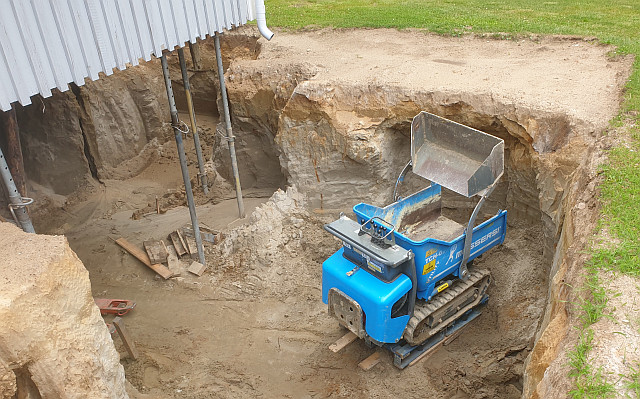
If you look at the picture I sent of the "excavation" - when I walk on the ground - what vertical pressure will the soil exert laterally? In some places, it is so compact that the spade has difficulty penetrating. (the wall you see will not change other than by "downpour" - Then the sand (which resembles flour in a dry state) will follow due to the slope - But if there is no slope, the "sand" will remain still.
My type of soil forms so-called false cohesion (sgi Geoteknik) There are definitely limitations - but the pressure is very evenly distributed (compared to stone and coarser particles).
But right now I feel we are "drifting from the subject."
One of my questions is - How strong is ordinary reinforcement (8mm) compared to 4mm round bar.
The other question - Is it stronger with reinforcement in every course, or is it just marginal?
(i.e., how much reinforcement should I buy?)
off topic.: This is really a drainage project - Couldn't drain with geotextile and regular drainage pipes. I placed a stretched geotextile over a bucket, on the geotextile I placed my sand - then poured water on the sand - not a drop came into the bucket... For me, geotextile or construction plastic has given the same result.
I chose another solution. The groundwater level changes quite a bit (around a meter I have measured).
It looks in the sketch as if the slab is also cast against the stone. In that case, you can skip the dowels since the slab acts as a counterhold. What you need to ensure is that the gable wall has support at the top if it is even possible to execute. If you remove/reduce the reason for needing reinforcement, you also save money as the amount of reinforcement decreases. Bi-steel and reinforcing bars anchor the force in different ways. I would avoid common iron since the thickness of the mortar is so small, there is nothing for the bar to grip onto. So you waste a lot of area relative to what can be anchored. If you have decided that no earth pressure will occur on the wall, then there is really no reason for reinforcement either.
Click here to reply
Vi vill skicka notiser för ämnen du bevakar och händelser som berör dig.