

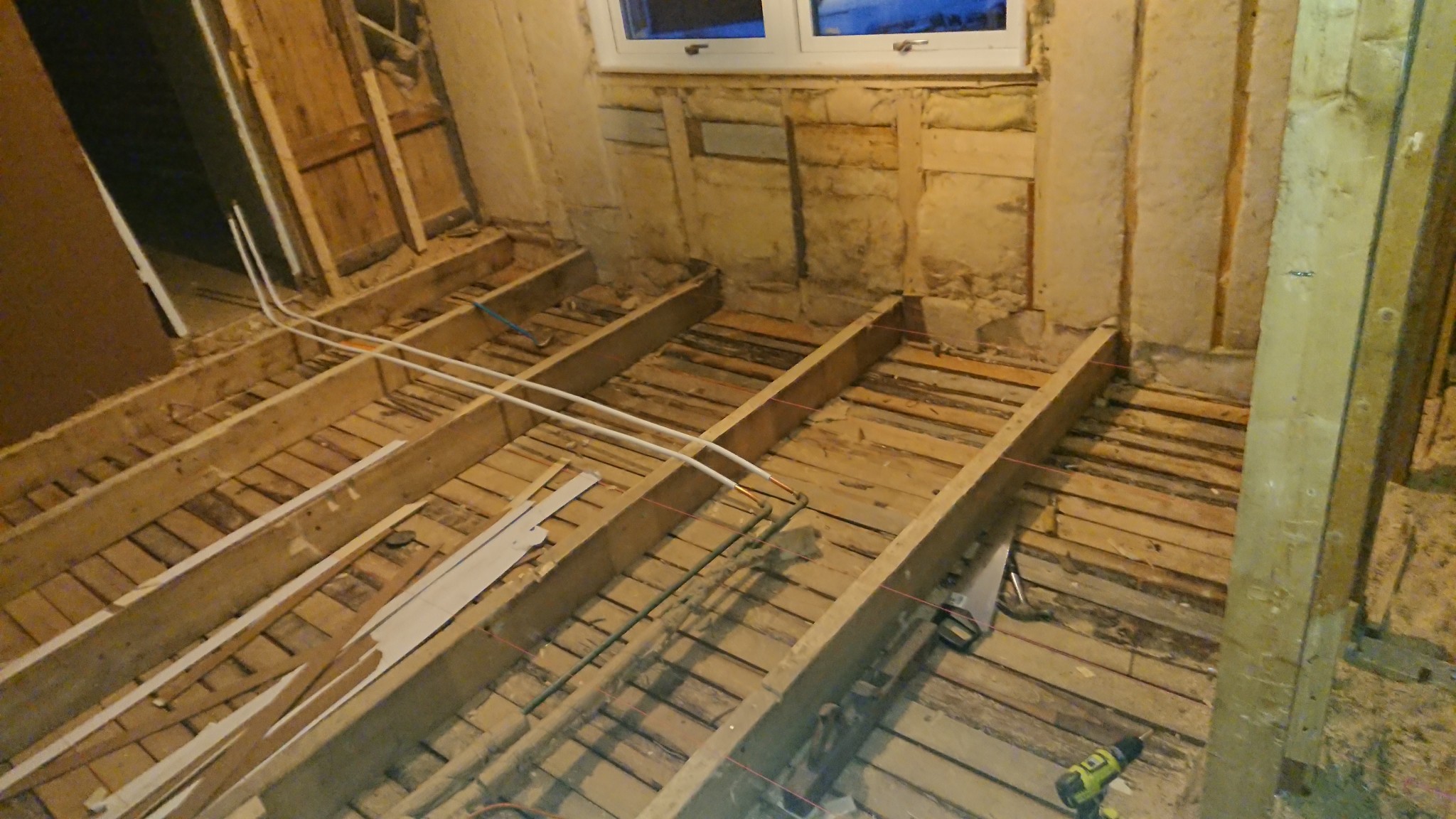
Hello! I'm planning to build a new bathroom and first need to fix the joists. It's my first major renovation.
The house is from 1924, and the beams measure 60x195mm. They have been planed down from 220mm at some point, resulting in a rather "rough" finish with many irregularities. Some beams are a bit warped, and the height also varies between the beams.
The center-to-center measurements vary between 69cm and 98cm. The span is 4m.
I'm thinking the best approach would be to screw-glue a 45x195 on the side of the existing beam to reinforce it and let it protrude slightly above the edge to achieve an even height. Then, add cross braces near the ends for lateral stability.
I then thought of reducing the center-to-center measurement with another 45x195mm rafter in between, making the center-to-center between 29.25cm and 43.75cm.
I don't have standard measurements for the joists, so I can't find any table to see if this would provide sufficient stiffness for the joists. Do I perhaps need to go below center-to-center 30?
What do you think?
Or is there perhaps a better solution?
On top, I plan to have water-based underfloor heating and tiles. I'm not sure what the best solution for that is either. Routed chipboard, plates + self-leveling compound?
The house is from 1924, and the beams measure 60x195mm. They have been planed down from 220mm at some point, resulting in a rather "rough" finish with many irregularities. Some beams are a bit warped, and the height also varies between the beams.
The center-to-center measurements vary between 69cm and 98cm. The span is 4m.
I'm thinking the best approach would be to screw-glue a 45x195 on the side of the existing beam to reinforce it and let it protrude slightly above the edge to achieve an even height. Then, add cross braces near the ends for lateral stability.
I then thought of reducing the center-to-center measurement with another 45x195mm rafter in between, making the center-to-center between 29.25cm and 43.75cm.
I don't have standard measurements for the joists, so I can't find any table to see if this would provide sufficient stiffness for the joists. Do I perhaps need to go below center-to-center 30?
What do you think?
Or is there perhaps a better solution?
On top, I plan to have water-based underfloor heating and tiles. I'm not sure what the best solution for that is either. Routed chipboard, plates + self-leveling compound?
In our extended upper floor, we have a span of about 390 cm with studs 45x220 at c/c 300 mm, and then noggings in between (also c/c 300 mm which is extremely excessive...)
On top of that, there is glued and screwed floor chipboard and finally a floor gypsum before the reinforced leveling compound with 12 mm underfloor heating pipes and tile on top.
Our constructor was particular that c/c 300 mm was sufficient for that span and the stud dimension if you glued and screwed floor chipboard on it.
Then it was our craftsmen who added extra floor gypsum and set the noggings at the same c/c as the studs.
It has worked well so far (2 years).
I would calculate what deflection your 195-studs provide and then perhaps add new ones in between to bring the c/c measurement as close to 300 mm as possible. I don't know if gluing and screwing one on the existing stud is necessary, possibly to get a straight top edge if they are uneven.
On top of that, there is glued and screwed floor chipboard and finally a floor gypsum before the reinforced leveling compound with 12 mm underfloor heating pipes and tile on top.
Our constructor was particular that c/c 300 mm was sufficient for that span and the stud dimension if you glued and screwed floor chipboard on it.
Then it was our craftsmen who added extra floor gypsum and set the noggings at the same c/c as the studs.
It has worked well so far (2 years).
I would calculate what deflection your 195-studs provide and then perhaps add new ones in between to bring the c/c measurement as close to 300 mm as possible. I don't know if gluing and screwing one on the existing stud is necessary, possibly to get a straight top edge if they are uneven.

There are several aspects to consider when designing floor joists. Partly, there's the total load, and partly there's the deflection, which doesn't necessarily correlate with load capacity. Then there's the load-bearing capacity of the flooring material (what is placed on top of the joists). Deflection is usually the biggest issue because the limitations are greater. Your idea of screw-gluing a 45x195 beam alongside the existing joists is an excellent thought. Together with a screw-glued floorboard, it provides an acceptable deflection. However, it is not ideal to combine it with a regular 45x195 beam in the middle of the sections. The effect then is a floor where the deflection is OK on every other beam and too high on the others. If you want to use that principle for a solution, you must use glulam in the middle of the sections. For instance, 115x180, mounted flush with the other floor joists. An alternative is to use even stronger glulam in the middle of the sections, such as 115x225, ignore reinforcing the old joists, and combine it with a stronger subfloor capable of spanning 1 m, such as 24 mm k-plywood.
J justusandersson said:There are several aspects to consider when sizing joists. Firstly, there's the total load, and secondly, the deflection, which doesn't necessarily correlate with load capacity. Then there's the load-bearing capacity of the flooring material (what's on top of the joists). Deflection is usually the biggest issue because the limitations are greater. Your idea of screwing and gluing a 45x195 beam next to the existing joists is an excellent thought. Together with a screwed and glued flooring board, it provides acceptable deflection. However, it's not great to combine that with a regular 45x195 beam in the middle of the spans. The effect will be a floor where the deflection is OK on every other joist and too high on every other one. If you want to use that principle for a solution, you must use glulam in the middle of the spans. Suggestively, 115x180 mounted flush with the other floor joists. An alternative is to use even stronger glulam in the middle of the spans, e.g., 115x225, ignore reinforcing the old joists, and combine it with a stronger top floor that can handle a 1 m span, e.g., 24 mm k-plywood.
Okay, interesting!
So if I understood the last alternative correctly, I can reinforce the joists as I planned and combine it with 24mm k plywood, which provides sufficient stiffness without reducing the center-to-center measurement?
Yes.
Click here to reply