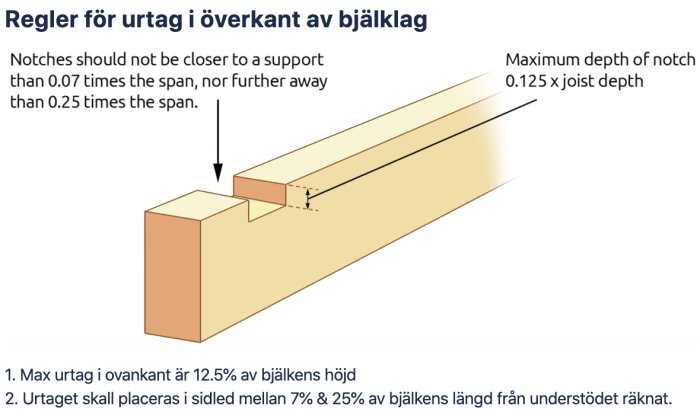
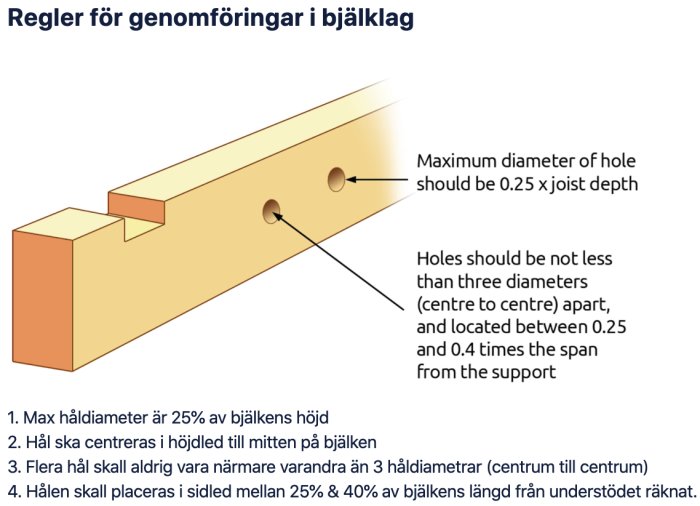
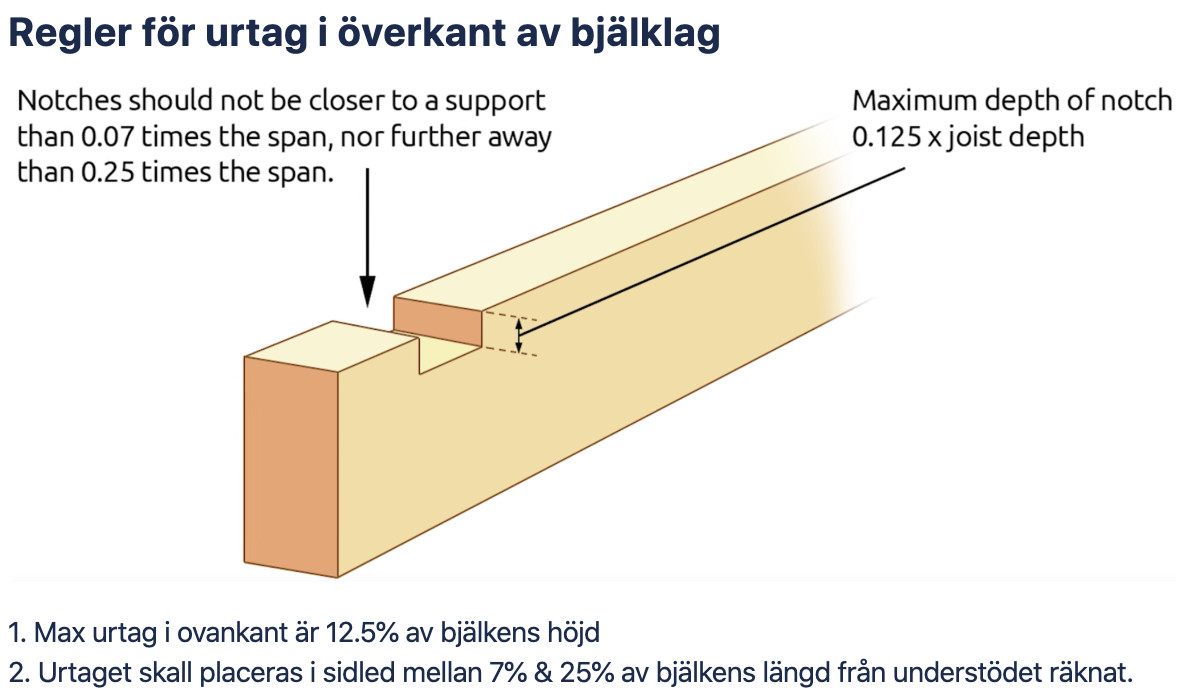
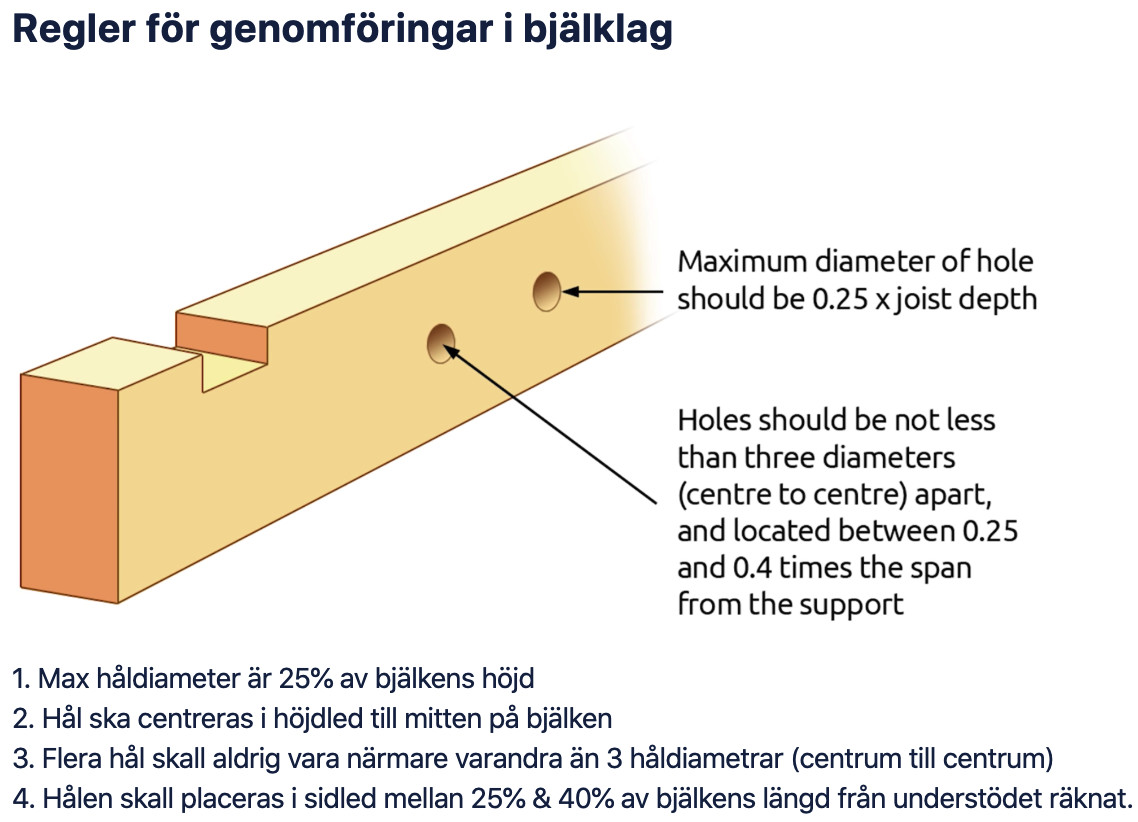
There are many thoughts about how and what one is allowed to do in load-bearing structures. I have found American & British regulations, but I wonder if there are equally clear (and generalizing) rules to rely on in Sweden?
The source of these regulations I have only found in the PDF file that I attach to this post.
If you Google and YouTube around, there are many foreign carpenters/electricians/plumbers who refer to these very rules, for example this one and this one. YouTube search for "joist hole" (joist = bjälke) and you'll find more examples.
Presumably, this type of general rule should depend on the type/quality of wood, etc., but it would still be interesting to see if equivalent guidelines are formalized in Sweden and if so, if they differ.
In Sweden, Eurocode 5 applies. Unfortunately, Eurocode is not as easy to read and generalizing as the American standards, but if you know what you're looking for, it usually works out. For easier readability, you can also find some information in the Glulam Handbook.
They make a slight distinction regarding the size of the drilling. 0->20mm, 20->40mm, 40+mm. The text is not as clearly written as the US/UK version, but now that I've sat down and dissected what they say in detail, it feels like Eurocode 5 is a bit more lenient/allowing than the other UK/US regulations.
For example, the UK/US regulations allow the maximum hole diameter to be 25% of the beam's height, while Eurocode 5 states that 50% is okay.
Another example is that the UK/US regulations specify a length range with exact percentages (25%->40% of the beam's length) where drilling is allowed, while the Eurocode 5 version says: "not closer to the support than twice the height of the beam (≥ 2h) and not near the midsupport."
Overly clear rules can provide an apparent safety. I think one should consult someone knowledgeable in construction statics for each major hole-cutting. The situation in the USA, with much greater responsibility on the consultants, makes it difficult to compare.
Several times when I have hired both electricians and plumbers to make holes and notches in joists that I have built, they have no knowledge or interest in checking with experts on how to make approved notches in joists. Holes and notches are made haphazardly, leading to rework or me having to reinforce in the end.
Therefore, it would have been fantastic if there was an equivalent of the PocketGuide (see the PDF file in the post above) that one can refer to with Swedish regulations.
Then I understand your need for simple rules a bit better. I think you can use your own principles, such as: Never make cutouts in the upper and lower parts. All drilling should be done in the middle of beams, at a proper distance from the supports (i.e., ends) and the middle of the floor structure. Drilling should not be too close together and never have a larger diameter than 50 mm.
Many drillings are unnecessary and the result of poor planning. It's not only electricians and plumbers who are guilty, but above all architects who haven't considered the need for space for the routing of all installations.
Correctly sized floor joists in uncomplicated decking almost always have a dimension determined by the need for the floor to feel rigid, not flex when walked on, and not sag too much when loaded with the standard 200 kg/m2.
In these cases, it is not the strength that is the determining factor, which is why smaller holes are not usually so critical. Hence, these rules of thumb work well without much further consideration.
That's how it is... But one should be able to avoid many mistakes by using something like US/UK rules, or something like @justusandersson's reasoning in a formalized form.
The last time I hired an electrician, he took his 18mm drill (to pull a 16mm conduit) and drilled straight through the hanbjälken (which in this case is a supporting part of the truss roof construction) vertically. So the poor truss built from 45mm wide timber was suddenly almost halved.