
3,903 views ·
11 replies
4k views
11 replies
Reduced load-bearing capacity with "notching"?
Hello,
As a novice DIY builder with no direct previous experience in construction, I have embarked on building a roof with accompanying walls (two, one gable, and one long side à la carport solution) for a bicycle shed.
The roof will consist of 10mm polycarbonate panels and cover an area of approximately 2000mm x 1700mm. An existing shed exterior wall will act as a support beam, along with 3 cast piers on the opposite side/long side, which, with three beams (95x45), will support the roof extending from the shed outwards.
Trying to describe my question feels almost more difficult than the original issue.
Here's an attempt;
The image below is of another roof – to support the roof in the longitudinal direction, these beams are set with angle irons. For my new bicycle shed, I would prefer to avoid angle irons and instead "notch out" the three beams (95x45) (from the shed wall to each respective post) and place the longitudinal beams, as in the example attached image, (e.g., 45x45) in there.
I understand that notching out 95x45 affects the load-bearing capacity, but is it so much that one should refrain from my ideas of "notching out" to achieve a neater solution?
I live on the west coast, so extreme snow loads are not an issue.
Is it incoherent?! Do you understand?!
Grateful for any answers
As a novice DIY builder with no direct previous experience in construction, I have embarked on building a roof with accompanying walls (two, one gable, and one long side à la carport solution) for a bicycle shed.
The roof will consist of 10mm polycarbonate panels and cover an area of approximately 2000mm x 1700mm. An existing shed exterior wall will act as a support beam, along with 3 cast piers on the opposite side/long side, which, with three beams (95x45), will support the roof extending from the shed outwards.
Trying to describe my question feels almost more difficult than the original issue.
Here's an attempt;
The image below is of another roof – to support the roof in the longitudinal direction, these beams are set with angle irons. For my new bicycle shed, I would prefer to avoid angle irons and instead "notch out" the three beams (95x45) (from the shed wall to each respective post) and place the longitudinal beams, as in the example attached image, (e.g., 45x45) in there.
I understand that notching out 95x45 affects the load-bearing capacity, but is it so much that one should refrain from my ideas of "notching out" to achieve a neater solution?
I live on the west coast, so extreme snow loads are not an issue.
Is it incoherent?! Do you understand?!
Grateful for any answers
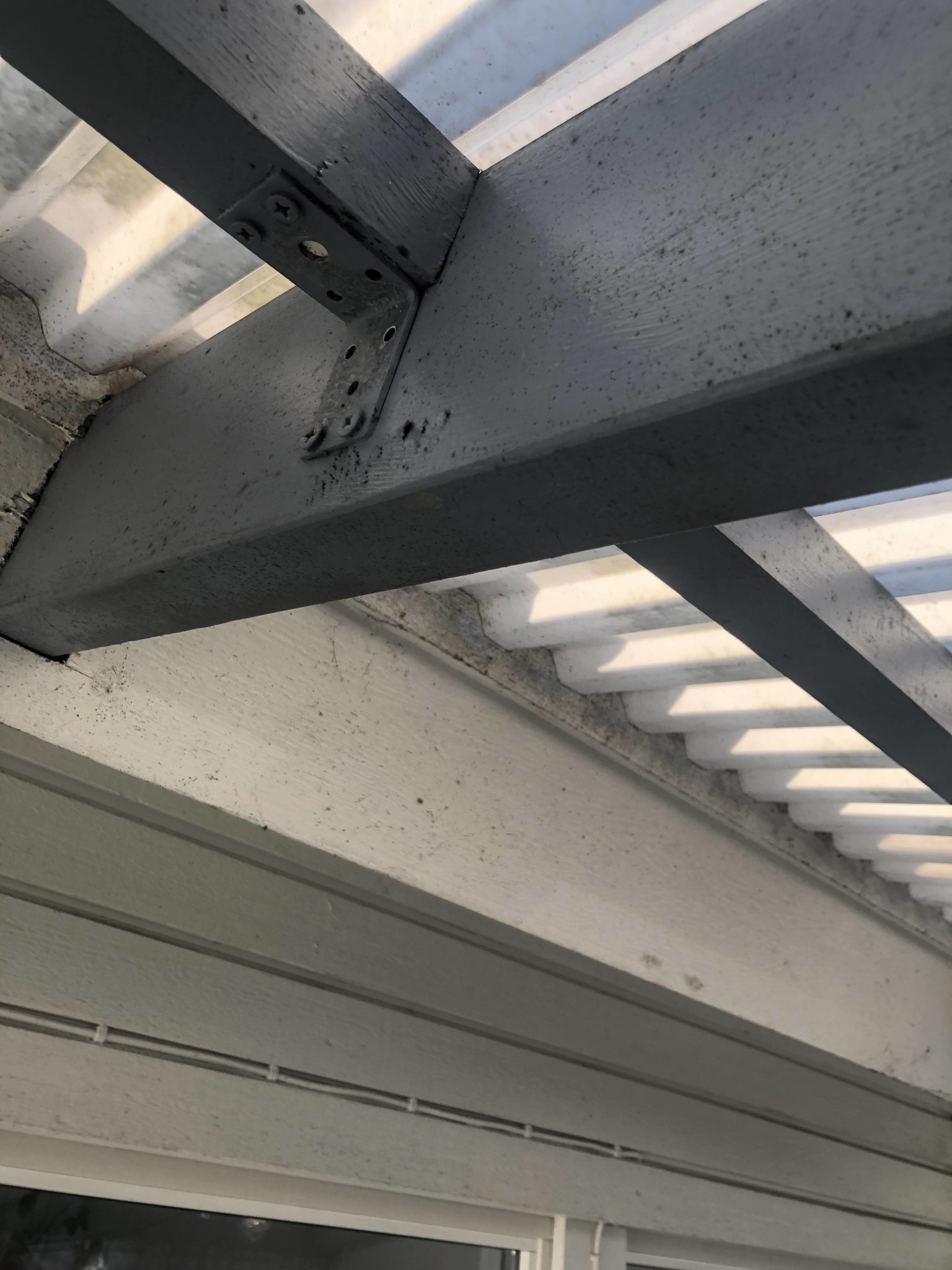
I don't think it's a good idea to unplug so much. If you have space, the easiest is probably to nail or screw battens on top of your 45x95 studs for the channel plastic to rest on.
If you notch out 45x45 from 90x45, you have 45 mm left. It is better to use 45x45 directly and avoid notching them.S seerikand said:Hi,
As a novice home builder without direct previous experience in construction, I have decided to build a roof with accompanying walls (two pieces, one gable and one long side à la carport solution) for a bicycle shed.
The roof will consist of 10mm channel plastic and an area of about 2000mm x 1700mm. It will be supported by an existing storage outer wall which will act as a carrying beam, and 3 cast plinths at the other end/long side with three beams (95x45) that will support the roof in the direction from the storage and outwards.
Attempting to describe my question feels almost more difficult than the original issue.
Here is an attempt;
The image below is of another roof - to support the roof in the longitudinal direction, these beams are set with angle brackets. For my new bicycle shed, I would preferably like to avoid using angle brackets and instead "notch out" the three beams (95x45) (from the storage wall to each concrete plinth) and place the longitudinal beams, as in the attached example image, (e.g., 45x45) there.
I understand that notching 95 x 45 affects the bearing capacity, but is it so much that one should refrain from my considerations of "notching out" to achieve a more attractive solution?
I live on the west coast so extreme amounts of snow are not an issue.
Is this confusing?! Do you understand?!
Grateful for answers
If the roof is 2 m wide, you can use 90x45 across instead.
Last edited:
After the notching, you can reinforce the beam with a screw to prevent it from cracking along the notch.S seerikand said:Hello,
As a novice home builder without prior construction experience, I have started building a roof with accompanying walls (two, one gable and one long side, à la carport solution) for a bicycle shed.
The roof will consist of 10mm panel plastic and an area of about 2000mm x 1700mm. It is an existing exterior shed wall that will act as a beam along with 3 cast plinths on the other end/long side which, with three beams (95x45), will support the roof in the direction from the shed outward.
Trying to describe my question feels almost harder than the original problem.
Here's an attempt;
The picture below is of another roof - to support the roof in the longitudinal direction, these beams are set with angle brackets. In my new bicycle shed, I would prefer to avoid angle brackets and instead "notch out" the three beams (95x45) (from the shed wall to each plinth) and place the longitudinal beams, as in the example attached image, (e.g., 45x45) there.
I understand that it affects the load-bearing capacity to notch out 95 x 45, but is it so significant that one should refrain from my thoughts about "notching out" to achieve a more aesthetic solution?
I live on the west coast, so extreme snow volumes are not an issue.
Is it vague?! Do you understand?!
Thankful for answers
Yes, now I was thinking about the practical handling. When you make a carpentry cutout, you won't get it completely perfect, and it will certainly be a little too much in some spot. And it only takes a small spot for it to determine the smallest measurement. But I edited my post, so the autists reading the thread can avoid discomfort.K Kane said:
Another option that looks nicer is to replace the angle bracket with one (or several) wooden pieces that are glued/screwed underneath and on the sides. Horizontal grain underneath and vertical grain on the sides, so three blocks for each transverse rule. With a miter saw, it becomes very quick to produce these wooden pieces. Pre-drill the holes so they don't crack during screwing (screwing is to keep everything in place while the glue cures/dries). Somehow, I am also bothered by angle brackets that make it look "cheap, sloppy, and inexpensive." When you replace their function with wooden blocks that fulfill the same function, it looks well-crafted and nice instead...
thank you for the good answer! Dumb question; horizontal/vertical grain...?!L Limpan4all said:Another alternative that looks nicer is to replace the angle bracket with one (or more) pieces of wood that are glued/screwed underneath and on the sides. Horizontal grain underneath and vertical grain on the sides, so three blocks for each crossbeam. With a miter saw, it goes really fast to produce these pieces of wood. Pre-drill the holes so they don't crack when screwing (the screwing is to keep everything in place while the glue cures/dries).
Somehow, I am also bothered by angle brackets, which make it look "cheap, sloppy, and low-quality."
When you replace their function with wooden blocks that fulfill the same function, it looks well-crafted and nice instead...
The pieces on either side of the transverse rule should have their grain direction vertically (standing grain). Whereas the one beneath the transverse should have its grain direction horizontally (lying grain).
Click here to reply
Similar threads
-
Bärighet invid vägg
Badrum -
Förlägga golvvärme utan försämrad bärighet och utan att höja 22mm
Värme allmänt -
Samfällighets gångväg 0,5m högre än trädgård vid tomtgräns, vems ansvar för gångvägens bärighet?
Juridik -
Does the load-bearing capacity of glulam deteriorate with many screws?
Building Materials and Construction Technology -
Försämrad isolering vid glipa taklist?
Frågor och svar om byggnation