It is not impossible, but rather it's more about the dimensions of the beam and whether the setup can handle the weight. However, more information is needed:
What type of roof is it? Slope?
What load is there on the floor structure?
Snow load zone?
The slope is around 45 degrees... The covering is eternit tiles.
We don't have any plans to have anything on the "2nd floor" but the plan is to have an insulated inner ceiling and plasterboard or maybe corrugated metal.
Snow load zone 2.0
Does it really look like you have drawn it? The green post neither adds to nor detracts from the durability of the truss in your drawing. It's not like the green posts are just put there to support a mezzanine that is full of old junk?
nah, there is no ceiling... I guess the horizontal one is there to hold the walls together so they don't collapse? and the post is probably there because it can't support its own weight over that span?
The horizontal bar is a low-hanging collar beam designed to prevent the walls from being pushed out. It might be too weak to support its own weight. In that case, it's easiest to replace it with a cable. If you want to create an intermediate floor that can be walked on, etc., due to the large span, some form of glulam construction is required. I don't think you should experiment too much with the old rafters, as the dimensions and quality can vary greatly.
If it's only on two roof trusses, and you don't need to use the loft, you could build a roof truss or a sturdy beam and place it lengthwise in the middle. From one load-bearing green post to another. That means instead of load-bearing posts underneath, there will be a load-bearing longitudinal beam on top that the crossbeams hang from.
A mid-floor that can be walked on is not relevant. A cable instead of the horizontal is an option, but would like to have a ceiling where the horizontal tie beam is, so hanging the self-weight in a cable from the ridge is more appealing.
Installing a beam under both rafters was, of course, the first thought, but unfortunately, the span becomes 12m, which is a bit long, and the beam becomes a bit too powerful.
I think you should dismiss the idea of using the existing roof trusses as support for a ceiling. The spans are too large in all directions. If you want a ceiling without pillars/walls underneath, you must build a beam system of glulam in combination with construction timber. Glulam beams at c/c 2.4 meters and spanning over 9 meters need to have a dimension of 90x360 mm just to support the dead weight of a floor deck.
I have been thinking a bit more....
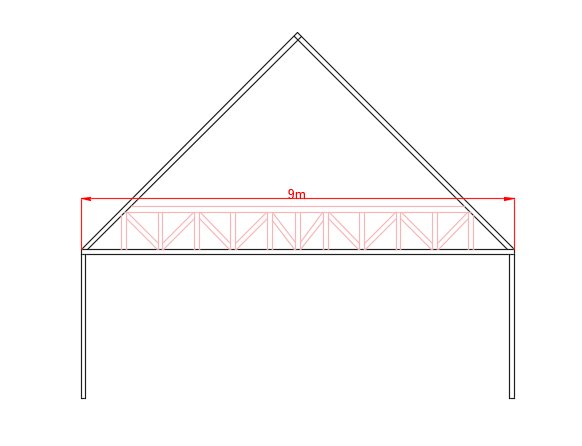
Just between these two roof trusses, I want the ceiling to be 1m higher to be able to use a car lift. My idea was to make a 1m high truss construction of the lower tie beam similar to this image. What do you think about that?
However you build, the construction should be self-supporting, i.e., it should not put a load on the existing truss. A car lift can manage well on an area that is 3x6 meters, right?
Vi vill skicka notiser för ämnen du bevakar och händelser som berör dig.