Is it necessary to have wind deflectors in combination with an air gap? It seems like you often only see an air gap in roofs?
Should the wind deflector be vertical down towards the wall plate and fit completely tight?
Is there a maximum angle on the vertical down towards the wall plate that the wind deflector must not exceed? I mean, can you set the wind deflector at a 90-degree angle to the wall plate, or does it block airflow up towards the ridge?
Should the wind deflector transition to the air gap, and should it be tight?
Is regular board sufficient material for the wind deflector?
Should there be an open gap at the top of the outer panel so that air from outside can easily move diagonally up through the wind deflector and air gap, or is ventilation sufficient even if the outer panel is "tight," note the quotes?
Besides directing wind away from insulation, is the task of the wind deflector to drive airflow upwards towards the ridge and prevent the airflow from stopping?
Is it necessary to have a wind deflector in combination with an air gap? It seems you often see just an air gap in roofs.
Should the wind deflector be vertically down toward the wall plate and fit completely tight?
Is there a maximum angle on the vertical down toward the wall plate that the wind deflector must not exceed? I mean, can the wind deflector be placed at a 90-degree angle to the wall plate, or does that block airflow up toward the ridge?
Should the wind deflector transition into an air gap and should it fit tightly?
Is regular board material sufficient for the wind deflector?
Should there be an open gap at the top edge of the outer panel so that air from outside can easily pass through diagonally up through the wind deflector and air gap, or is the ventilation sufficient even if the outer panel fits "tightly", note the quotation marks.
Besides diverting wind away from insulation, is the wind deflector's task to drive the airflow upward toward the ridge and prevent the air current from stopping?
Wind deflector/air gap go hand in hand, basically the same thing, you don't need to have a waxed cardboard if you don't want to, as you can meet with the wind barrier on the facade and the air gap depending on which wind barrier you use?
The wind deflector is a simple and convenient way since you don't need to be so meticulous with the wind barrier ending at the rafters.
Is it necessary to have wind deflectors in combination with an air gap? It seems often you only see an air gap in the roof?
Should the wind deflector be vertical down to the wall plate and completely sealed?
Is there a maximum angle on the vertical down to the wall plate that the wind deflector cannot exceed. I mean, can you set the wind deflector at a 90-degree angle to the wall plate or does it block the air flow up to the ridge?
Should the wind deflector transition to the air gap and should it be sealed completely?
Is a regular board sufficient as material for the wind deflector?
Should there be an open gap at the upper edge of the outer panel so air from outside can easily continue diagonally up through the wind deflector and air gap, or is the ventilation sufficient even if the outer panel "seals" tightly, note the quotation marks.
Besides directing the wind away from insulation, is the task of the wind deflector to drive the airflow upwards toward the ridge and prevent the airflow from stopping?
Yes, the panel should be released at least 22mm from the raw board/or the fabric you have.
I will respond with a few comments, someone correct me if necessary.
Janu78 said:
Wind deflector/air gap goes hand in hand, kind of the same thing
OK, so wind deflector and air gap can preferably be connected directly with each other.
is it possible to meet with the wind protection on the facade and the air gap depending on which wind protection you use?
Just so I understand correctly, it is possible to meet the air gap with the wind paper on the facade as an alternative to having a wind deflector. Now, since there is no wind paper on the facade/upstairs, which I plan to insulate, I assume I need a wind deflector.
The wind deflector is a simple and convenient way since you don't have to be so precise with the wind protection termination at the rafters.
OK, because it is mainly about deflecting the wind from insulation and directing it up to the air gap.
"Yes, the panel should be at least 22mm away from the sheathing/cloth you have."
I assume you are referring to the air gap? Not that there should be a gap out through the outer panel into the air gap?
I respond with a few comments, someone correct me if needed.
OK, so wind barriers and air gaps can advantageously be connected directly with each other.
Hhfkdkfvmsd said:
Yes
Just to make sure I understand correctly, it is possible to match the air gap with the wind paper on the facade as an alternative to having an air deflector. Now the wind paper is missing on the facade/upper floor I am going to insulate, so I assume I then need an air deflector.
Hhfkdkfvmsd said:
Yes, it will be easy for you to execute.
OK, because it is primarily about diverting the wind from the insulation and further up to the air gap.
Hhfkdkfvmsd said:
I assume you mean the air gap? Not that there should be a gap through the outer panel into the air gap?
Yes, there should be a gap so that air blows in from the outside.
Yes, there should be a gap to allow air to blow in from outside.
Ok! I completely missed that, is there any guideline on how large the gap should be, like the air gap should be at least 22mm, is it possible to say something similar for this gap at the top of the outer panel?
Do you want to place insect netting on the gap or does it interfere with airflow with a fine mesh net?
Ok! I completely missed that, is there any guideline on how large the gap should be, like the air gap should be at least 22mm, is it possible to say something similar for this gap at the top of the outer panel? Do you want to put an insect net over the gap or does a fine mesh net interfere with the airflow?
We usually have the air gap about 35mm, what kind of panel do you have? If you have a board and batten panel, you place the underboards first so they end about 22-30 mm from the rough sheathing, then you place a batten board, a board on the underboards between the rafters that all the batten boards connect to. Yes, you need an insect net; there are mosquito nets available at the building supply store.
We usually have the air gap about 35mm,
what kind of panel do you have? If you have a cover panel, you first place the underboards so that they end about 22-30 mm from the roofing board, then place a lock support, a board on the under boards between the rafters to which all cover boards connect.
Yes, you must have insect nets, there are mosquito nets available at the hardware store.
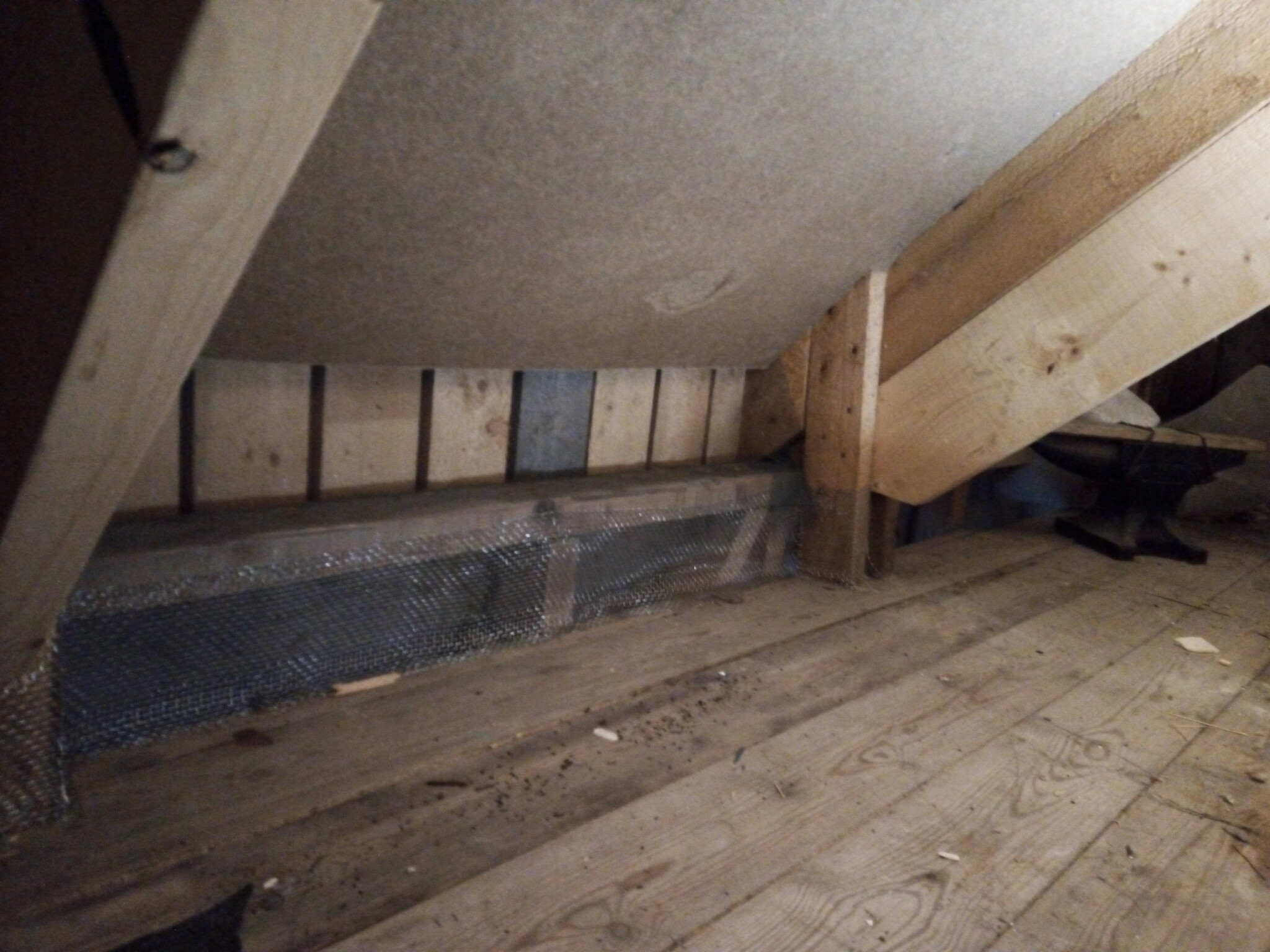
It looks like this, the panel runs all the way up to the board and the air gap (45mm) all the way against the panel.
One might then consider
- cutting the air gap a bit from the outer panel
- opening a gap of about 30mm at the top edge of the outer panel
- placing a wind deflector vertically against the floor (it's open against the outer panel behind the rodent net)
- connecting the wind deflector to the opening on the cut air gap?
It looks like this, the panel runs all the way up to the tongue-and-groove, and the air gap (45mm) goes all the way to the panel.
One might then consider
- trimming the air gap a bit away from the outer panel
- opening a slit about 30mm at the top of the outer panel
- placing a wind deflector vertically to the floor (it's open towards the outer panel behind the rodent mesh)
- connecting the wind deflector to the opening on the trimmed air gap?
[image]
That sounds good, trim the hardboard so that you can access to trim the panel and set the mosquito net, then fold in the wind deflector and attach it to the rafters sideways, you don't have to be very precise with the trimming of the hardboard since the wind deflectors cover well.
Is it good if there is an angle on the wind deflector to direct the air towards the air gap for better ventilation... or can it stand directly on the floor and vertically upwards (red) and then connect to the air gap (green)? insulation (yellow).
Click here to reply
Vi vill skicka notiser för ämnen du bevakar och händelser som berör dig.