
27,722 views ·
37 replies
28k views
37 replies
Questions about trusses at an angle, and construction of a floor level?
Self-builder
· Östergötland
· 1 837 posts
It is 5.40 according to that drawing, but it can indeed be divided as you say. Yes, the right part should be longer than the left, though not by much, I think (I haven't decided on the measurements yet). It might just be 1.20 longer on each side, if the right part is 10.8m and the left 8.4, alternatively 9.6/7.2. I need to go a little further with the floor plan first, and I think it should end up somewhere around 120 square meters without internal walls, the living space will be somewhat smaller then, but I plan to have a fairly open floor plan, I think that’s good...
Self-builder
· Östergötland
· 1 837 posts
Then it includes 28 sqm of secondary space on the upper floor, the horizontal line there is at 185 cm, so it will just be 2 long narrow rooms up there, about 4x4m (4x1.8m standing height).
Edit: The diagonal line is intended as stairs, somewhere in the middle.
The joists as mentioned 5.40 in the sketch, possibly could be supported with a wall, but maybe not everywhere.
The vertical stud on the upper floor to the right might help support the joists if built that way? The height there is around 80 cm.
It's possible to buy ready-made roof trusses also shaped like a triangle according to the upper right part?
Bought ready-made for the garage, convenient and not too expensive either.
Edit2: Wall thickness 355mm, roof thickness just under 400mm, should be quite energy-efficient?
It is intended to be a vacation home, but well constructed.
Edit: The diagonal line is intended as stairs, somewhere in the middle.
The joists as mentioned 5.40 in the sketch, possibly could be supported with a wall, but maybe not everywhere.
The vertical stud on the upper floor to the right might help support the joists if built that way? The height there is around 80 cm.
It's possible to buy ready-made roof trusses also shaped like a triangle according to the upper right part?
Bought ready-made for the garage, convenient and not too expensive either.
Edit2: Wall thickness 355mm, roof thickness just under 400mm, should be quite energy-efficient?
It is intended to be a vacation home, but well constructed.
Last edited:
Self-builder
· Östergötland
· 1 837 posts
I have to think about whether it's possible to relieve with supports given the floor plan, but you don't think the construction of the "roof truss," i.e., the support there, provides any relief in any way?
Maybe it's not possible to get pre-made roof trusses that have that shape, I don't know...
Maybe it's not possible to get pre-made roof trusses that have that shape, I don't know...
I believe, with an emphasis on believe, that the "support" which goes from the roof beam to the intermediate floor does not provide any benefit at all to the load-bearing capacity of the intermediate floor, rather the opposite.
However, for the roof beam, it does provide benefits.
If the intermediate floor is about 5.4m, then the roof beams will be even longer, this plus snow and wind load makes it some form of kerto beam.
And regarding the intermediate floor, you can lay it in the other direction.
And insert a steel beam in the direction you have now drawn the floor. But I would guess that you need at least one HEB180 for this... But this should be calculated by a structural engineer. In that case, you don't need to have any load-bearing wall at all for the floor's sake. But if there is a wall in that direction, it can be made load-bearing and just lay in a beam (if it must be open).
It should be possible to get ready-made roof trusses for this. But it will rather be ready-made beams, with some extension according to your request.
However, for the roof beam, it does provide benefits.
If the intermediate floor is about 5.4m, then the roof beams will be even longer, this plus snow and wind load makes it some form of kerto beam.
And regarding the intermediate floor, you can lay it in the other direction.
And insert a steel beam in the direction you have now drawn the floor. But I would guess that you need at least one HEB180 for this... But this should be calculated by a structural engineer. In that case, you don't need to have any load-bearing wall at all for the floor's sake. But if there is a wall in that direction, it can be made load-bearing and just lay in a beam (if it must be open).
It should be possible to get ready-made roof trusses for this. But it will rather be ready-made beams, with some extension according to your request.
An image showing how to solve a ridge beam against a ridge beam in a T. The problem that arises is specifically the distance between the gables on the main section; it must not be too long, as that beam supports everything. Additionally, when that beam bends downwards, the walls push out.
But maybe something similar can be done with scissors trusses and ridge beams.
But maybe something similar can be done with scissors trusses and ridge beams.
Self-builder
· Östergötland
· 1 837 posts
The line on the roof beam above the "support" is drawn 5.40 from the "ridge." I might as well have the rafters CC60 (or closer), even the intermediate floor. But it feels, without calculating it, like CC60 should be sufficient, I think, 45x220 is quite rough but it's possible that snow & wind load becomes too large, CC30 could be used as well. Kerto or glued-laminated timber is quite expensive. According to the Byggmax website, a 45x220x5.4m beam costs about 200 krona. Glulam beam 56x225x6m 762kr, 66x315x6m 1188kr, 90x315x6m 1668kr. CC30 over 10m thus becomes about 7,000 krona with regular beams. Glulam: CC30 56x225 becomes 26,000 krona, 66x315 becomes 40,000 kr, 90x315 57,000 kr. CC60 56x225 becomes 13,000 krona, 66x315 becomes 20,000 kr, CC120 90x315 becomes 15,000 kr. Whatever you buy, it won't be a large amount in the grand scheme of things, but it will be HEAVY! :/ Perhaps the easiest is to buy ready-made roof trusses anyway, I’ll check with the place where I bought them last, it's quite advantageous to order, have the strength calculated, and delivered. My 12 roof trusses for the garage cost around 34,000, I believe.
Self-builder
· Östergötland
· 1 837 posts
According to the calculation program on Moelven's website, a Kerto beam is required as follows, calculated for a 6.4m roof beam. (However, not sure if it is the right type of truss).
For concrete tiles 0.9kN/m^2 self-weight:
CC30 45x220 (29mm deflection), CC60 45x300 (22mm deflection), CC120 45x360 (25mm deflection).
For metal roofing 0.45kN/m^2 self-weight:
CC30 45x200 (29mm deflection), CC60 45x260 (26mm deflection), CC120 45x360 (19mm deflection).
I don't know for sure if this is correct, but that's what you get there anyway..
For floor joists CC60, Kerto 45x300 (15mm deflection) is required, CC30 45x260 (12mm deflection).
Thus, one can conclude that the floor joists don't work with standard studs, apparently, without a partition wall..
For concrete tiles 0.9kN/m^2 self-weight:
CC30 45x220 (29mm deflection), CC60 45x300 (22mm deflection), CC120 45x360 (25mm deflection).
For metal roofing 0.45kN/m^2 self-weight:
CC30 45x200 (29mm deflection), CC60 45x260 (26mm deflection), CC120 45x360 (19mm deflection).
I don't know for sure if this is correct, but that's what you get there anyway..
For floor joists CC60, Kerto 45x300 (15mm deflection) is required, CC30 45x260 (12mm deflection).
Thus, one can conclude that the floor joists don't work with standard studs, apparently, without a partition wall..
Self-builder
· Östergötland
· 1 837 posts
According to a price list I found, a 45x450 Kerto beam seems to cost around 300kr/m (I assume, the unit/length wasn't specified). So let's say you need about 100m for the "rafter beams," that would be sufficient with CC120, and cost roughly around 30,000kr. One advantage is that you can insulate 450mm directly and just lay a layer of crisscrossed 45x45 on the inside, thus raising the roof outward. However, whether it looks aesthetically pleasing, I don't know, it might look strange. You also don't want to think about what they weigh... but if you have a crane truck, which would likely be a necessity, it should go reasonably quickly to set them up. I saw a shed they built here in town recently, with glulam beams, thick as hell. Why they used such large beams I can't answer, but it certainly wasn't cheap, I think they were around 100x500mm in dimension at least. The horizontal roof joists were only attached with angle irons from each side, but the roof slope was much less than the 25 degrees I've sketched out, maybe only 10 degrees, I don’t know if that solution works with a steeper slope?
Self-builder
· Östergötland
· 1 837 posts
How do the Swedish Tax Agency's rules work for living area/storage area when it comes to sloped ceilings? Like in the left part of my sketch, when you have a sloped ceiling but 3-4 meters ceiling height, it should count as living area I guess. At what measurement is the boundary between living area and storage area? For flat ceilings, it's at 2.4m, right? Is it the same for sloped ceilings?
The upper floor will only be 2 small rooms, with maybe 2-3 meters of full ceiling height and then some meter with a sloped ceiling. If I move the support a bit to the left, the "truss" might become more sustainable. I'm also considering increasing the width by about a meter to around 6m, then I think it might be easier to partition rooms on the ground floor with a load-bearing wall.
I will probably reduce the left part of the house a bit instead, and I'm considering reducing the length of the right part a little too, though I have seen some similar houses nearby, which are quite broad, certainly longer than 10m even. The drawback with my design might be that it could be a bit difficult to resolve the floor plan if I want to expand in the future, but I also don't know right now how big I want it to be.
The upper floor will only be 2 small rooms, with maybe 2-3 meters of full ceiling height and then some meter with a sloped ceiling. If I move the support a bit to the left, the "truss" might become more sustainable. I'm also considering increasing the width by about a meter to around 6m, then I think it might be easier to partition rooms on the ground floor with a load-bearing wall.
I will probably reduce the left part of the house a bit instead, and I'm considering reducing the length of the right part a little too, though I have seen some similar houses nearby, which are quite broad, certainly longer than 10m even. The drawback with my design might be that it could be a bit difficult to resolve the floor plan if I want to expand in the future, but I also don't know right now how big I want it to be.
Self-builder
· Östergötland
· 1 837 posts
According to what I find on the Swedish Tax Agency's website, all areas that are 1.90 or more should be counted as living space, and if you have slanted ceilings, you should add 60cm outside the boundary at 1.90. Additionally, if you have an entire floor that is under 2.10, you should inform about that under additional information. But I have heard some rule for 2.40 or am I remembering completely wrong? What applies to new construction?
There are no official rules for when to calculate living area, which I find strange. Different authorities have different rules that they recommend.
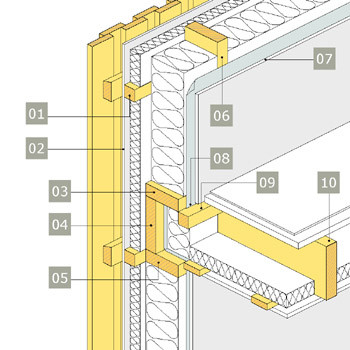
Here you have a good picture of how to solve the problem when you are making the intermediate floor on the second story.
Here you have a good picture of how to solve the problem when you are making the intermediate floor on the second story.
- Horizontal wall stud.
- Wind protection.
- Bottom plate.
- Edge beam.
- Top plate.
- Vertical wall stud.
- Interior wall covering.
- Clamped vapor barrier.
- Nogging.
- Floor joist.
Self-builder
· Östergötland
· 1 837 posts
Good picture, it looks pretty smooth; the question is if I can buy ready-made roof trusses to erect on top of a regular wall, so maybe I can avoid the hassle with that. I'll also sketch a bit on the floor plan; I think I might be able to partition it to get 3+3m or similar, if I widen the right part. 3 meters is not very large, though, it's whether it will be enough...
The idea is then roughly 4 rooms of 4x3m as bedrooms, kitchen, and bathroom, plus sauna, hallway, and space for stairs on the right. Living room to the left, that part will have a ceiling height of 2.5-4m, and there will be a stove there too.
Then the rooms upstairs, I'm considering if a ductless heat pump can be installed with individual heat transfer units, which they sell quite cheaply nowadays, with thermostats, one for each room from the living room/left part straight through the wall, should work pretty well?
Haven't come so far in plans for heating, but I have two ideas:
1. Ductless heat pump, and a regular wood stove, water heater.
2. Underfloor heating in the entire slab, solar collectors on the roof, air-to-water heat pump, storage tank and electric heater, water-jacketed wood stove.
The latter is surely great when finished, the question is what it costs compared to alternative 1, which doesn’t cost much... What do you think?
The idea is then roughly 4 rooms of 4x3m as bedrooms, kitchen, and bathroom, plus sauna, hallway, and space for stairs on the right. Living room to the left, that part will have a ceiling height of 2.5-4m, and there will be a stove there too.
Then the rooms upstairs, I'm considering if a ductless heat pump can be installed with individual heat transfer units, which they sell quite cheaply nowadays, with thermostats, one for each room from the living room/left part straight through the wall, should work pretty well?
Haven't come so far in plans for heating, but I have two ideas:
1. Ductless heat pump, and a regular wood stove, water heater.
2. Underfloor heating in the entire slab, solar collectors on the roof, air-to-water heat pump, storage tank and electric heater, water-jacketed wood stove.
The latter is surely great when finished, the question is what it costs compared to alternative 1, which doesn’t cost much... What do you think?
Self-builder
· Östergötland
· 1 837 posts
In my small cabin where I have direct electricity heating, I had a consumption of 122kWh in January while maintaining about 10 degrees. If you assume the house would be roughly 10 times larger and therefore 1220kWh to keep +10 inside when it’s -10 outside (approximately), you might roughly estimate 3660kWh to maintain +20 inside when it’s -20 outside with direct electricity heating? (around 300 cubic meters)
Say you have such a cold month per winter where I live, and 3 months with +20 inside and -10 outside.
Then 3 months with +20 inside and 0 outside, 3 months with +20 inside and +10 outside, the remaining 2 months free.
Then you should end up somewhere around 16470kWh in a year with direct electricity heating, calculated with 200mm insulation in the roof and 150mm in the walls.
The house will have 400mm in the roof and 300mm in the walls—how much of a difference will that make?
Then additionally, an air heat pump uses about half compared to direct electricity heating.
Then you should be down to somewhere between 4000-8000 kWh/year, roughly calculated as 6000, let's say.
Water heating is not included in this...
That seems fairly normal though for 120 sqm compared to district heating, etc.?
Compared to some houses on hemnet: 300 sqm - 20,400 SEK/year, district heating. 170 sqm - 14,000 SEK/year, district heating. 200 sqm - 20,400 SEK/year, district heating. 130 sqm - 15,520 SEK/year, district heating.
It varies between 70-120 SEK/sqm & year.
So with district heating, you should be at 8-14 thousand, really.
Is district heating more expensive than a heat pump, or is it because old houses are poorly insulated that I can't get the numbers to match?
Edit, realized that the year indeed has 12 months and not 6
Say you have such a cold month per winter where I live, and 3 months with +20 inside and -10 outside.
Then 3 months with +20 inside and 0 outside, 3 months with +20 inside and +10 outside, the remaining 2 months free.
Then you should end up somewhere around 16470kWh in a year with direct electricity heating, calculated with 200mm insulation in the roof and 150mm in the walls.
The house will have 400mm in the roof and 300mm in the walls—how much of a difference will that make?
Then additionally, an air heat pump uses about half compared to direct electricity heating.
Then you should be down to somewhere between 4000-8000 kWh/year, roughly calculated as 6000, let's say.
Water heating is not included in this...
That seems fairly normal though for 120 sqm compared to district heating, etc.?
Compared to some houses on hemnet: 300 sqm - 20,400 SEK/year, district heating. 170 sqm - 14,000 SEK/year, district heating. 200 sqm - 20,400 SEK/year, district heating. 130 sqm - 15,520 SEK/year, district heating.
It varies between 70-120 SEK/sqm & year.
So with district heating, you should be at 8-14 thousand, really.
Is district heating more expensive than a heat pump, or is it because old houses are poorly insulated that I can't get the numbers to match?
Edit, realized that the year indeed has 12 months and not 6
Last edited: