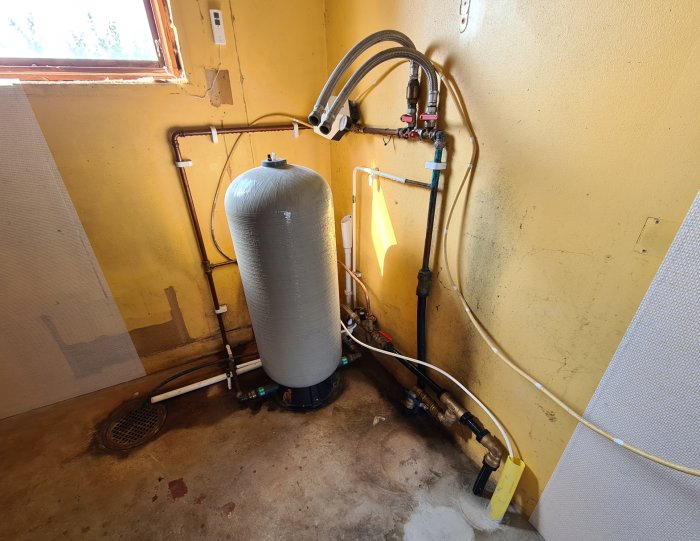
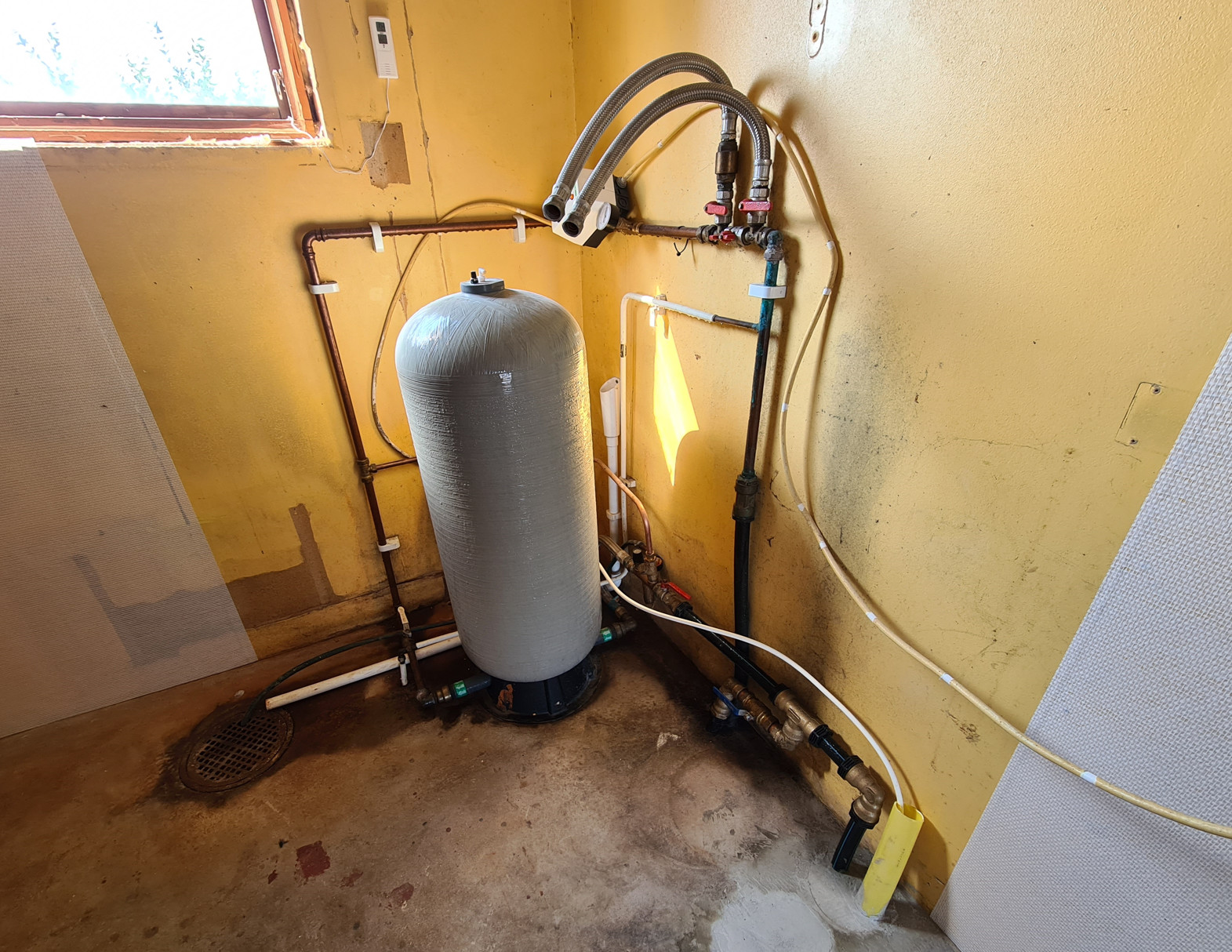
My hydrofor and water pipes produce a lot of condensation that constantly drips onto the floor and runs toward the floor drain.
Sometimes it's so much that it manages to flow toward the adjoining wall (as the incoming water comes up from the slab just a few mm from the wall).
I am in the process of renovating the room where the equipment is located (a room in the garage) and thought I'd take the opportunity to fix this now as well.
I'm putting textured wallpaper on the walls and painting them white. I will also lay tiles on the floor with a baseboard up to the wall, which I plan to seal with a silicone joint up against the wall.
My thought is that there might be some type of waterproof fabric/mat/wallpaper that I can put on the wall behind the textured wallpaper, which can then run down onto the floor slab by some dm, and which I then glue properly to the slab before I lay the tile adhesive.
Or is there some other option that might be better suited?
Note that the outgoing water goes down into the slab with just a few mm distance from the wall.
Condensation water is usually not a problem. It's just a few weeks during the summer when it's a lot.
Wet room paint on the fabric or tiles on the wall, or a wall fan to ventilate the room
Thanks. So you think it's enough with wet room paint on the fabric? I don't need to do anything special behind the fabric?
Today there is no ventilation in the room at all. There is an electric radiator keeping about 10 degrees in winter.
The garage is covered in plastic and insulated. I assume that was intended when it was built to ensure the water pipes in the room don't freeze during winter.
If I make a hole in the facade and install a wall fan, it might not be so good in winter?
I have considered installing a dehumidifier and using it on the worst days, something like this:
I had used a dehumidifier. I always run one in the basement, and there's no more condensation on the pressure tank or pump. As a bonus, there's much less frost in the freezer too.
Ventilating risks becoming counterproductive. The cold pipes function as a dehumidifier. By ventilating, more moisture is drawn in which can condense on the pipes. By having a dehumidifier in the room, there's less left to condense on the pipes. Insulation also helps. And if you have a waterproof layer on the wall and floor, it withstands water. Keep in mind that if you have a waterproof layer on the wall but not the floor, the moisture can pass through the floor to the chipboard from which it cannot evaporate as easily if the wall surface is sealed. Elegant assembly of the motor protection, by the way.
Ventilating risks becoming counterproductive. The cold pipes function as a dehumidifier. By ventilating, you draw in more moisture that can condense on the pipes. By having a dehumidifier in the room, there is less moisture left to condense on the pipes. Insulation also helps. And if you have a waterproof layer on the walls and floor, it can withstand water. Keep in mind that if you have a waterproof layer on the wall but not on the floor, moisture can seep through the floor to the chipboard, from where it cannot evaporate as easily if the wall surface is sealed. Elegant installation of the motor protection, by the way.
Thanks for the help!
Yes, it's a bit temporary just when the picture was taken. All the electricity will be properly redone with new cables after the surfaces are fixed in the coming days
Click here to reply
Vi vill skicka notiser för ämnen du bevakar och händelser som berör dig.


Jonatan79 said:

