
7,767 views ·
19 replies
8k views
19 replies
pour a 9x7m large slab ?
hi
I'm building a houseboat and was at the Stockholm fair today and when I got home I got a super idea
I've been thinking for a long time about how to move my houseboat and I think I have the solution.
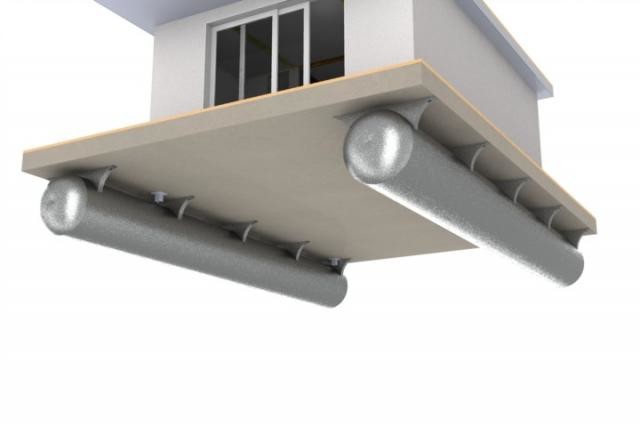
Cast a 9x7x0.3m large slab with reinforcement (how much?) and everything, and then specially order two tanks from www.tanksvets.se that are 9m long and 1m in diameter. What do you think? With a 2700/m3 the slab would weigh 5 tons and the tanks would have about 18 tons of buoyancy.
Any disadvantages and is it possible to cast such a large slab and how strong will it be?
I'm building a houseboat and was at the Stockholm fair today and when I got home I got a super idea
I've been thinking for a long time about how to move my houseboat and I think I have the solution.
Cast a 9x7x0.3m large slab with reinforcement (how much?) and everything, and then specially order two tanks from www.tanksvets.se that are 9m long and 1m in diameter. What do you think? With a 2700/m3 the slab would weigh 5 tons and the tanks would have about 18 tons of buoyancy.
Any disadvantages and is it possible to cast such a large slab and how strong will it be?
Hello
You have miscalculated a bit, the volume of the pontoons is:
(0.5^2*3.14*9)*2=14.3 m^3 (radius squared*pi*length)*number of pontoons
Since water weighs around 1 ton/m^3 (depending on temperature and salinity), you can usually directly convert the volume in m^3 to buoyancy in tons.
9*7*0.3=18.9 m^3
If you are correct and the density of concrete is 2.7 tons/m^3, then the slab weighs 18.9*2.7=51.03, that is, the slab weighs 3.57 times more than your buoyancy. This is not considering the weight of the pontoons themselves, otherwise even worse.
PS.
You seem to have simply calculated the volume of the pontoons as if they were cubic rather than cylindrical. And regarding the weight, it seems you've just got an order of magnitude error.
Best regards, Björn
You have miscalculated a bit, the volume of the pontoons is:
(0.5^2*3.14*9)*2=14.3 m^3 (radius squared*pi*length)*number of pontoons
Since water weighs around 1 ton/m^3 (depending on temperature and salinity), you can usually directly convert the volume in m^3 to buoyancy in tons.
9*7*0.3=18.9 m^3
If you are correct and the density of concrete is 2.7 tons/m^3, then the slab weighs 18.9*2.7=51.03, that is, the slab weighs 3.57 times more than your buoyancy. This is not considering the weight of the pontoons themselves, otherwise even worse.
PS.
You seem to have simply calculated the volume of the pontoons as if they were cubic rather than cylindrical. And regarding the weight, it seems you've just got an order of magnitude error.
Best regards, Björn
OPPS:blushing:Belaruz said:Hello
You've calculated a bit wrong, the volume of the pontoons will be:
(0.5^2*3.14*9)*2=14.3 m^3 (radius squared*pi*length)*number of pontoons
Since water weighs about 1 ton/m^3 (depends on temperature and salinity), you can often directly convert the volume in m^3 to buoyancy in tons.
9*7*0.3=18.9m^3
If you are correct and the density for concrete is 2.7 tons/m^3, then the slab weighs 18.9*2.7=51.03, meaning the slab weighs 3.57 times more than the buoyancy you have. This is if you disregard the weight of the pontoons themselves, otherwise even worse.
PS.
You seem to have simply calculated the volume of the pontoons as if they were cubic and not cylindrical. And regarding the weight, you seem to have just made an error with one order of magnitude.
Best regards, Björn
then the idea fell apart as quickly as it emerged
do you have any good idea how I can make it work? if I were to go down to 20cm, it would weigh about 34 tons, and if a 5cm thick piece of cell material is placed in the middle, I get 25 tons - 3 tons (cell buoyancy) = 22 tons and increase the radius to 0.7m and add a tank in the middle, then it becomes possible.
feels like I'm going a bit too far, or is it physically possible?
is it easier, of course, will the result be better, probably notcheetah1 said:
now after yesterday's tiredness, one realizes that a 30cm thick concrete block is very thick! feels like 10cm would work, right? because then it would weigh around 17 tons, which is not a big problem to get it to move.

Well, normally a constructor could probably handle a 1 dm thick slab that is 9x7 meters with relatively light load. It's mostly about how it should be reinforced.
What complicates it a bit is that it will be in water, and if it's salt or brackish water, it becomes even trickier.
To protect the reinforcement from rust, it must be sufficiently embedded in the concrete, and the concrete must be of high and dense quality. This may mean the slab needs to be thicker, not because of strength, but to protect the reinforcement.
This is definitely a task for an experienced concrete designer. They can calculate the necessary reinforcement as well as the concrete class to use and the necessary cover depth. Stainless steel reinforcement may also be considered. Air-entraining agents in the concrete are also required, especially if the boat is not to be taken out in good time before each winter.
Having a concrete hull for a houseboat is nothing new, there is, for example, one in Uppsala harbor. But it seems to be designed more as a hull, and without any pontoons underneath. Not having pontoons leads to the advantage of a "uniform support" under the entire concrete and the forces are modest, to say the least.
What complicates it a bit is that it will be in water, and if it's salt or brackish water, it becomes even trickier.
To protect the reinforcement from rust, it must be sufficiently embedded in the concrete, and the concrete must be of high and dense quality. This may mean the slab needs to be thicker, not because of strength, but to protect the reinforcement.
This is definitely a task for an experienced concrete designer. They can calculate the necessary reinforcement as well as the concrete class to use and the necessary cover depth. Stainless steel reinforcement may also be considered. Air-entraining agents in the concrete are also required, especially if the boat is not to be taken out in good time before each winter.
Having a concrete hull for a houseboat is nothing new, there is, for example, one in Uppsala harbor. But it seems to be designed more as a hull, and without any pontoons underneath. Not having pontoons leads to the advantage of a "uniform support" under the entire concrete and the forces are modest, to say the least.

If you want the pontoon to last for several years, you should not cast it yourself, as you as a private person will have a very hard time obtaining all the additives needed in the concrete mix. If you mix it yourself, you won't have a way to know the w/c ratio in relation to the k-value in the mix. If by any chance you manage to get air-entraining agents, how will you know that the air pore percentage is 4.5 - 5.5% without an air pore meter?
The concrete in your concrete pontoon requires the same high quality as the bridge piers of the Öresund Bridge if you want it to remain afloat for many years, and you can't produce such concrete at home.
There are prefab factories that cast concrete pontoons (I have transported one myself when I used to drive a trailer tractor. Loaded in Finland, unloaded on Orust Gothenburg). The pontoon was about 10 x 2.5 m and 50 cm high, completely covered with concrete and weighed 10 - 12 tons. But in the water, it only sank 10 cm - huge buoyancy!
My advice is: Don't mix your own concrete, buy a ready-made concrete pontoon!
Otherwise, the alternative is to build a polystyrene bed 40 cm thick, and to match the reinforcement with the concrete quality, you must use at least a 12 mm dense reinforcing mat (does not need to be stainless steel) to cover the polystyrene all around with 50 mm spacer blocks. The concrete thickness should be 10 cm all around. If you live in Uppsala, both Swerock, Betongindustri, and Färdig Betong can mix your batch, which will be unloaded with a hydraulic chute. You will be shocked when you hear what the concrete costs! Bridge pier concrete meant to be in brackish water is expensive, insanely expensive!
By the way! Concrete weighs 2.3 tons/m3! If it weighed 2.7 tons/m3, all 3-axle concrete trucks in Sweden would be overloaded when carrying their usual 5.5 m3.
The concrete in your concrete pontoon requires the same high quality as the bridge piers of the Öresund Bridge if you want it to remain afloat for many years, and you can't produce such concrete at home.
There are prefab factories that cast concrete pontoons (I have transported one myself when I used to drive a trailer tractor. Loaded in Finland, unloaded on Orust Gothenburg). The pontoon was about 10 x 2.5 m and 50 cm high, completely covered with concrete and weighed 10 - 12 tons. But in the water, it only sank 10 cm - huge buoyancy!
My advice is: Don't mix your own concrete, buy a ready-made concrete pontoon!
Otherwise, the alternative is to build a polystyrene bed 40 cm thick, and to match the reinforcement with the concrete quality, you must use at least a 12 mm dense reinforcing mat (does not need to be stainless steel) to cover the polystyrene all around with 50 mm spacer blocks. The concrete thickness should be 10 cm all around. If you live in Uppsala, both Swerock, Betongindustri, and Färdig Betong can mix your batch, which will be unloaded with a hydraulic chute. You will be shocked when you hear what the concrete costs! Bridge pier concrete meant to be in brackish water is expensive, insanely expensive!
By the way! Concrete weighs 2.3 tons/m3! If it weighed 2.7 tons/m3, all 3-axle concrete trucks in Sweden would be overloaded when carrying their usual 5.5 m3.
Thanks for all the tips.
I wasn't planning on doing it myself; I will hire an expert.
Tyresö: Thanks for the tip about prefab factories, but the problem is that they are so heavy! Does anyone have an idea of how big a motor I would need to travel in Mälaren (I will only use it in Mälaren) if everything would weigh around 60 tons?
Mikael_L would it work with stainless steel reinforcement and what are the disadvantages of it?
I have decided that I will use 3 tanks to make the weight more even, with the third one attached in the middle.
Hubbe2: I have tried to find a good cheap way to manufacture in wood or metal. I have asked some companies, and it becomes very expensive. The concrete version makes it so incredibly easy to attach the house (the house and the base will be built separately).
My budget is around 100,000 SEK and can go up to 150k but hopefully won't have to.
I wasn't planning on doing it myself; I will hire an expert.
Tyresö: Thanks for the tip about prefab factories, but the problem is that they are so heavy! Does anyone have an idea of how big a motor I would need to travel in Mälaren (I will only use it in Mälaren) if everything would weigh around 60 tons?
Mikael_L would it work with stainless steel reinforcement and what are the disadvantages of it?
I have decided that I will use 3 tanks to make the weight more even, with the third one attached in the middle.
Hubbe2: I have tried to find a good cheap way to manufacture in wood or metal. I have asked some companies, and it becomes very expensive. The concrete version makes it so incredibly easy to attach the house (the house and the base will be built separately).
My budget is around 100,000 SEK and can go up to 150k but hopefully won't have to.
I really have no idea, it's not my area of expertise.husbåt said:
But I know that stainless steel reinforcement exists, and it must have been developed for some purpose.
For example here...
The disadvantage should at least be the price, but possibly with less concrete usage, it might not be too unprofitable, maybe...
So, I can't help you, either you hire someone who knows about concrete in water + durability or you have a long uphill climb with knowledge acquisition. But sometimes the journey is more enjoyable than the destination.
100-150', do you mean only the slab then, or slab + pontoons, or everything?
If you mean more than just the slab, then you should already start preparing for a potential shock.
Just the concrete itself will probably cost around 15-25', then it needs to be reinforced, forms built, etc.
My very uneducated guess is that you can get a slab + something to float with (pontoons...) for something around 100, or some tens of thousands more. But don't take this as any truth, it's a pure wild guess mixed with a lot of ignorance. :blushing:
But exciting project, I must say.
You really very much kindly please update us all as it progresses.

Member
· Västerbottens län
· 18 070 posts
Why not cast a tub out of concrete, there are sailboats made of concrete.
Protte
Protte
I was thinking 100k for the foundation itself with pontoons and everything, not the house itself.Mikael_L said:I have no idea really, not my area of expertise. But I know there is stainless reinforcement, and it must have been developed for some purpose.
The downside should at least be the price, but maybe with less concrete consumption it might not be too unprofitable, perhaps...
So, I can't help you, either you hire someone who knows concrete in water + strength or you have a long uphill with learning. But sometimes the journey is more fun than the goal.
100-150', do you mean only the slab then, or slab + pontoons, or everything? If you mean more than just the slab then you should already start preparing for a possible shock. Just the concrete itself will surely set you back 15-25', then it has to be reinforced, molds built, etc.
My highly ignorant guess is that you can get a slab + something to float with (pontoons..) for around 100, or a few tens of thousands more. But don't take this as any truth, it's a pure raw guess, mixed with a lot of ignorance. :blushing:
But an exciting project I must say. You are very, very welcome to update us as it progresses.
Around 15kkr for the concrete (it's 6.3m3) then 20kkr for each pontoon (I'll send an email and check) and the rest for work hours for some expert and money to the guy who lifts it into the water.
Am I thinking correctly?
I think you should take another look at concrete floating pontoons. As previously mentioned, they have very good buoyancy and are likely cheaper than casting a slab and welding some steel pontoons.
"thanks for the tip about prefab factories, but the problem is that they are so heavy! does anyone have an idea what size motor I would need to go on Lake Mälaren (I will only use it in Lake Mälaren) if everything would weigh about 60 tons?"
To drive 60 tons at 27 knots requires 2x1200hp. With two diesel engines of around 2-3 liters, I guess you could get around at the same speed as sailboats.
"thanks for the tip about prefab factories, but the problem is that they are so heavy! does anyone have an idea what size motor I would need to go on Lake Mälaren (I will only use it in Lake Mälaren) if everything would weigh about 60 tons?"
To drive 60 tons at 27 knots requires 2x1200hp. With two diesel engines of around 2-3 liters, I guess you could get around at the same speed as sailboats.
I'm not good with engines, how much hp do two 2-3l engines have? Also, it takes a lot of power to drive around 60 tons, especially if you have concrete pontoons as they have much more resistance compared to regular pontoons. I plan to travel 5km on average each day, how much would it consume (diesel or petrol)?dannan said:I think you should take another look at concrete floating pontoons. As previously mentioned, they have very good buoyancy and will probably be cheaper than casting a slab and having some pontoons welded in steel.
"thanks for the tip about prefab factories but the problem is they are so heavy! does anyone have an idea of what size engine I would need to travel in Mälaren (I will only use it in Mälaren) if everything would weigh about 60 tons?"
To drive 60 tons at 27 knots requires 2x1200hp. With two diesel engines of about 2-3l, I guess you can get around at the same speed as sailboats.
PS: I only plan to have outboards.
Last edited:
Stainless steel reinforcement bars are only used when the road administration or railway administration is constructing a structure where there is a risk of saltwater (poured bus stops, bridge foundations in saltwater, etc.). Assuming regular reinforcement bars cost approx. 8 - 16 SEK/kg, stainless steel reinforcement bars (just a wild guess because I know it's a shocking price) cost 400 SEK/kg. Anyway, stainless steel reinforcement bars are so expensive that a private person doesn't even need to consider using them in their construction, no matter what is being built!Mikael_L said:I have no idea really, it's not my area of expertise. But I know there is stainless steel reinforcement, and it must have been developed for some purpose.
The downside should at least be the price, but possibly with less concrete usage, it might not be too unprofitable, maybe ...
So, I can't help you; either you hire someone who knows about concrete in water + strength, or you have a long uphill journey of knowledge acquisition. But sometimes the journey is more fun than the destination.
100-150', do you mean only the slab, or slab + pontoons, or everything? If you mean more than just the slab, then you should already start preparing yourself for a possible shock. Just the concrete itself will surely cost 15-25', then it needs to be reinforced, forms need to be built, etc.
My very uninformed guess is that you can get a slab + something to float with (pontoons ..) for something around 100, or a few tens of thousands more. But don't take this as any truth; it's a pure wild guess, mixed with a lot of ignorance. :blushing:
But an exciting project, I must say. I'd love it if you could update us as it progresses.
It's only the railway and road administration designers who can afford to include stainless steel reinforcement bars in their constructions because it's "only" from the taxpayers' bottomless money locker that they take "some" kronor from!