
12,318 views ·
39 replies
12k views
39 replies
Posts for the terrace - have I completely messed up?
Both AB and B are above ground, so no difference. B is usually used for finished carpentry with pine while AB is for paneling, boards, battens, decking, etc. A would have been preferable as it is most common for posts, but since you are using it above ground, it's a bit overkill anyway.A Amrich said:
It looks like you have a recessed floor joist? Since no screw beams rest on the carrier beam in the previous picture.
Overall, acrylic paint, which is often used on houses, is hardly preferable for posts where you paint all four sides. And if you still want to paint a post on all four sides with acrylic paint, snickerifärg should be chosen.Johan Gunverth said:
I have primed with indstriprimer, like Caparols Unigrund or Biltemas snickerigrund. This grips the wood really well. It's held for 25 years on the oldest pressure-treated woodwork I've painted. Probably stronger impregnation back then, but the principle is the same. What you paint on the primer matters less. Choose the same type of paint as for the house.
The pressure-treated laminated posts are already dried out and should be paintable directly. Wipe them down with a solvent, like white spirit or T-sprit first. There might be "greasy" residues on them.
Yes, that's correct, the floor joists are at the same level as the front support beam. Built by previous owners and looks okay.K kniv said:Both AB and B are above ground, so no difference. B is typically used for finished carpentry of pine while AB is for paneling, boards, battens, decking, etc. A would have been preferable as it is most common for posts, but since you're using it above ground, it's a bit overkill anyway.
Looks like you have a recessed floor structure? Since no screw battens rest on the support beam in the previous picture.
Does it really not matter if I choose B or AB? The image below is from the wood guide, which made me a bit unsure. Is it just the surface of NTR B that is impregnated? In my case, it's the end grain at the bottom of the post that will be the most exposed.
Strange that there are glulam posts in A and AB but not in A when it's recommended for posts?

It can vary greatly; my parents have a patio that is over 30 years old, not treated, and it's low down. But it has its own roof. Nothing there has rotted.S Stefan1972 said:
I personally wouldn't want to start redoing things at this stage... I would keep going and deal with the consequences later, which could be decades in the future... I would try to get linolja down there at the bottom so it can soak into the end grain. I might also try to get tar in there.
It might be easier to do something with the roof overhang, for example, if it doesn't already have one, install a gutter and downspout which makes the overhang larger and diverts water more effectively.
It might be easier to do something with the roof overhang, for example, if it doesn't already have one, install a gutter and downspout which makes the overhang larger and diverts water more effectively.
Thank you
I'm prepared to redo it as long as I know what the "best" solution is. I thought I was in the clear when I found pressure-treated glulam posts, but when they turned out to be only NTR B, I became unsure of how much better that would actually be compared to what I have now.
The roof overhang is quite substantial at the moment, but the front end of the deck is facing the direction from which the wind blows, so it probably gets wet about 50cm onto the deck with each shower right now without it blowing particularly hard.
Thanks for the advice!DennisCA said:
Personally, I wouldn't want to start redoing things at this stage.... I would just go ahead and deal with the issue later, which could be decades in the future... I would try to get some linolja down there at the bottom so it can soak into the end grain. I might also try to get some tjära there.
It might be easier to do something with the roof overhang, like if it doesn't already have one, install a gutter and downspout which will make the overhang larger and lead water away more effectively.
I'm prepared to redo it as long as I know what the "best" solution is. I thought I was in the clear when I found pressure-treated glulam posts, but when they turned out to be only NTR B, I became unsure of how much better that would actually be compared to what I have now.
The roof overhang is quite substantial at the moment, but the front end of the deck is facing the direction from which the wind blows, so it probably gets wet about 50cm onto the deck with each shower right now without it blowing particularly hard.
I thought I would follow up on how this story ended.
I found a solution that was acceptable in terms of economy, effort, and results:
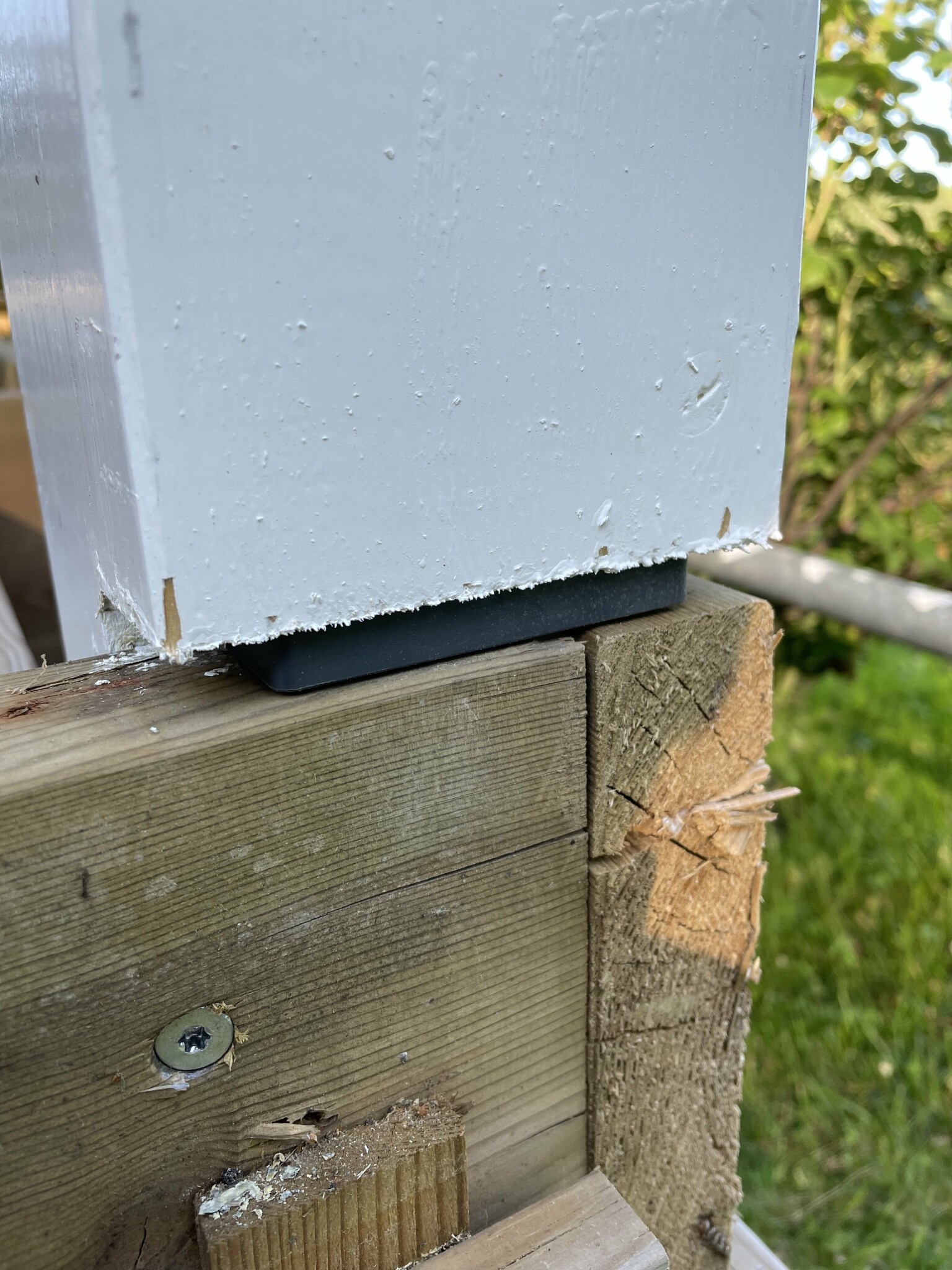
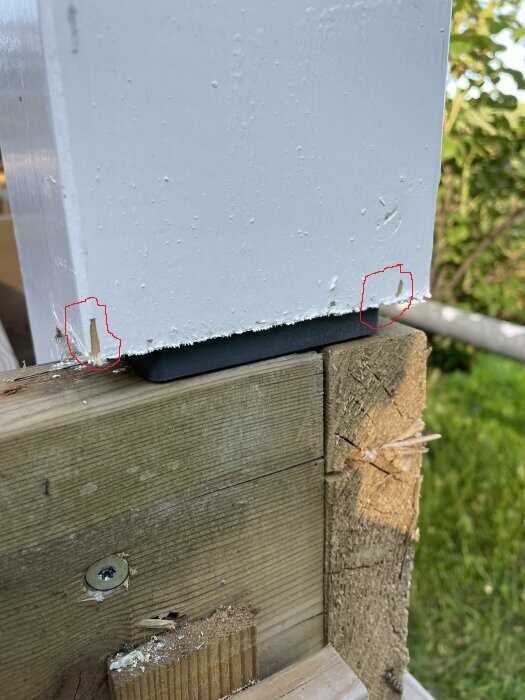
I loosened the screws at the bottom of the posts, jacked them up with a jack, and placed shims under the post both against the plinth and the beam. This should prevent the end grain from standing in water and help it dry out faster.
I already had the shims, so the cost was 0 kronor, and it was very quickly resolved. Hopefully, I've extended the lifespan of my posts somewhat with this solution.
Thanks for all the advice in the thread, even though I eventually chose my own alternative.
I found a solution that was acceptable in terms of economy, effort, and results:
I loosened the screws at the bottom of the posts, jacked them up with a jack, and placed shims under the post both against the plinth and the beam. This should prevent the end grain from standing in water and help it dry out faster.
I already had the shims, so the cost was 0 kronor, and it was very quickly resolved. Hopefully, I've extended the lifespan of my posts somewhat with this solution.
Thanks for all the advice in the thread, even though I eventually chose my own alternative.
Last edited:
Perfect! That's what I wrote in post #6
My entire patio construction and conservatory are built on 10mm plastic spacers.
My entire patio construction and conservatory are built on 10mm plastic spacers.
Yes, apologies, credit where credit is due! It was probably your suggestion that settled in the back of my mind and matured for a while. Thank you for your help 😄L Leif i Skåne said:
I don't share that opinion, I believe that bare (or linseed oiled) wood surfaces hold up better than posts painted all around with Beckers window paint.S sblixten said:
Water-dilutable alkyd, which is likely the question in this case, is hardly the best if you're going to paint a post on all sides.K kniv said:

Well done!
/W
/W
No!S sblixten said:
Those who have access to compressed air, try blowing through one end of freshly cut firewood when it's fresh and wet, it bubbles at the other end.
At the sawmill, the freshly cut wood is dried by cooking it in steam up to 120° temp, and the water in the wood squirts out of the end grain. There are many cubic meters of liquid from a wood dryer!