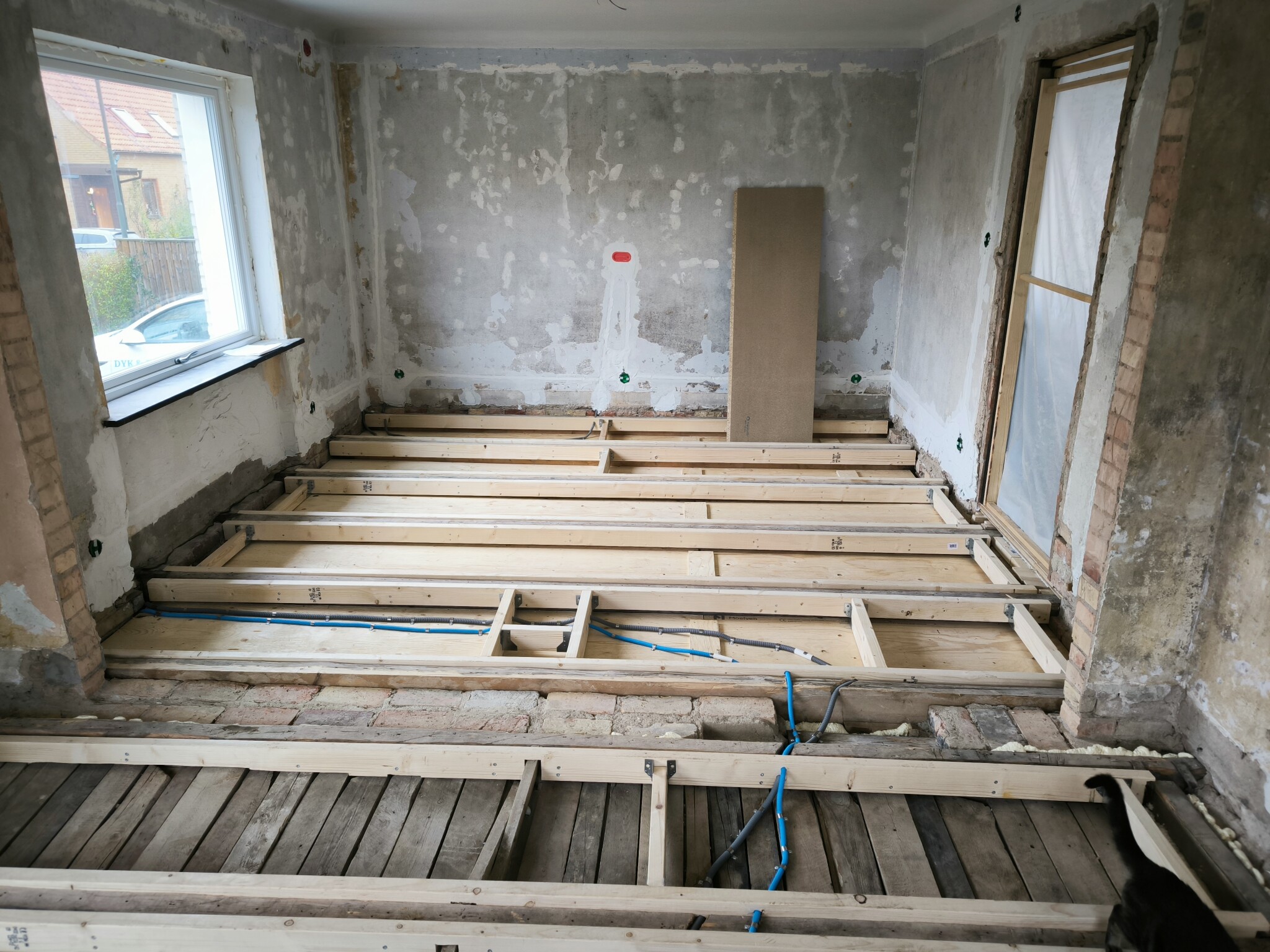
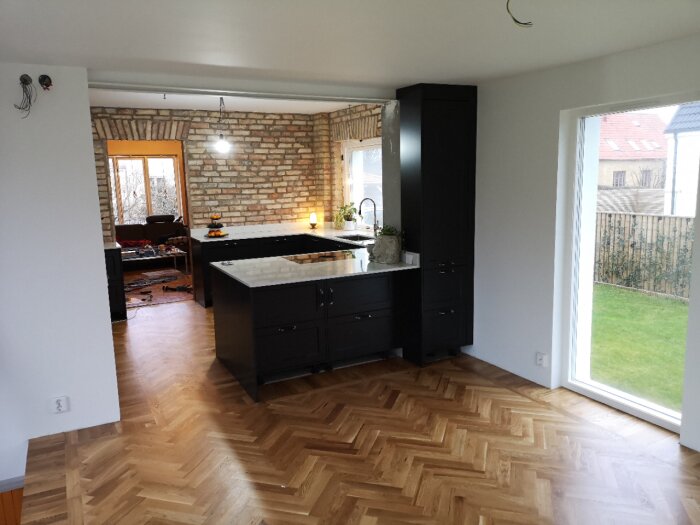
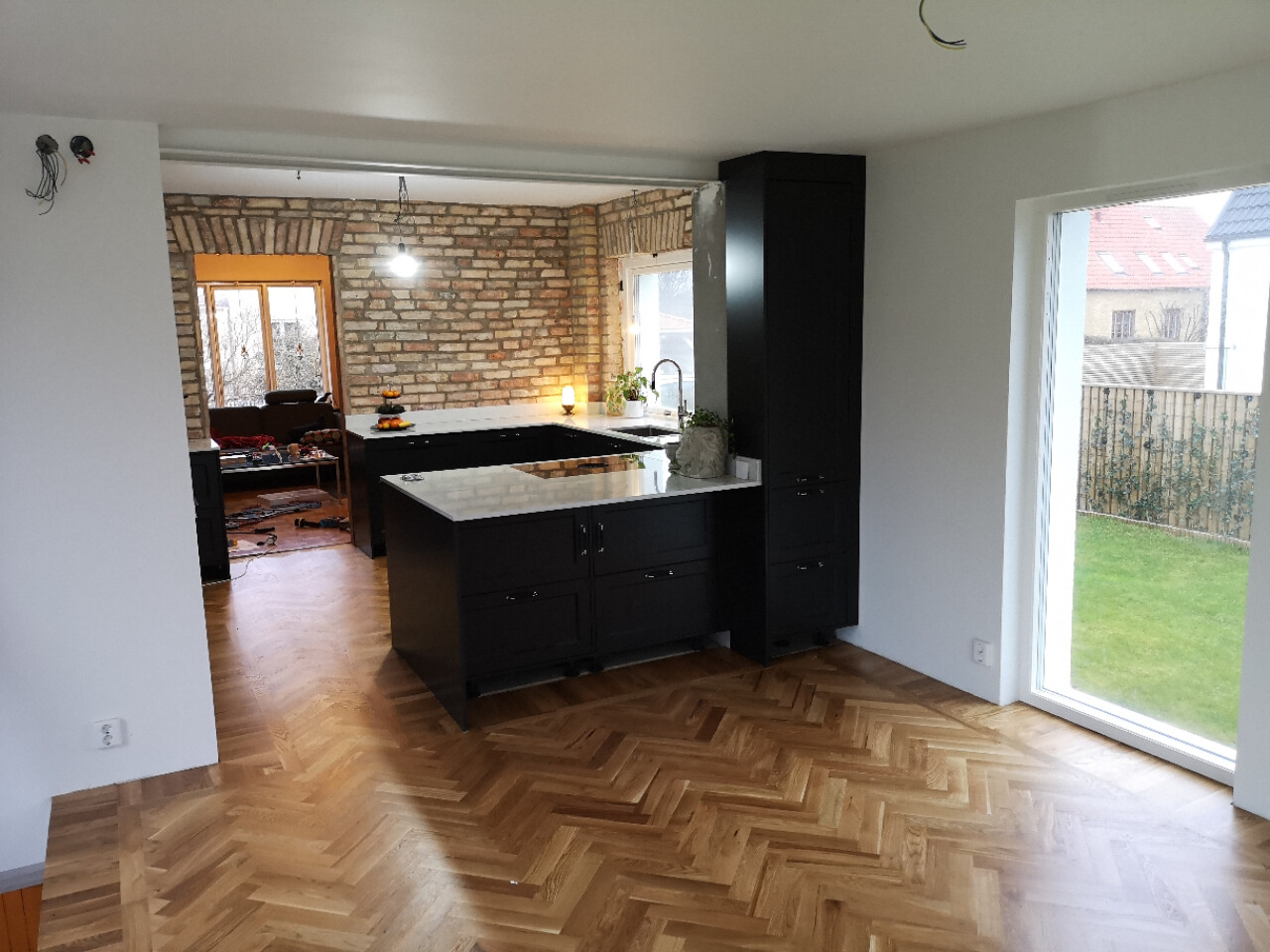
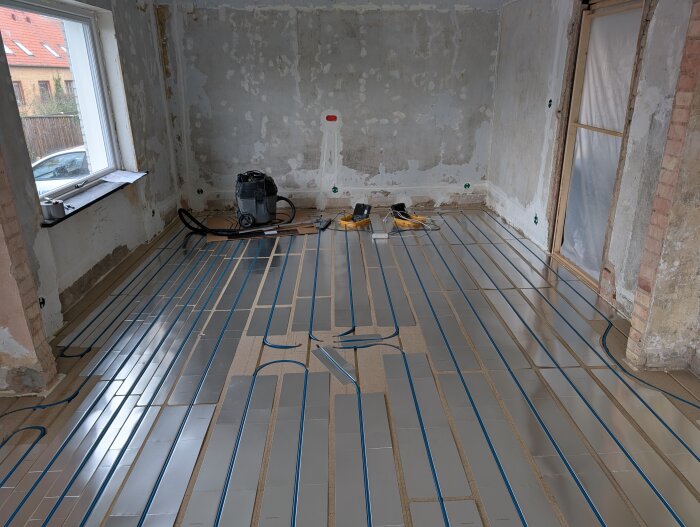
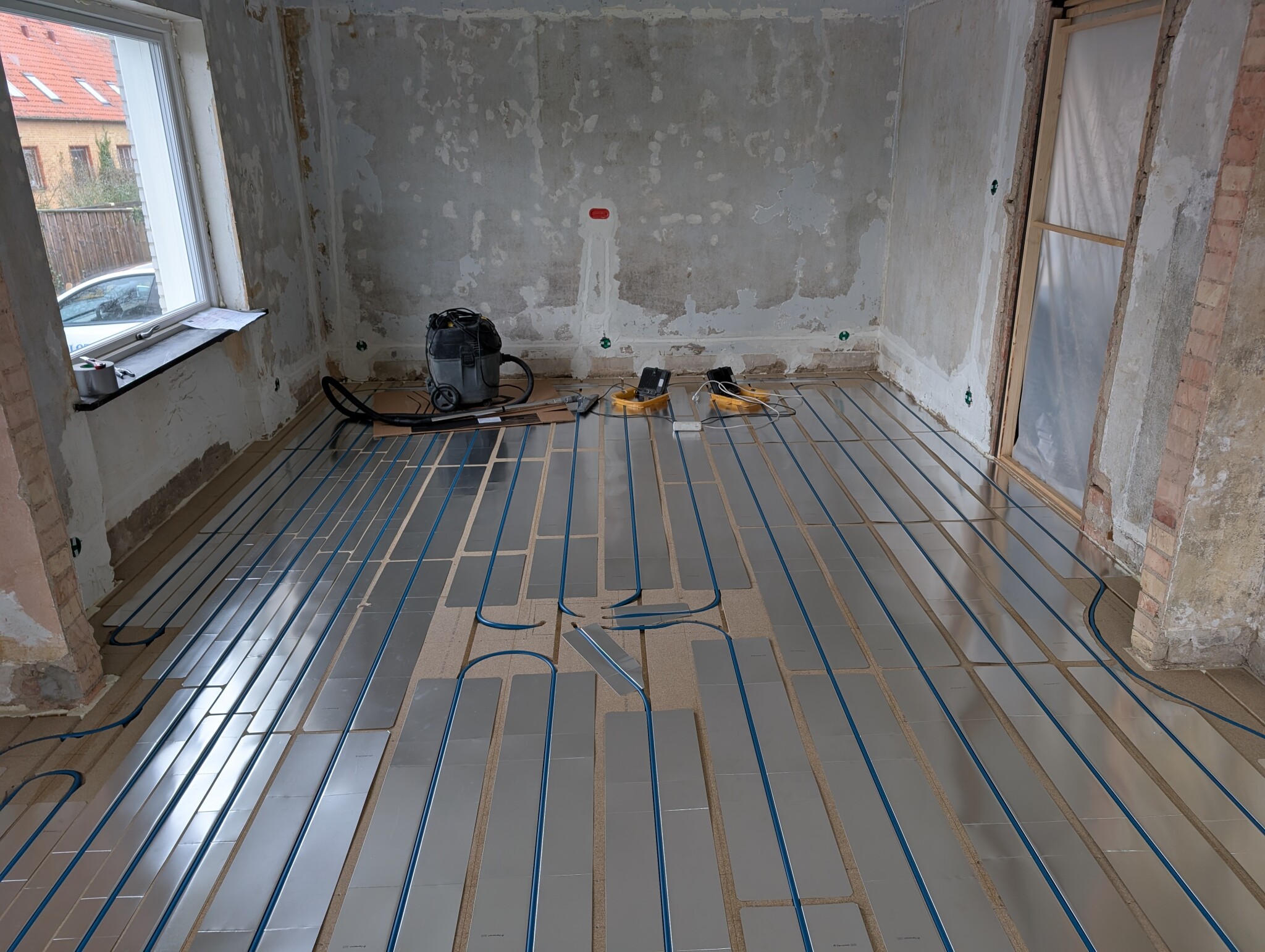
I'm planning to lay herringbone parquet in this room:
It can't be laid on this substrate. So I plan to glue and screw plywood first.
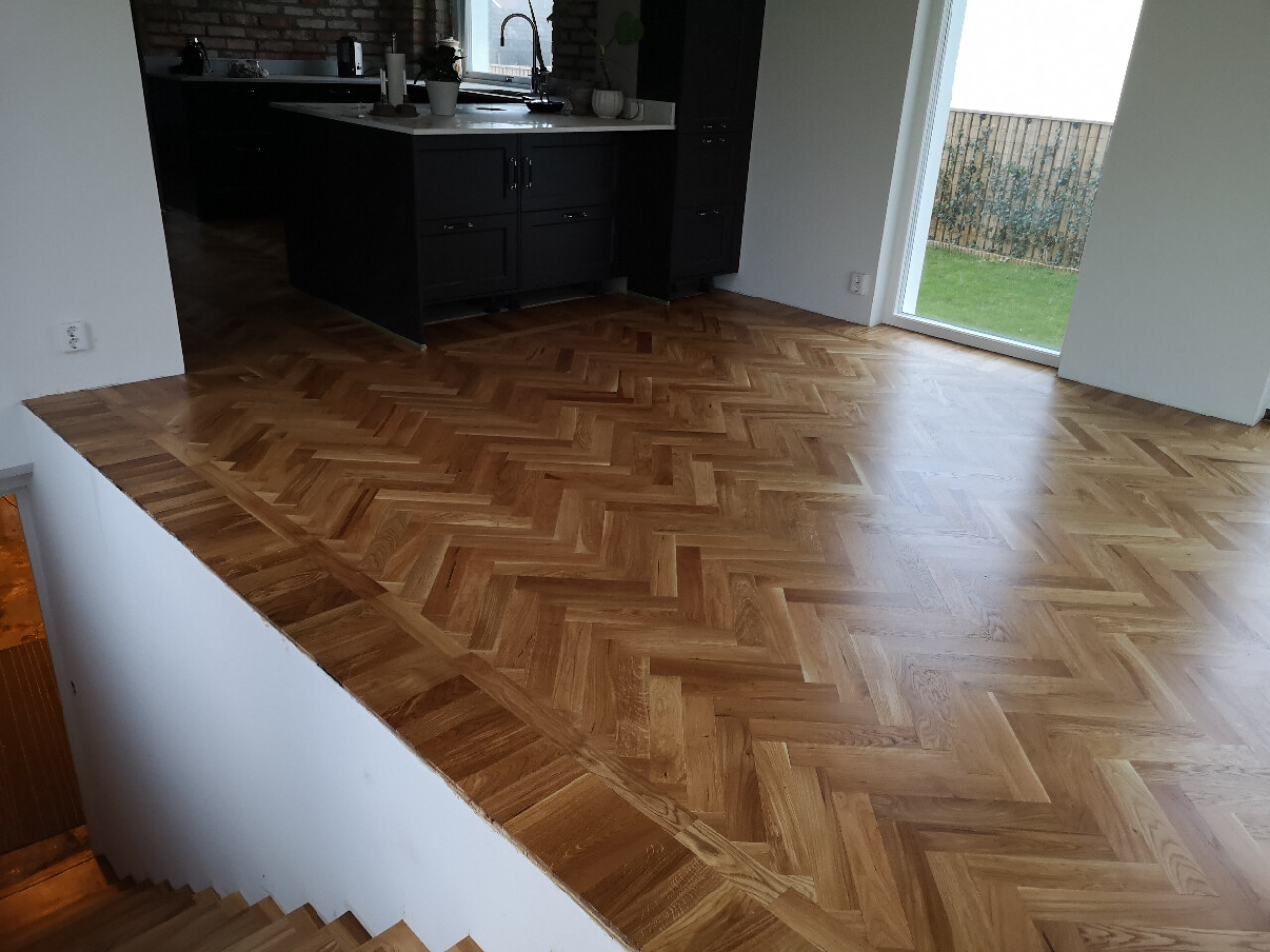
But what dimension? In the adjoining room, we've done the same thing. We used 6mm slightly smaller boards from jem&fix. It worked okay, but I had to drive around Skåne to buy all they had to get the needed amount.
Today, I checked 7 mm boards at Bauhaus. They were incredibly flimsy and wavy. Maybe they will be good when glued and screwed.
The 10 mm option felt much more stable.
The price will be about 2400 more, so not too bad.
But how will it affect the heat distribution from the underfloor heating?
I screwed and glued 10mm plywood and glued strip parquet on it.
If I were to do it again, I would use leveling compound as a base!
Those who have used leveling compound elsewhere with us said it wasn't good. They couldn't guarantee when there was wood underneath, then wood on top. That it would move differently or something.
Otherwise, that was my initial thought.
Those who have used self-leveling compound elsewhere in our home said it wasn't good. They couldn't guarantee it when there's wood underneath, then wood on top. That it would move differently or something.
Otherwise, that was my initial thought.
Depends a bit on your subfloor?
Is it grooved floor chipboard directly on the joists?
Otherwise, it's at least 12mm of self-leveling compound + mesh on what you have today. It would feel really bad to lay wood panels over the heating coils, would likely kill the underfloor heating.
Edit: consult with others in the industry, since self-leveling is done on chipboard with wooden joists when making bathrooms, for example. Then again, there are different requirements for rigidity when tiling. I've had to do that at home myself.
Otherwise, it's at least 12mm of self-leveling compound + mesh on what you have today. It would feel really bad to lay wood boards over the loops; it would practically kill the underfloor heating.
It doesn't kill the underfloor heating, but it is significantly dampened. I've installed an extra fan convector on the ceiling of the upper floor because the underfloor heating is so limited due to too thick wood on top.
On the lower floor, I have travertine, so it heats much better there.
Gypsum floorboards might be a better alternative perhaps?
Is it just grooved particleboard directly on the joists?
Otherwise, it's at least 12mm self-leveling compound + mesh on what you have today. It would feel really bad to lay wood boards over the loops, it would likely kill the underfloor heating.
Edit: check with others in the industry, you do pour on particleboard with wooden joists when making bathrooms, for example. Then again, there are other requirements for stiffness when it comes to tiles. I've had that done at home myself.
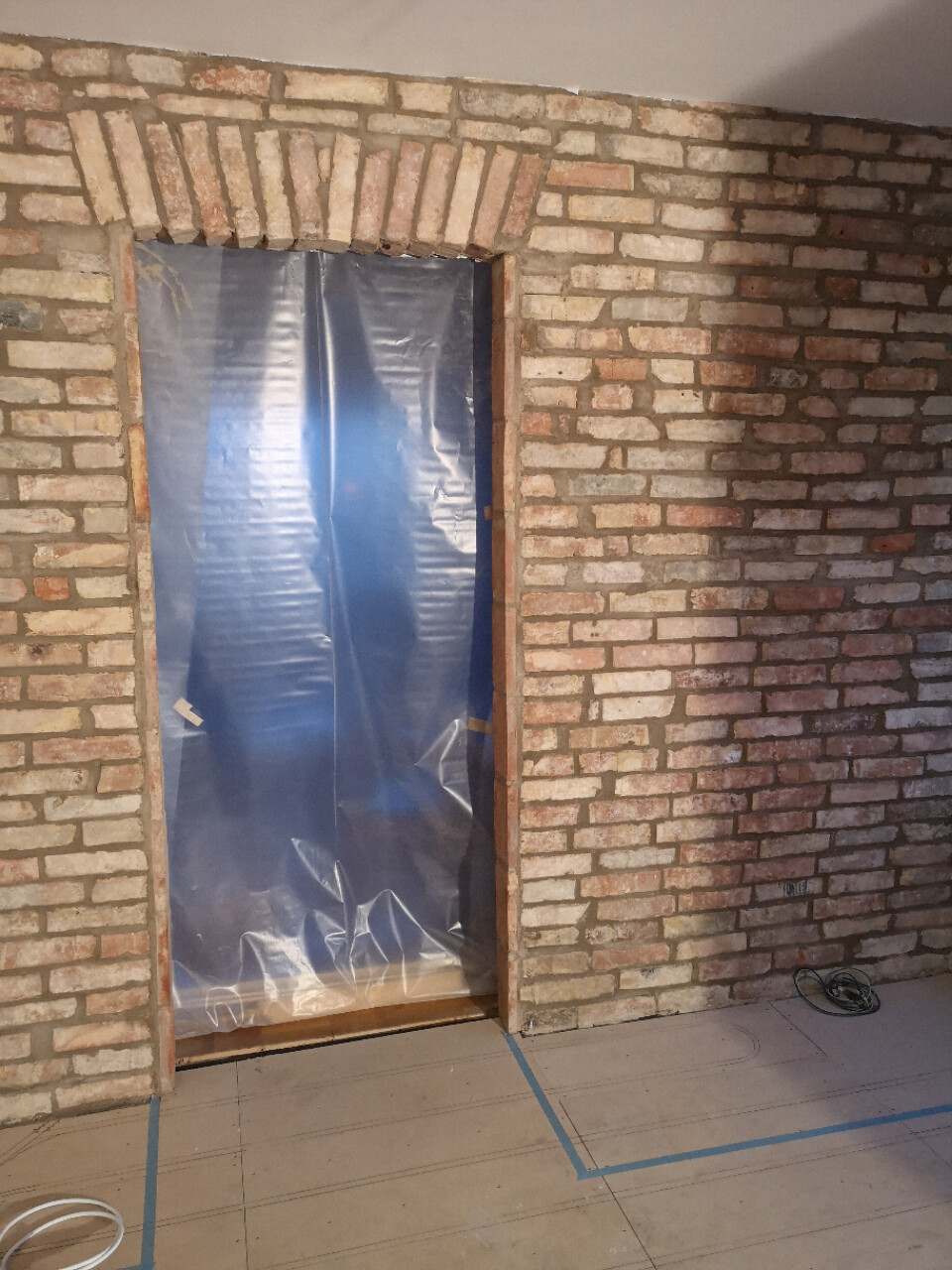
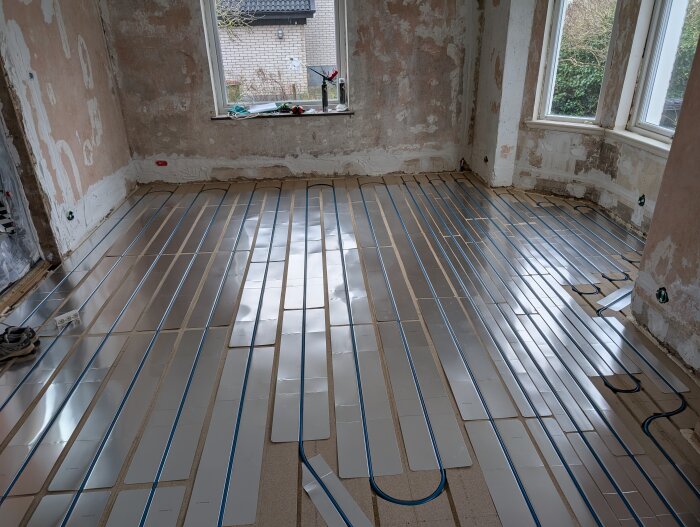
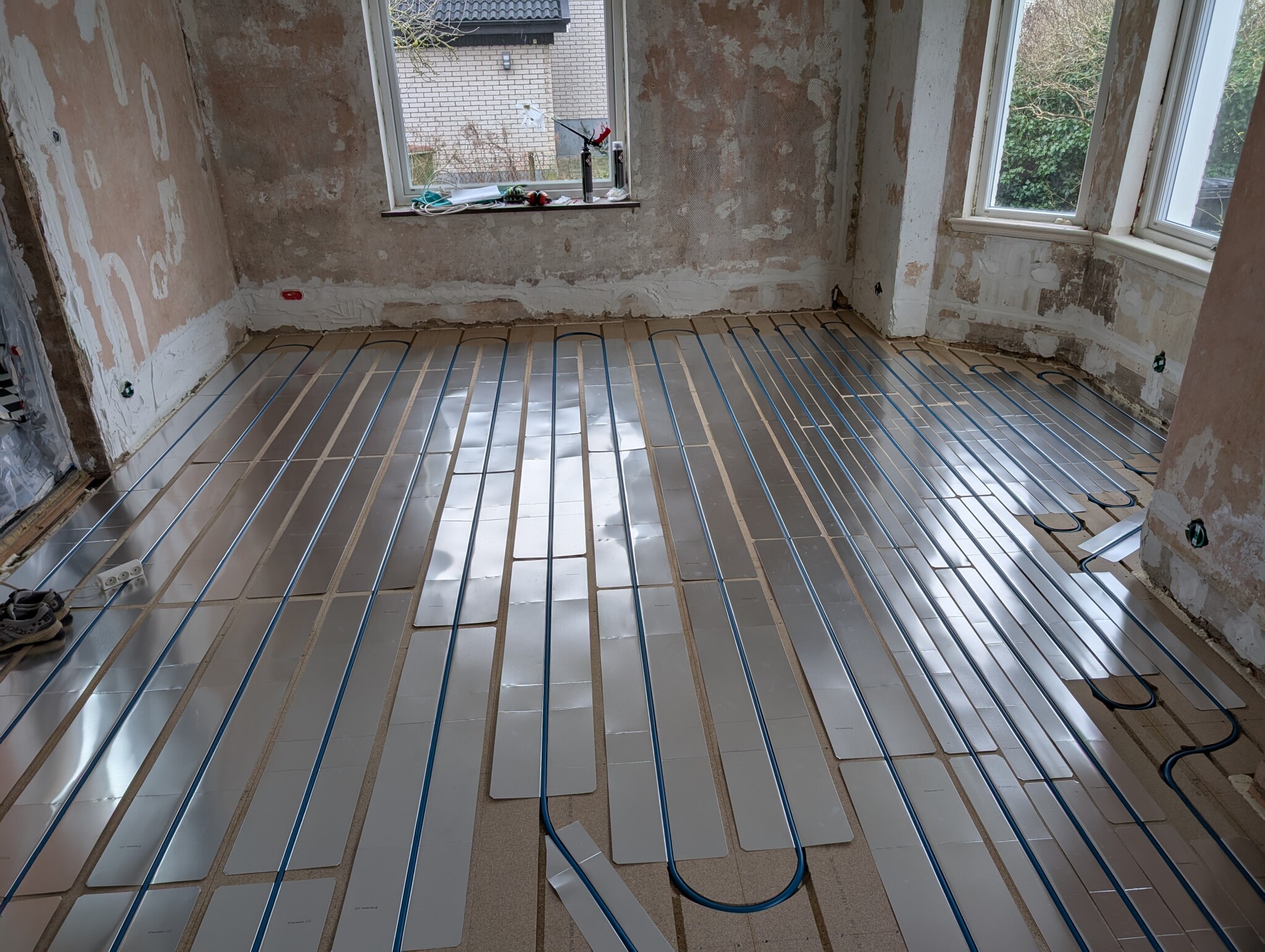
It's grooved particleboard on this:
Insulation is there too.
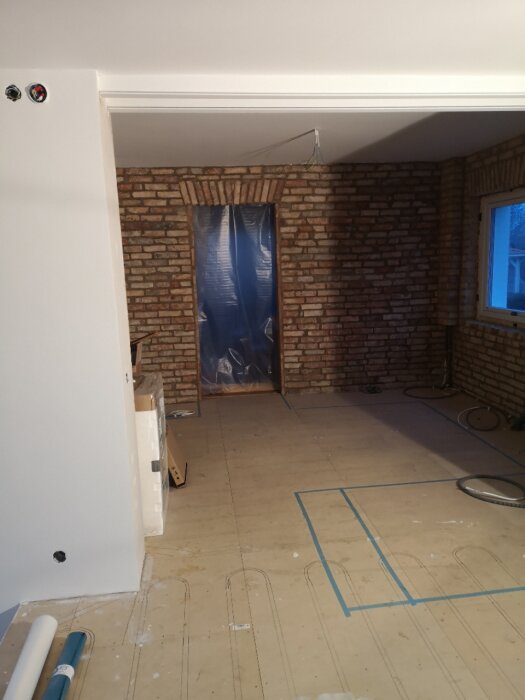
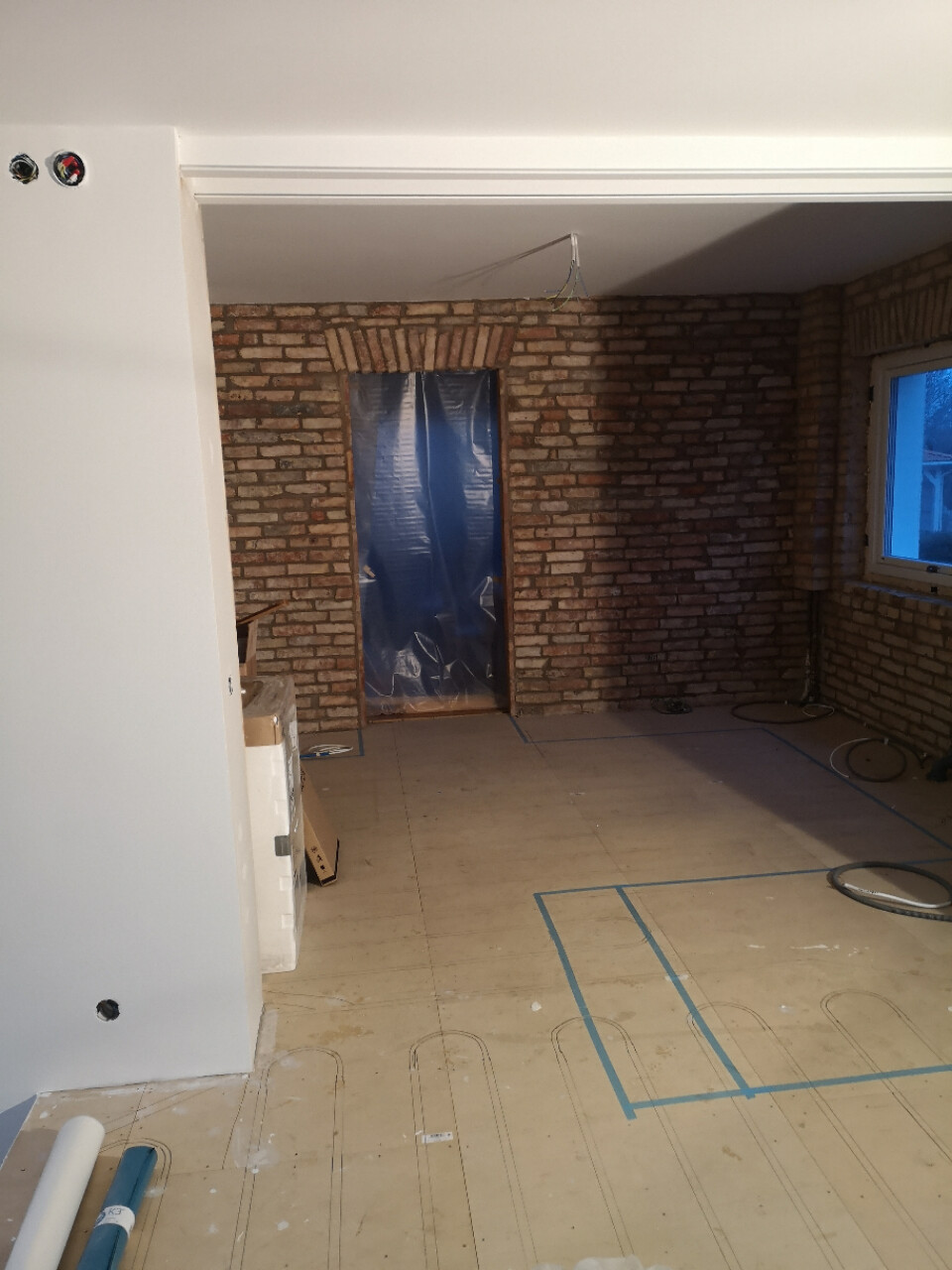
The underfloor heating works in the other room. But there it’s only 6mm plywood as mentioned.
They look like they are well reinforced by you! There isn't the same requirement for flexural rigidity when it comes to parquet compared to tiles. I don't really see the problem with the guys not wanting to float on that? Consult others in the industry for more perspectives.
But special primer with sand in it, mesh, and at least 12mm float above the loops is the industry standard otherwise in your case.
They look like they are well reinforced by you! There is not the same requirement for bending stiffness when it comes to parquet as there is for tiles. Can't really see the problem with the guys not wanting to pour on that? Check with others in the industry for more perspectives.
But special primer with sand in, mesh, and at least 12mm pour above the loops is otherwise the industry standard in your case
I've sent it to a couple of others.
Got a reply from them that they can do it. But the price of 43,000 seems a bit steep.
I'll check with a 7mm plywood and see how it looks.
No shit, what a rip-off! Had 13 sqm of self-leveling compound laid in our laundry room with an industrial self-leveling compound from Finja a few years ago, about twice as expensive as regular self-leveling compound. It cost 13k including labor after deductions!
Self-leveling compound is relatively cheap and it goes really fast for those who do it. Check around or go with the 7mm you found, if it's wavy just use more glue and screw it tighter really.
If you plan to screw, mark where the loops go on the walls and directly above on the ceiling with a hanging string where there are turns and/or crossovers.
Spread the glue evenly across the back of the board with a 6 or 8mm notched trowel.
Keep in mind that you might need to screw (and possibly glue) the panels first!
However, I still recommend self-leveling compound... ☺️
If you plan to screw, mark on the walls where the loops go, and directly above on the ceiling with hanging string where there are turns and/or across.
Spread the glue with a 6 or 8mm notched trowel evenly over the board on the backside.
Bear in mind that you may need to screw (and possibly glue) the plates first!
However, I still recommend self-leveling compound... ☺️
We marked where the loops went when we did it the last time.
Worked perfectly.
I have just worked with exactly the same "issue" and unfortunately got quite alarmed by some who emphasized the importance of having a good foundation specifically for "solid wood solutions" like herringbone parquet as it expands and contracts. I have talked to suppliers of cast-in-place concrete who told me that they have experienced cases where it was laid too thin and used "regular" cast-in-place concrete and the parquet then tore the concrete with cracks/buckling as a result.
For wooden substrates, I have heard from parquet companies that the rule of thumb is "foundation as thick as the parquet"....
Unfortunately, a too thick foundation also gives a thick floor and the underfloor heating becomes less efficient, and if you read LK's instructions, they say to contact them if the floor thickness is over 25mm (and when you do, at least I don't get very sensible answers, more than to "reduce the floor thickness").
Through a parquet supplier, I received a recommendation to use the following:
...which is supposed to be designed specifically to lie under parquet floors (despite the thickness).... I have yet to decide, but it currently feels like the "better" option, albeit really expensive.
Then, I personally think it's better to lay a wooden subfloor than to use cast-in-place concrete if possible... IF you're unlucky enough to suffer damage, I think it would be difficult to remove all the concrete and keep the underfloor heating intact....
Following the discussion and possible decisions with interest.
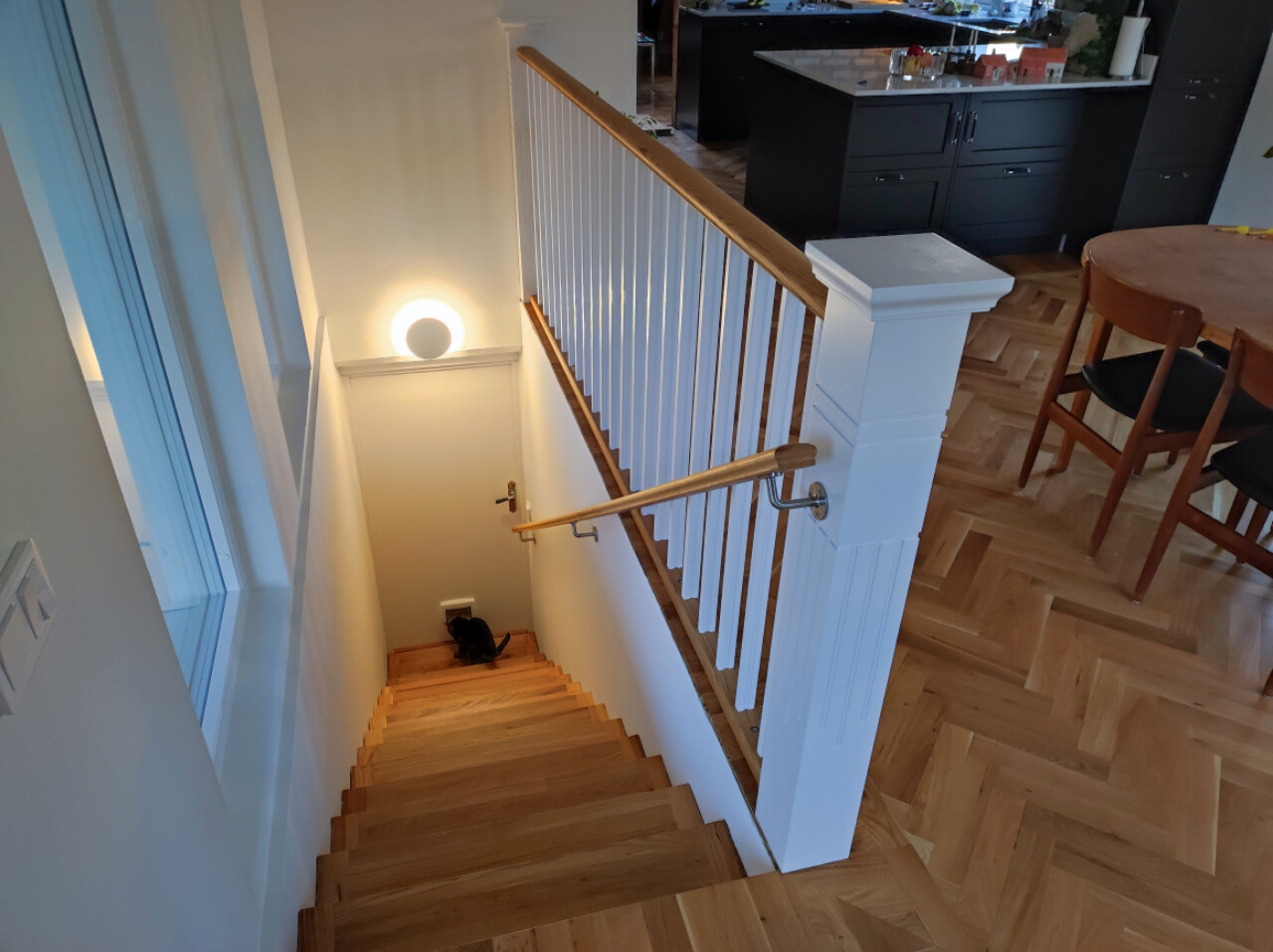
In the adjoining room, we screwed 6mm plywood as mentioned. It has worked without problems for 2 years at least. So, I'm not particularly afraid that it won't work. But of course, I want the floor to be as good as possible and to get as much as possible out of the underfloor heating. Is it then, 7 mm or 10 mm plywood, or perhaps floor gypsum that I should take?
Other room.
Vi vill skicka notiser för ämnen du bevakar och händelser som berör dig.

anders07 said: