Hello!
We have a house from the early 30s that we are renovating room by room, and now it's the basement's turn. In one of the rooms, there was wood paneling on half the wall (the part below ground) which, of course, is not a good idea, so it has now been removed.
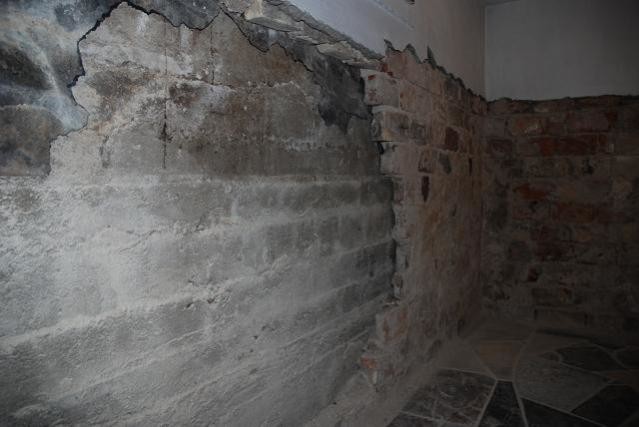
Behind the wood paneling, there was a somewhat thick layer of cement mortar with embedded wooden studs, so after some chipping away, both the studs and mortar were removed. We are going to mount wall-mounted shelves, so the wall needs to be flat, and the mortar was thicker than the wall section above.
Behind the mortar, there is a brick wall of varying quality. As the attached picture shows, part of the brick wall came off when the mortar was removed. Behind the brick wall, you can see the cast concrete wall.
So my first question is, if one now plans to plaster this wall, should it be done directly on the concrete wall, or should we rebuild the demolished brick wall and then plaster on top of it? There seems to be an air gap between the brick wall and the concrete wall that might need to be preserved? However, it's drained with Platon on the outside, and everything seems to be bone dry, even though it was likely damp before since the brick wall has seen its better days.
Is lime mortar the way to go, or can we stretch to KC for a bit better adhesion? We were planning to paint the wall afterward, and the tip seems to be silicate paint, but I'm a bit worried about odors since we have very young children.
And while I'm at it... I'm (not my partner

) considering tearing down the ceiling that is plastered with reed, etc., and putting up beadboard. Is this suitable in a basement? The subfloor is still made of wood, so it shouldn't make any difference... Should a vapor barrier be used?
If you've read this far, let me take the opportunity to thank you for your attention!
Regards,
Anders