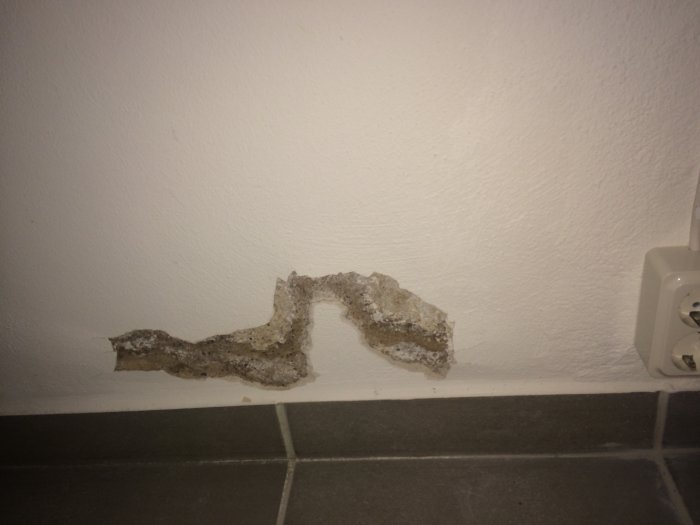
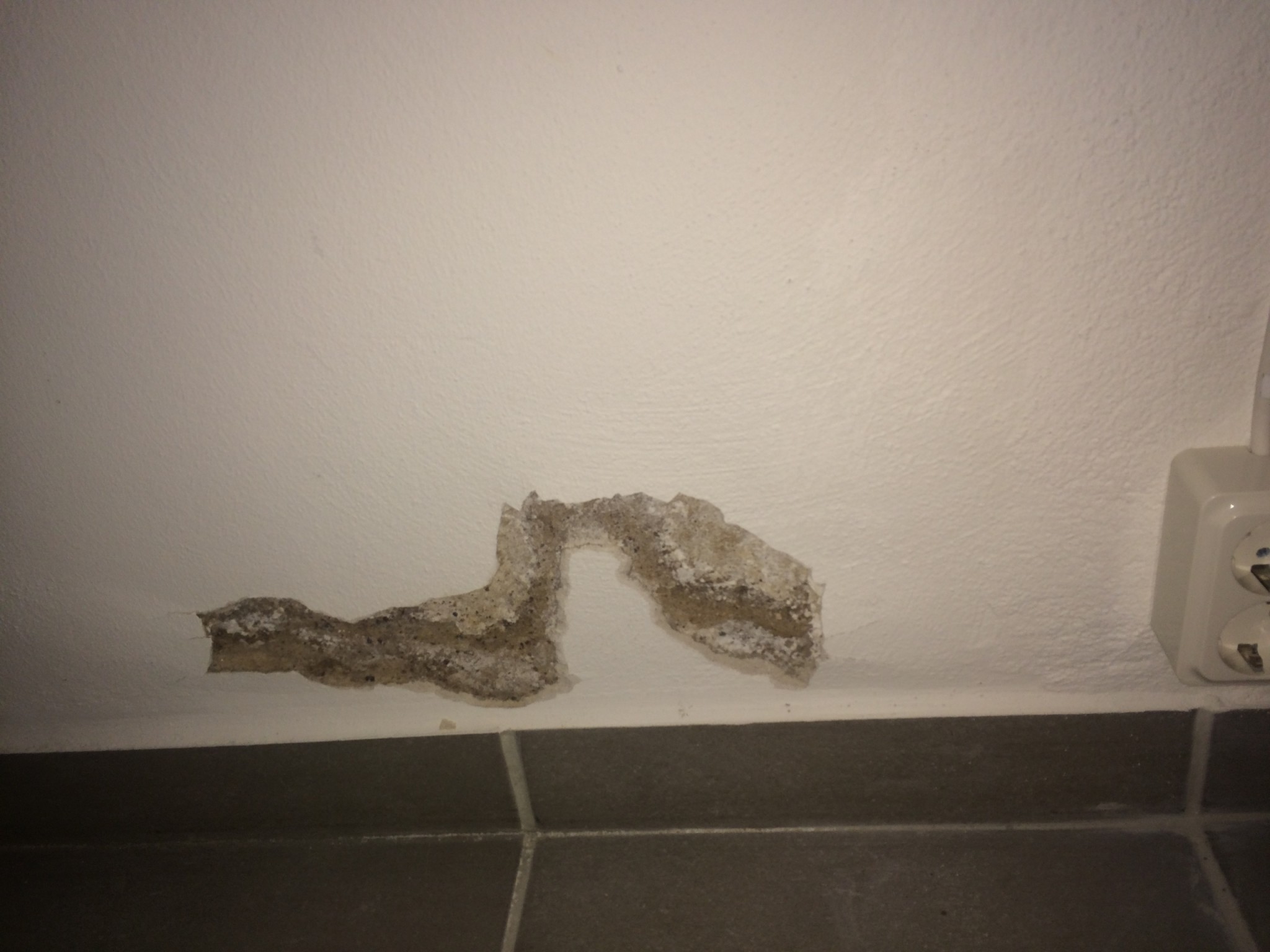
Hello! I live in a house from the 40s that was drained just a few years ago. Some of the rooms in the basement have been renovated, i.e., tiles and painted walls. In one spot, the plaster has started to come off, with no signs of it anywhere else. This is right down by the floor on the outer wall that has a staircase outside. That part of the wall is therefore not insulated/drained.
What can I do to prevent it from getting worse? Of course, I can fill it and paint white again, but it feels a bit dull to have to do it every five years; I'd rather solve the underlying problem if possible
I can add that we have a dehumidifier in the basement, so it's dry and nice.
Can investigate it in daylight tomorrow. It's an open staircase but with a wooden cover or whatever you want to call it. However, the previous owners hadn't used it for a few years, and it is not airtight.
It is most likely that water seeps into the wall during rain (but can also come up through the slab) and when it accumulates enough, it becomes so wet that the paint peels off.
Do you know what kind of paint it is?
It should be a paint that "breathes" and allows moisture to pass through, known as "silikatfärg". If it is painted with acrylic or oil paint, it is too dense and traps moisture. In that case, you must first sand off all the old paint and apply silikatfärg directly onto the plaster.
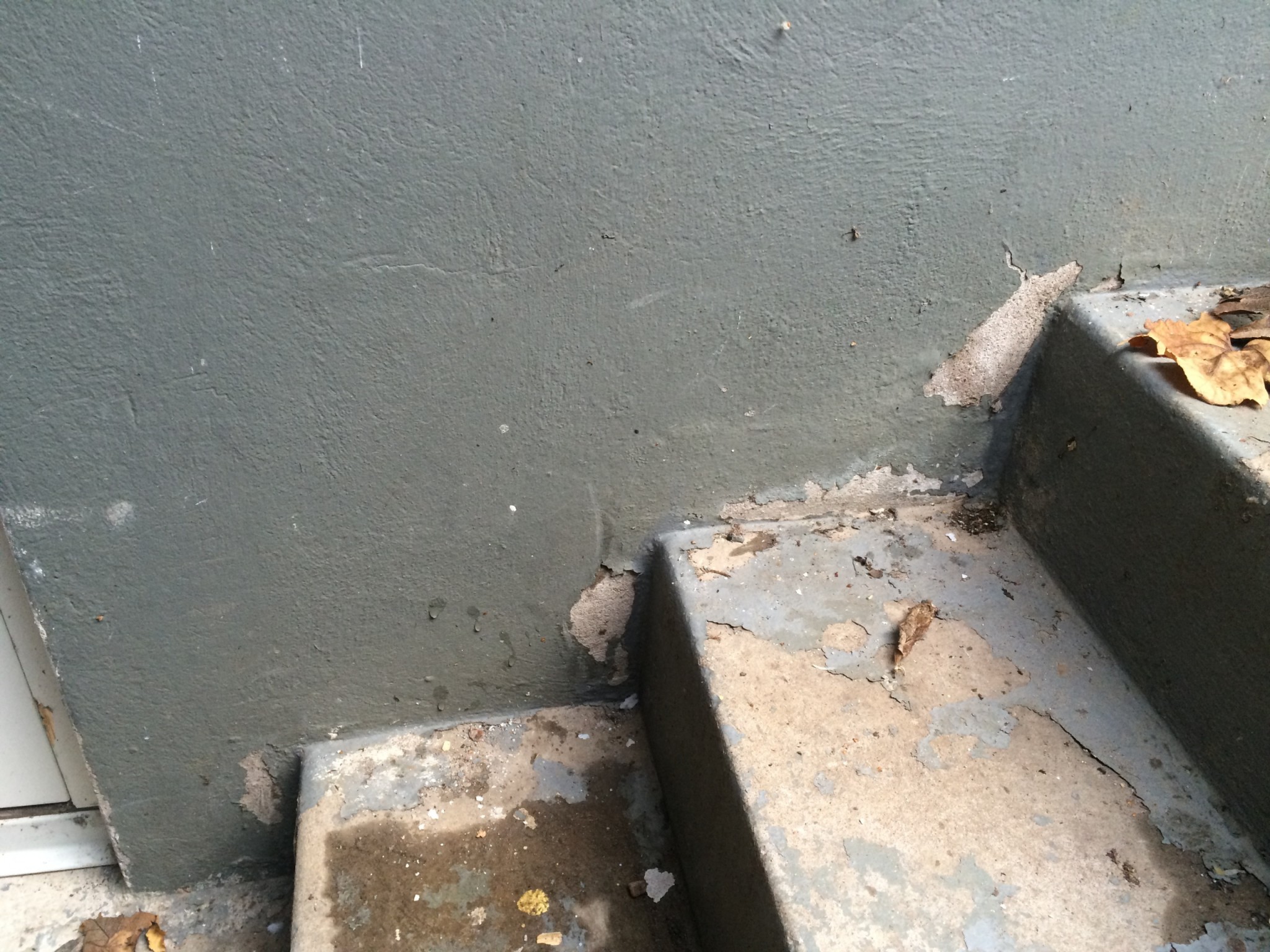
If rainwater can get in and the stairs become wet, the concrete will absorb it, and your stairs definitely seem to have received their share of water. If it has been open previously but is now closed, it could even be the aftermath from that time causing the plaster on the wall to crumble when it has dried out. You can see this on walls 1-2 years after, for example, poor drainage has been addressed.
I hope it's painted with the right kind of paint! It looks good on the inside on all the other walls and even on some other walls in the stairwell. But it has clearly taken damage from being open. We put back the lid/doors when we moved in three years ago but don't know how long the stairwell was without them before that. Unfortunately, I don't remember how the paint looked in the stairwell then, but on the inside of the wall, no damage was visible. Perhaps it showed up when we started using the dehumidifier? Either way, it's time to craft a better lid. It's especially fitting now that the windy weather has damaged the old one
It may be the dehumidifier that's causing more moisture to move inward in the wall. Moisture migrates towards heat exchange, and the drier it gets inside, the further "inward" the moisture moves in the wall.
Honestly, I don't think any cover will help. An uninsulated wall will always "leak," if not direct water, then at least moisture. If the humidity is high outside, and it's drier and warmer indoors, moisture will enter the wall even without water.
Depending on how the wall is constructed (I'm assuming lightweight concrete) and how moisture can "move" in the wall, more or less condensation occurs, and it gets wet.
The only way to fix it is to ensure that the wall can release moisture freely, meaning that moisture can migrate both outward and inward in the wall depending on the environment.
Silicate paint is the only thing that works, alternatively tiles on the wall as they can "breathe" through the grout of the tiles. You must remove the old paint completely first, but only on the exterior wall, as it traps moisture, making it wet.
If it's you who painted and you used silicate paint, you should have noticed that the paint was a bit more expensive and not available on the "regular" shelf...
It was not us who painted but a construction company hired by the former owners. I know that the company has renovated the inside, but I'm unsure if they have also painted the staircase. Since it is a reputable and (from what I understand) skilled company here in town, I really hope they have painted with silicate and not cut corners!
Well, it's not "cheating" to not paint with silicate paint, but it might be a lack of knowledge... If you know that the wall is an uninsulated exterior wall made of aerated concrete, you should consider it, but they probably saw an indoor room and went ahead with regular wall paint without thinking much further.
I think 90% of all painters would do the same thing, just go ahead with regular wall paint without reflecting on moisture.
A bit tricky, this one.
We have a completely open basement staircase where the wall is constructed with hollow block concrete and then plastered both outside and inside. The inside is painted with regular wall paint, i.e., not silicate, and despite our house being over 50 years old, there are no paint flaking or salt efflorescence, and it's probably been 10 years since we refreshed the wall with some new paint. Silicate paint is all well and good, but perhaps there are problems that need to be addressed instead. Moist walls are not good, and only addressing it with a paint that sticks is solving symptoms instead.
Is it the picture that's deceptive, or is the staircase wet on the steps, the dark areas?
Well, it's not "cheating" to not paint with silicate paint but it can be ignorance... If you know that the wall is an uninsulated exterior wall in lightweight concrete, you should give it some thought, but they have probably just seen a room indoors and gone with regular wall paint without thinking any more about it.
I think 90% of all painters would do the same thing, just go with regular wall paint without considering moisture.
It's probably concrete brick on a house from the '40s,
I would suggest that the water possibly disturbing the interior is UNDER the stairs. (Tried to estimate where the damage on the wall was in height and compared it with the stairs/steps outside)
The stairs are usually a place that often gets overlooked in drainage jobs because the stairs are not easy to move, and one would prefer not to have to redo them.
Regardless of where it comes from, it is a bit tricky to fix the problem. A basement will always be exposed to moisture, regardless of drainage (it can just as well come from the floors as from the walls - generally speaking).
If you take a quick look at your wall and stairs, it seems okay (no big cracks/settlements), the paint flakes off as usual on the steps.
If you want to try something, you might consider possibly building a roof over the stairs and the surrounding area, check how the ground slopes right there (make sure it slopes away from the house and stairs). Is there a drain by the door (?) ensure that the water gets there and away (i.e., the right gradient towards the drain, and check that the steps do not collect water).
I would probably plaster and paint the damage inside, but expect it to likely return eventually (a bit depending on the weather - just in that area). If large parts start coming off in other areas/walls, I would bring in an expert for consultation
Thanks for the tips! It's true that the step is wet in the picture, but that was due to melting snow. I don't think the stairs usually look wet unless something is dripping on them. I think I will follow what Snigla and anders07 suggest: repair the damage, scrape off all the paint on that wall, and paint with silicate. It's a tedious job, but I'd rather do it properly once. Fortunately, it's not such a big wall anyway This wall is probably the house's "weak point." No insulation, no drainage, just concrete protecting against the outside.
Click here to reply
Vi vill skicka notiser för ämnen du bevakar och händelser som berör dig.