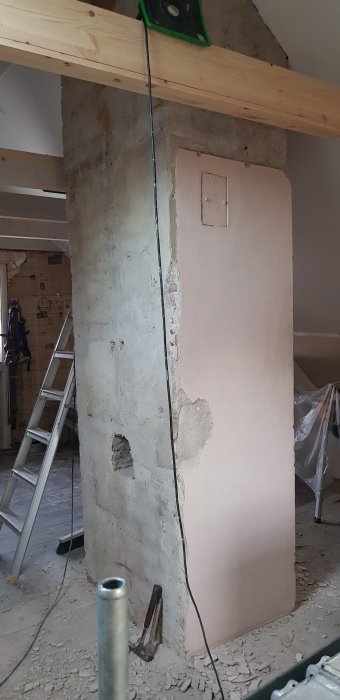
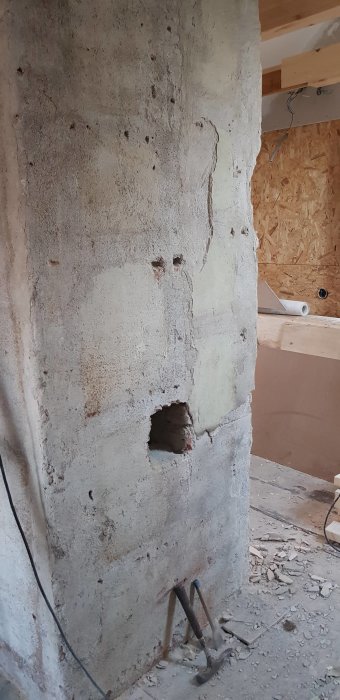
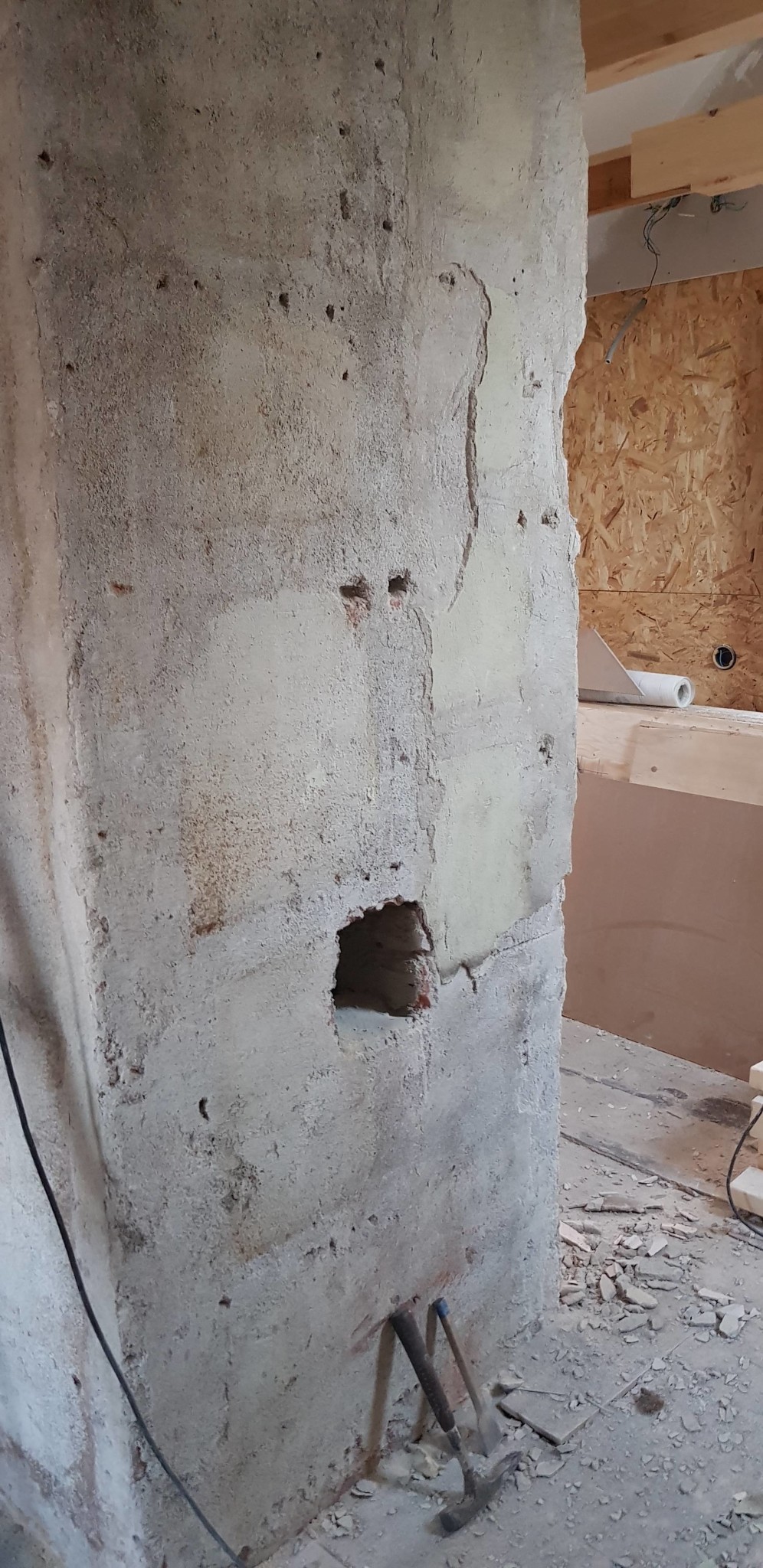
Hello, working on an attic renovation and need to plaster and paint the chimney. The house was built in 1929. Brick underneath, of course, previously plastered, repaired, and painted in some areas.
The plan is to repair the plaster, smooth it out, and then paint it white.
Started knocking down some loose plaster now and noticed there seems to be some light but fairly hard mortar originally on the brick, perhaps KC mortar.
Then it seems that in some areas it's been plastered over with a fine-grained mortar, which adheres well without sounding hollow, but is very porous and can basically be scraped off with a masonry hammer and chisel. This is painted pink and yellow in the photos below. It should be lime mortar, even though you can't really see the ballast in it, which I usually think you can see when it's lime plaster. But when it's so loose, it can hardly be anything else, right?
So - skip removing the porous mortar and plaster/repair/smooth out the rest with lime mortar. Or remove all the loose mortar so only the harder KC mortar remains, and then repair/smooth out as needed with C mortar?
Lime plaster should be what was originally used, and it must work excellently today as well. If you paint the plaster with linoljefärg, you get a good patina as a bonus. I have personally used linoljefärg on plastered chimneys with excellent results. It lasts for decades.
It's not outdoors, it shouldn't be necessary with silicate/lime paint, I was thinking of using a type of matte wall paint. Or linoljefärg as mentioned above, but it's many square meters and would probably be quite expensive
Do not use acrylic paint, it is impermeable and therefore unsuitable for plaster. Alkyd oil paint works but does not provide the same good results as linseed oil paint. Linseed oil paint is not excessively expensive, especially not in relation to its lifespan.
Absolutely, I agree with that, our entire house (1920s) is a lime-plastered brick house, painted with lime paint from Sto most recently in 1996, held extremely well.
But I learned from an old mason that the choice of plaster paints depends on which mortar you are painting on. For lime plaster, KC plaster, of course silicate, lime paint, or at least mineral-based.
But on our plastered (type B mortar, hard anyway) concrete base, we painted according to the mason's advice with regular Alcro base paint, probably acrylic. It held just as well as the lime paint on the lime plaster. The foundation should be plastered with harder mortar and can just as well be painted with acrylic.
It also depends on whether it's weather-exposed. Indoors, I find it hard to believe that the paint needs to be as diffusion open as it does outdoors.
But my concern is whether it's risky to use C mortar when the substrate is a bit mixed KC and lime mortar.
The main rule is not to use a harder mortar on top of a softer one, but it's probably not a disaster to use C-mortar. But the question is why? Painting a base (concrete block or pure concrete) on one side with an acrylic-based paint probably can't be compared to painting a chimney, which gets warm in the middle, with the same type of paint. Another main rule is that diffusion-tight layers should be applied on the warm side of a construction. I wouldn't take the chance.
Ok, then I'm with you, thanks for the clarification. But considering that it's preferable to paint planed rather than sawn wooden surfaces with linseed oil paint, I'm wondering how it works to paint on lime plastered surfaces. I imagine that nothing flows out, it absorbs a lot, and the brush wears out immediately. But maybe I should challenge my concerns then
Ok, then it's polished and done. Now I'll water it for 3 days, then I plan to apply lime paint (I was considering linseed oil paint, but I got hold of white "cultural lime paint" from Weber cheaply at Beijer 10 minutes away!).
But! Now I saw on some site (Alcro) that "The plaster should have hardened (carbonated) for about 3-4 weeks under regular moistening."
Annoying! Is it really necessary indoors? I remember our mason painted lime paint on lime plaster pretty quickly outdoors on our facade. And it has lasted for 8 years now.
Click here to reply
Vi vill skicka notiser för ämnen du bevakar och händelser som berör dig.