
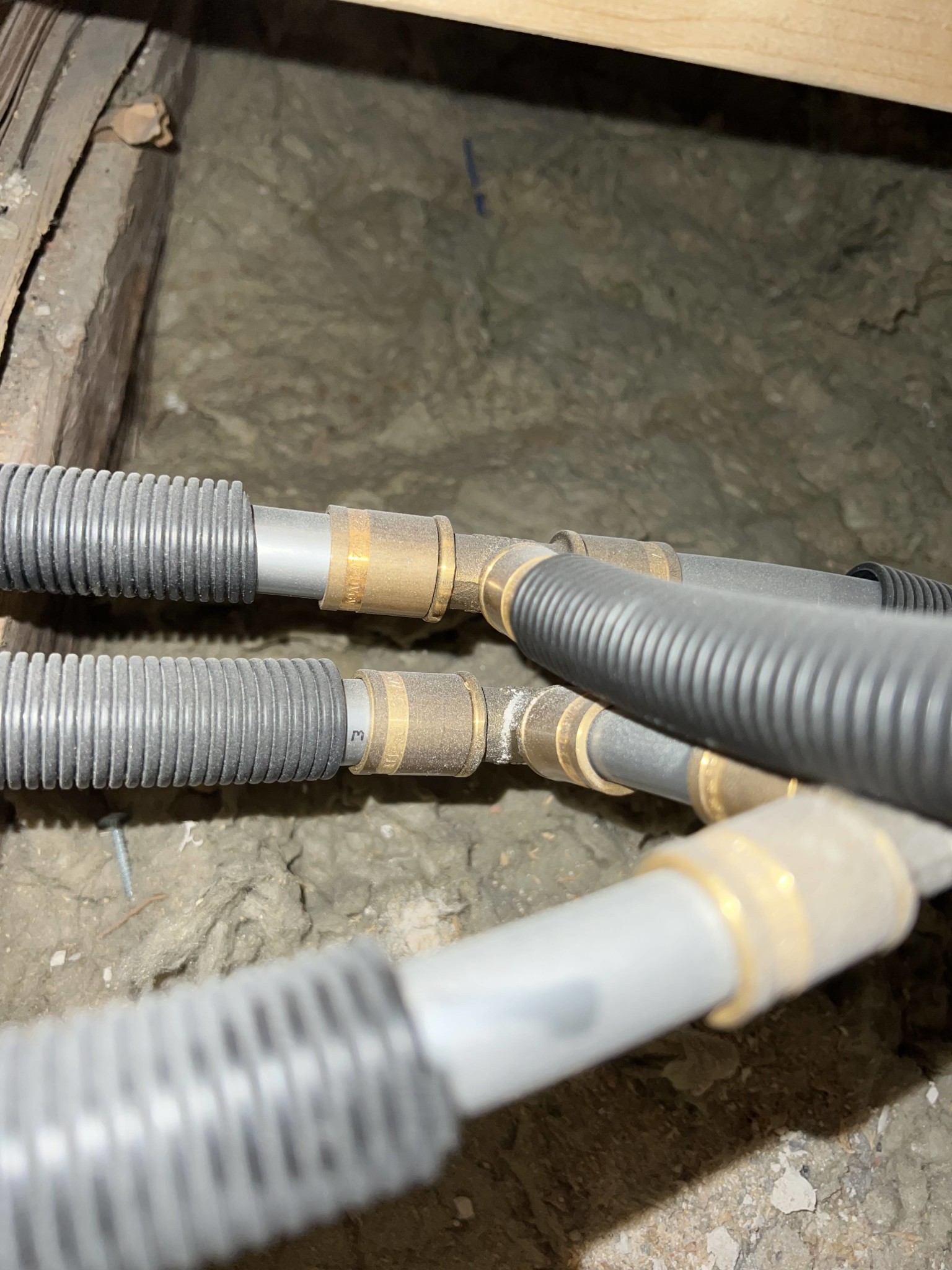
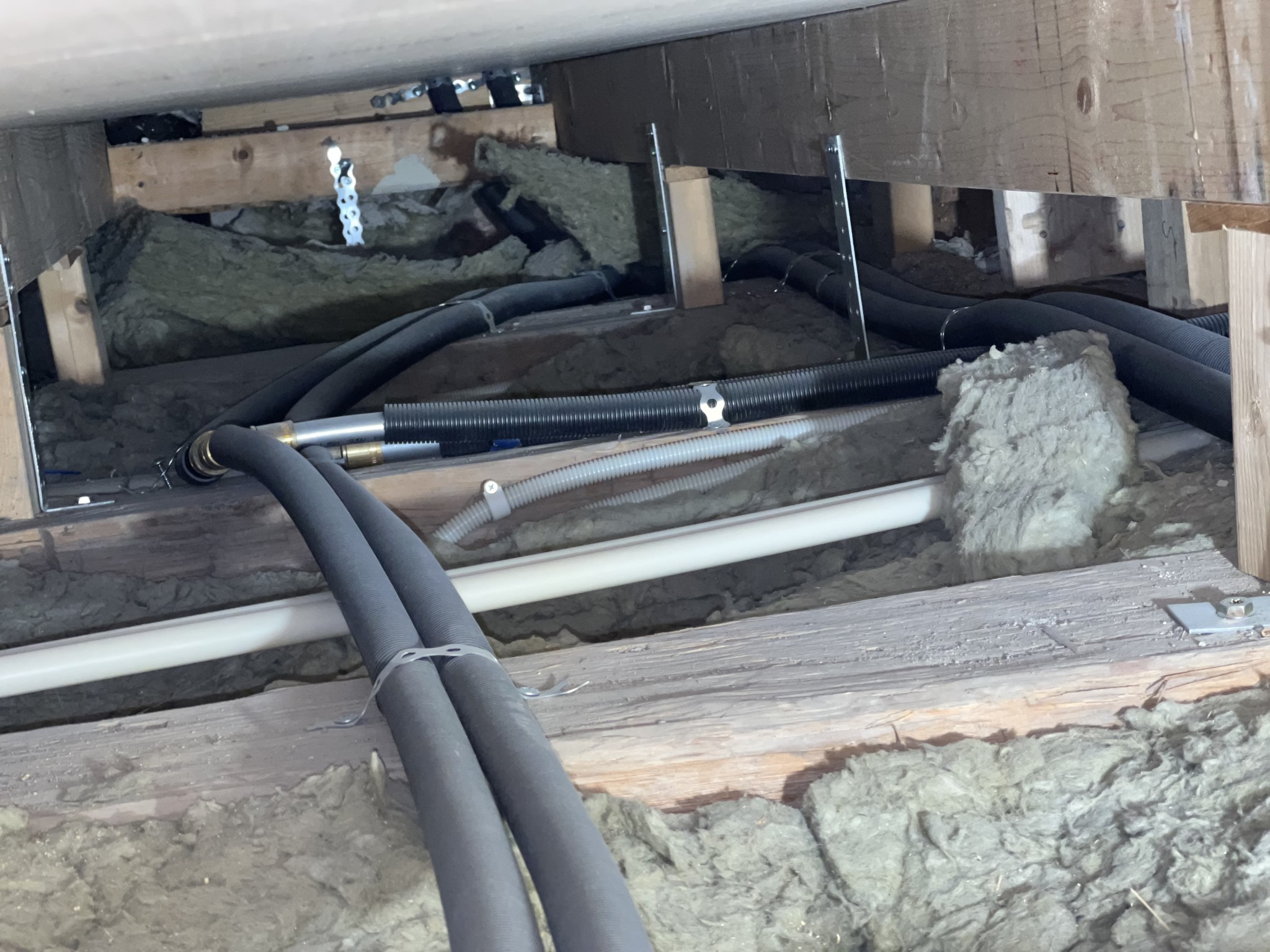
I have an apartment (condominium) in an old building from 1850. The house was completely renovated to modern standards in 2004 by a large and reputable construction company. Due to water damage (nail in pipe), we have torn out the bathroom. Under the floor, there is a 30-40 cm air space for pipe installations, etc. Below that, the old timber beams are located. See attached images.
I have read that hidden pipes are not supposed to be spliced. However, in this case, I have found several splices (type T-junction) under the removed floor. Maybe it was okay to do so 18 years ago? The black hose outside the pipe is probably intended as extra security so any leaking water can drain to a well-chosen place, right? Here, it would run straight into the joist. We don't have a distribution cabinet or similar; instead, the right hose/pipe in image 2 is the incoming water which is then divided into branches under the floor.
I have also understood that new installations must be done according to today's standards during renovations. In itself, it's not a problem now that we can access the splices under the bathroom. The problem is that I can see more splices under my hallway floor (a few meters outside the bathroom) leading to the kitchen and laundry room. These cannot be accessed for replacement without also tearing up the hallway floor.
How should I approach this? Just take care of what I can reach and ignore the rest - or redo everything? What are my obligations to the association/neighbors? How does the insurance company view it if a splice under the hallway floor breaks in a few years? Theoretically, I could have replaced it, but at a fairly large cost. Can I claim additional compensation for the extra costs from the insurance company? Pressurized piping is technically the association's property. Should I discuss this with the board? Share your wise advice!
I have read that hidden pipes are not supposed to be spliced. However, in this case, I have found several splices (type T-junction) under the removed floor. Maybe it was okay to do so 18 years ago? The black hose outside the pipe is probably intended as extra security so any leaking water can drain to a well-chosen place, right? Here, it would run straight into the joist. We don't have a distribution cabinet or similar; instead, the right hose/pipe in image 2 is the incoming water which is then divided into branches under the floor.
I have also understood that new installations must be done according to today's standards during renovations. In itself, it's not a problem now that we can access the splices under the bathroom. The problem is that I can see more splices under my hallway floor (a few meters outside the bathroom) leading to the kitchen and laundry room. These cannot be accessed for replacement without also tearing up the hallway floor.
How should I approach this? Just take care of what I can reach and ignore the rest - or redo everything? What are my obligations to the association/neighbors? How does the insurance company view it if a splice under the hallway floor breaks in a few years? Theoretically, I could have replaced it, but at a fairly large cost. Can I claim additional compensation for the extra costs from the insurance company? Pressurized piping is technically the association's property. Should I discuss this with the board? Share your wise advice!

Everything beneath the surface layers is the association's responsibility, so I would have sent the pictures and concerns to them. They are involved anyway since the water damage likely affects the structure and thus the association's property.


Your obligations here are minimal; you did the right thing by informing the condominium association's board, so they can decide whether to reroute these pipes that the association is responsible for. If it's a small association, the simplest solution is usually for the board to get a quote from the plumber already involved in the project to fix the pipes. Alternatively, the board may decide to live with the risk that it could leak without being detected. That day, that trouble, so to speak.
Yes, sounds reasonable.
But still curious about the joints, are they OK a’la 2004 and can they remain now that we know about them and have a (theoretical) chance to replace them?
We are 8 apartments in the association living in these old buildings, so if you replace them in mine, there are still 7 left. The association also consists of an additional 80 apartments in newer buildings.
But still curious about the joints, are they OK a’la 2004 and can they remain now that we know about them and have a (theoretical) chance to replace them?
We are 8 apartments in the association living in these old buildings, so if you replace them in mine, there are still 7 left. The association also consists of an additional 80 apartments in newer buildings.
Depends on which perspective you have when reading safe water. Tap water should always be installed without hidden joints. Some believe that VS can be installed with hidden joints.M Ferro94 said:Yes, sounds reasonable.
But still curious about the joints, are they OK a’la 2004 and can they remain now that we know about them and have a (theoretical) chance to replace them?
We are 8 apartments in the association living in these old buildings, so if they are replaced in mine, there are still 7 left. The association also consists of an additional 80 apts in newer buildings.
I would argue that hidden joints should be avoided.
2004 I have no idea exactly what the regulations said.
Click here to reply