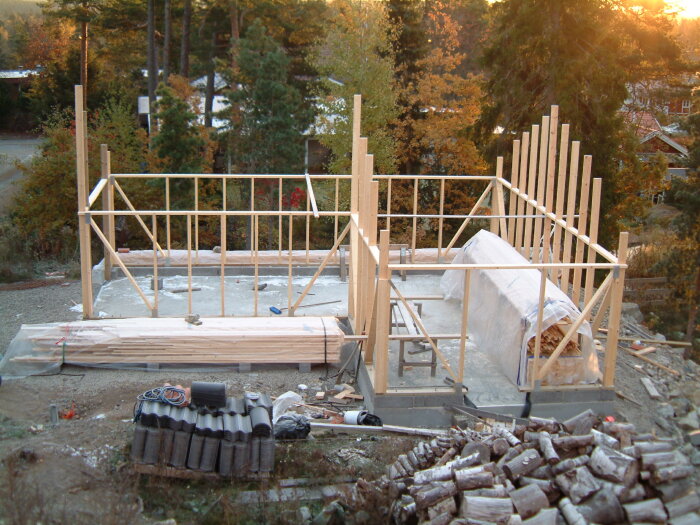
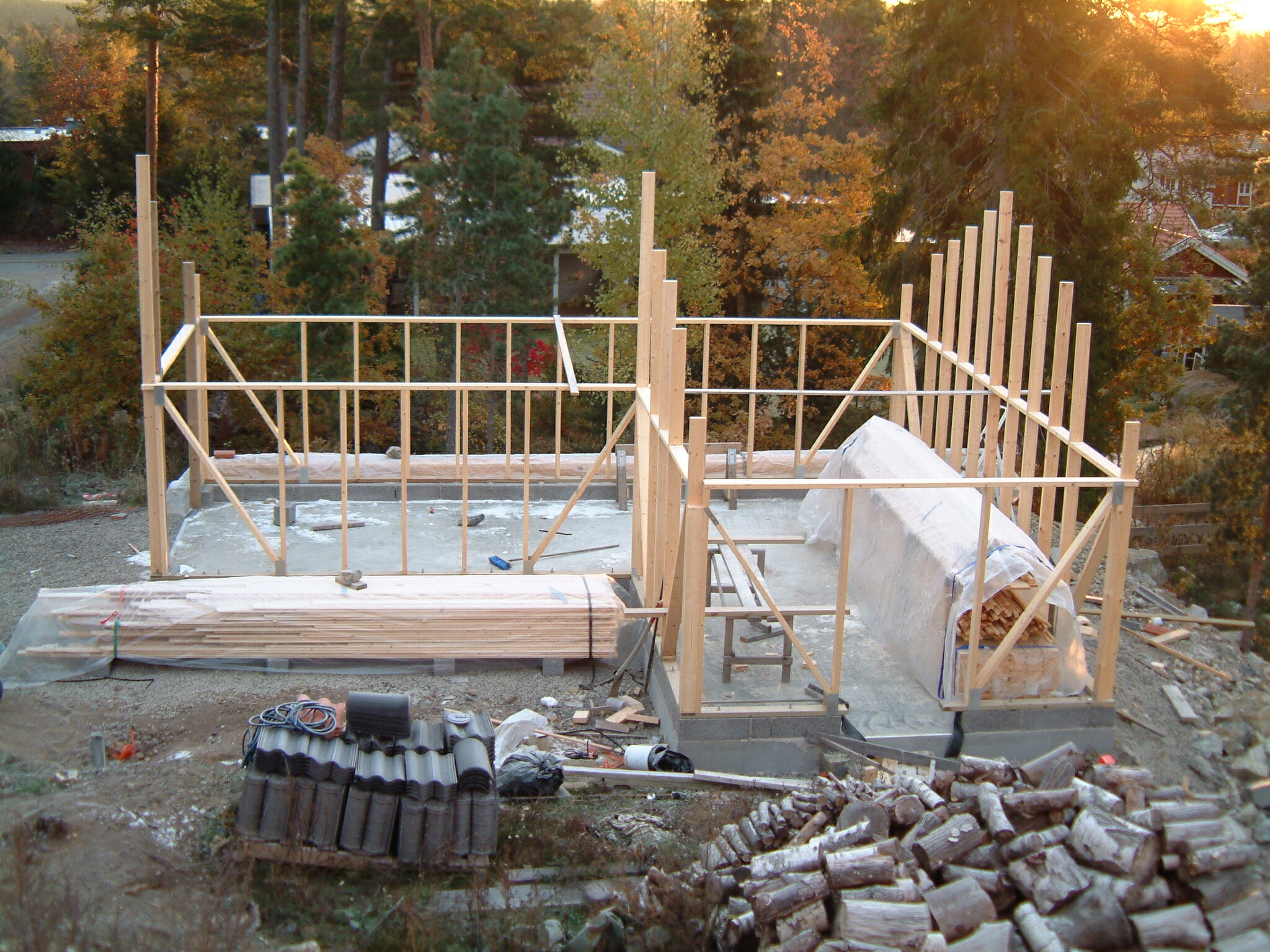
As many have pointed out. There need to be diagonal braces in all directions in the corners. It will of course be better when asfaboard is placed on the outside and OSB+gypsum on the inside, but until then it will be very wobbly without these...
Picture from my garage build...
What does the construction drawing say? How should the walls be laterally stabilized? With panels? How close with screws? Does the drawing of the roof trusses include cross braces between the trusses or should the roof be stabilized only with raw board?
Aabiz said:
Hey, I'm in the middle of building a double garage, when I was about to put up the raw board, I noticed that the whole frame was wobbling. Is this normal? Even now when all the raw board is up, it still wobbles a bit, will this fix itself with the facade or when there's a bit more weight due to the roof tiles?
I'm a bit worried that I've missed something I should have put in haha, I'm attaching some pictures so you can see how the frame is constructed.
By the way, I think that the raw board doesn't necessarily need to go all the way to the ridge, the small gap of about 5-7cm that I have now can be covered with paper, then I'll put ridge board holders, a ridge board and ridge insulation over there so it feels unnecessary to spend time getting it perfect there, what do you think?
Edit: I assume that the sill insulation, which is about 1 cm foam, can make it all a bit wobblier?
Bracing with iron bands rarely works well. They slacken in the summer when it's hot.
What's missing is:
-Wind protection boards on the walls. Wind fabric is a nuisance that's only good for wrapping up the manufacturer when you've killed him and need to dispose of the body.
-Braces on the walls, especially the back wall
-Braces in the intermediate ceiling
-Braces to prevent the roof trusses from toppling over.
No construction drawings are needed for this. It's all about common sense.
What do you mean also? It is only the embedded beam that carries the roof trusses. Just as I wrote, it is only 45 mm that carries the roof trusses on each end.
The wall plate doesn't contribute at all when it comes to supporting the roof trusses...
Exactly, and it works.
You don't need to have a beam under every roof truss.
The general joint being discussed is in the lower beam of the roof trusses.
Exactly, and it works.
You don't need to have a rule under every roof truss.
The "generalskarv" being referred to is in the lower frame of the trusses.
What I wondered was what you mean by "also"?
What do you mean it works? It feels like you're just guessing.
And I didn't talk about having a rule under every roof truss, it was posts I was talking about. Of course, it's better to have a post under each roof truss, that's what carpenters do when they build, probably for a reason.
The "generalskarven" in the lower frame is absolutely not a problem, it's only tensile forces there. And there was no mention of the lower frames in the text about "generalskarv," only "överliggare."
But spontaneously it feels like some people are exaggerating a bit. It won't "collapse," very few buildings in this country do.
Sure, it's better with braces or perforated strips, but once it's finished with paneling it probably won't sway or collapse either.
But spontaneously it feels like some people are exaggerating a bit. It won't "collapse," very few buildings in this country do that.
Sure, it's better with braces or metal bands, but once it's fully built with paneling on, it probably won't sway or collapse.
Well, there's no panel on TS's construction yet. Once it's there, it's mostly about when the autumn storms set in, that's when having the stability isn't such a bad idea.
Yes, garages are a type of building that is somewhat sensitive. Due to the large opening on the entrance side, where you essentially have no stabilizing wall, a garage building becomes quite sensitive.
A relative’s neighbor renovated his garage, extended it with a storage section, and at the same time replaced the roof, moving all the roof tiles from one side of the roof to the other. He extended by demolishing the rear gable wall and expanding there. One windy night, the entire building collapsed like a house of cards.
He had previously built an unauthorized storage section as an extension against the rear gable wall. He was given an order to demolish it, which he did. The day after the inspection from the building permit office, he started rebuilding the storage section again, but now as a direct extension of the garage, with bad consequences...,
I also heard some years ago about a double garage that essentially blew away when the garage doors were open. It was also built by a contractor known from TV, "fuskbyggarna". There too, it was primarily a matter of instability.
What I was wondering was what you mean by "also"?
What do you mean works? Feels like you're just giving your opinion and guessing.
And I haven't talked about having a support under each truss, it was posts I was talking about. Of course, it's better to have a post under each truss, that's what carpenters do when they build, probably for a reason.
The "general splice" in the subframe is absolutely no problem, there are only tensile forces in it. And nothing was mentioned about the subframes in the text about general splice, only "top beams."
Are you going to answer what you mean by "also"?
That is, what besides the beam carries the roof trusses. I don't see anything other than the beam supporting them..
Here's an image showing how standing studs are typically placed under the roof trusses.
But now there's a real hammarband in this garage. If you have that, I don't think it's of much importance if there aren't posts directly under each roof truss. The weight is distributed anyway.
In the image above, there's nothing like that at all........
Are you going to answer what you mean by “also”?
That is, what else besides the beam supports the roof trusses. I don't see anything other than the beam supporting them...
Here's a picture showing how standing studs are usually placed under the roof trusses.
Well, wall plates are better and resolve the placement of windows and doors. But there are certainly other theories.
The garage has wall plates.
One thing I notice is that the roof trusses only rest on a 45mm load-bearing surface at each end. It spontaneously feels like there could be a very high pressure on a small area, especially with snow load, but otherwise too.
On my garage, I have a post directly under each roof truss. With 120 cc on the roof trusses, a truss ends up on every other post. I don't know if it's necessary, but it becomes robust with a significantly larger load-bearing surface.
There is a recessed supporting beam of 170mm on the outside of the top plate. It was the contractor who recommended this because the roof trusses didn't align exactly with the wall studs.
But quite spontaneously, it feels like some are exaggerating a bit. It won't "collapse" - very few buildings in this country do that.
Sure, it's better with bracing or metal bands, but once finished with cladding, it is unlikely to sway or collapse.
Well, a sports hall in my county suddenly collapsed one winter day because the builder neglected braces that would prevent the trusses from tipping, relying instead on taplåten to hold them together. Pure luck that no one was there at the time, many could have died. A large hall turned into kindling.
Vi vill skicka notiser för ämnen du bevakar och händelser som berör dig.



Nissens said:
FredrikR said: