Janu78 said:
Hi, no offense but this is an example of how it should not look.

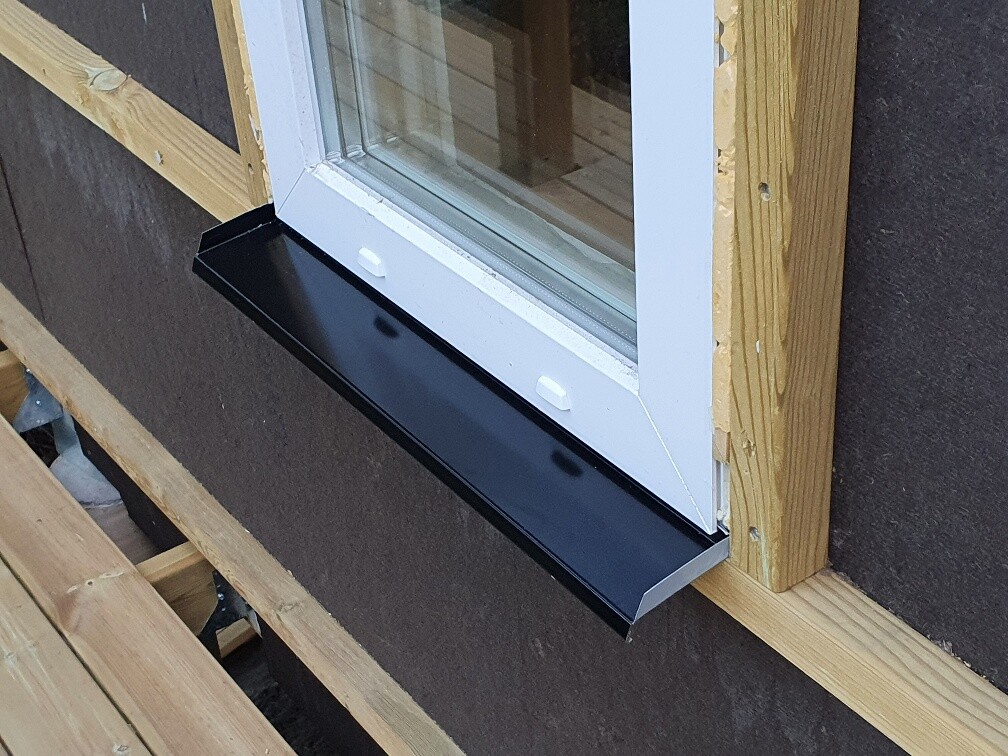
The flashing should also cover the air gap, either behind the asfaboard or directly against the asfaboard with sealing between the asfan and the sheet metal.

Your flashing lacks the upturned eaves as it should be.

Then the sheet metal should extend 40mm beyond the outside of the casing if I remember correctly.

Because as it is now, driving water that gets behind the panel can run into the construction over the window.
Are you possibly confusing over- and under-flashing?
Window with a black metal sill flashing installed, showcasing lack of side protection for the overflashing.
Upturn is needed to protect the casings but you have none on the sides for the flashings...
 
P
Cruzze Cruzze said:
You might not be mixing up upper and lower flashing?
[image]
No, the window flashing looks fine.
 
  • Like
J_K_H and 1 other
  • Laddar…
P
Cruzze Cruzze said:
You're possibly mixing up överbleck and underbleck?
[image]
I'm closing this thread now, a few too many DIY fixers so it's unfortunately not turning out so well😤
 
  • Like
leifberggren and 2 others
  • Laddar…
Janu78 said:
I am closing this thread now a bit too many DIY fixers so it's not going so well unfortunately😤
You are welcome to explain the purpose of the bend on the overflashing and how these bends should integrate into the outer panel...
 
P
Cruzze Cruzze said:
Please explain the purpose of the bend on the top flashing and how these bends should be integrated into the outer panel...
You bend up one edge that you have on the window flashing. Then you make the panel as you have done, I usually have 28mm between the bottom edge of the panel and the metal, but you can have less if you want, just a bit difficult to paint the end grain. The bend is so the water doesn't drive in behind the panel.
 
  • Like
Daniel Barnaniel
  • Laddar…
Cruzze Cruzze said:
Unruly thread this...
Mounted on furring strips, or rather another horizontal batten as the furring strips didn't align vertically:

[image]
Then over with the panel with drip edge, and it will be fine...
[image]
So if you change windows, do you have to tear down the panel as well?
 
P
E Evalarsson36 said:
So if you replace the windows, do you have to tear down the panel as well?
But he's not replacing them.
E Evalarsson36 said:
So if you replace the windows, do you have to tear down the panel as well?
often you need to, at least above windows and doors, people don't seem to understand the importance of properly installed overbleck!
 
  • Like
Joak
  • Laddar…
Janu78 said:
But he doesn't change.

often you need it above windows and doors, people don't seem to understand the importance of properly installed drip caps!
What do you mean by he doesn't change? That's why I'm asking, right? But there are very mixed opinions here and no one claiming to be a metalworker.
 
P
E Evalarsson36 said:
What do you mean by he's not really switching? That's why I'm asking. But it's very scattered here and no one claims to be a tinsmith.
You come in with the question in the discussion that Cruzze and I have, it's not scattered, that's how it should be done. But you can do what you want with your house since you have not understood the importance of properly installed flashings.
E Evalarsson36 said:
What do you mean by he's not really switching? That's why I'm asking. But it's very scattered here and no one claims to be a tinsmith.
 
E Evalarsson36 said:
The carpenter says it should sit behind the wind paper. How that will work, I don't know. Seems difficult when you're replacing windows, I think.
Your carpenter is correct in principle even if the attitude is wrong. The flashing should have its top and back edge behind the wind barrier. Water can penetrate behind the panel, run on the barrier, and should exit via the flashing.
 
  • Like
UffePlåtis and 1 other
  • Laddar…
E Evalarsson36 said:
What do you mean by he doesn't switch? That's why I'm asking. But there is a very mixed bag here and no one claims to be a roofer.
I'm a roofer and yes, Janu is right. You shouldn't need to remove either the flashing or the panel during future window replacements if some thought is given to the installation of the flashing.
 
  • Like
UffePlåtis and 2 others
  • Laddar…
P Plåtsax said:
I am a sheet metal worker and yes Janu is right. You should not need to remove either the flashing or panel for future window replacement if you think ahead a little during the installation of the flashing.
Ok. Thank you
 
Janu78 said:
You enter with the question in the discussion that Cruzze and I are having; it is not random, that's how it's supposed to be done. But you can do whatever you want with your house since you haven't understood the importance of properly installed overbleck.
Of course, I understand that it's important to do it right. I don't know why you keep misinterpreting me. That's why I'm asking.
 
E Evalarsson36 said:
I'm having a discussion with my carpenter about how the flashing should be placed. We don't completely agree. Is there anyone here who is a sheet metal worker who can show pictures of how it should look? Wood panel
When I installed mine, I placed the flashing against the wind barrier and taped the upper edge of the flashing to the wind barrier with construction tape. Then nailed lath over it. The wind barrier should be as intact as possible.
 
J J_K_H said:
Hen can't mean wood paneling with "fasad".
What do you mean a facade can't be made of wood, YES HE knows that I put up base paneling on the wall
 
  • Haha
UffePlåtis
  • Laddar…
Vi vill skicka notiser för ämnen du bevakar och händelser som berör dig.