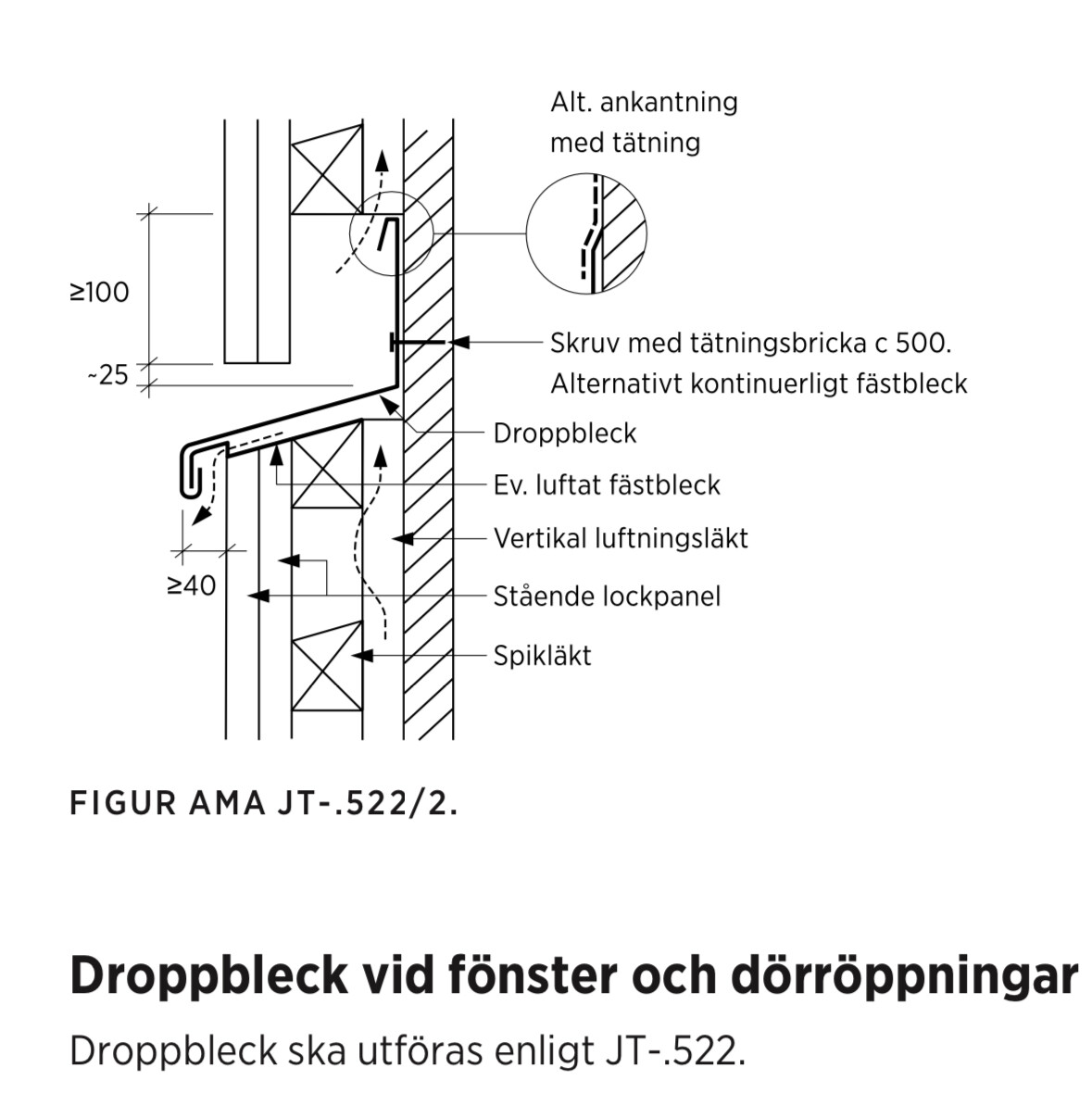
He is not wrong. During renovation, you must adapt according to reality, of course. But I would say that the further in the flashing is placed, the better. I have always tried to install it inside the wind barrier or on the wind barrier with sealing/tape between the metal sheet and the wind barrier. This is to lead out any water that may find its way in behind the facade. In practice, it shouldn't be many drops. Even House AMA states that "Drip flashings should be installed in such a way that water that can penetrate a ventilated and drained air gap is led out of the construction." House AMA is not a law but a reasonably good starting point.
In my ears, he sounds like a serious carpenter on this technical issue, definitely more work than placing the flashing further out. However, his poor attitude is unfortunate, to put it mildly.
Janu78 writes a good solution that I would strive for if possible.
According to HusAMA: "Drip edges should be installed in such a way that water that may penetrate a ventilated and drained air gap is directed out of the structure."
Drip edges are "flashings for directing water at, for example, decks, balconies, hatches, top edges of windows, doors, and the like."
There are also solutions where one edges metal against e.g. a windboard with sealing.
If you ensure that water penetrating behind the panel is directed out of the structure, you get a good professional solution as long as you also consider that windows can be replaced and the facade is ventilated (if there are requirements).
Janu78 writes a good solution that I would strive for if possible.
According to HusAMA: "Drip edges should be installed in such a way that water that can penetrate into a ventilated and drained air gap is led out of the construction."
Drip edges are "flashing for the drainage of water at, for example, terraces, balconies, hatches, window tops, doors, and similar."
There are also solutions where you connect flashing to, for example, bargeboards with sealing.
If you just manage to lead out water that penetrates behind the panel out of the construction, you get a good professional solution as long as you also consider that windows can be replaced and the facade is ventilated (if required).
Thank you finally someone who knows something, so many DIYers and know-it-alls who find something on the internet and think they are experts!
There are many different ways to install flashing, and different methods can be appropriate for different houses depending on how the house wall is built and constructed.
To determine if it is professionally executed, much more information about your house is needed, and in practice, probably an on-site inspection; only then can one say if it is professionally acceptable or not. Googling how it's done in new constructions today is not necessarily the right approach for an old house with a different construction.
It's unfortunate that the original poster and the builder cannot find functional communication to resolve this.
There are many different ways to install flashing, and different methods can be appropriate for different houses depending on how the house wall is built and constructed.
To answer whether it has been done professionally requires much more information about your house and probably an on-site inspection. Only then can one say whether it is professionally acceptable or not. Googling how it is done in new constructions today is not necessarily the right approach for an old house with a different construction.
Then it's unfortunate that the OP and builder can't find a way to have effective communication to sort this out.
But if the carpenter proposes and wants to place the flashing inside the wind barrier, one can assume that this is possible to do. And also assume that it is correct since it is the preferred method according to current "industry standards." But of course, with more information that we don't currently have, it might have been different.
However, if the carpenter has suggested and wants to put the flashing inside the weather barrier, one would assume that it is possible to do so. And also assume that it is correct since it is the preferred method according to the current "industry standards". But sure, with more information that we don't have now, it might have been different.
Yes, it is far too early to clearly express that something is wrong. The original poster wants clear black and white information about what is wrong or right, but reality is a bit more complicated than that. To be able to catch your carpenter in such a way that it is truly wrong and not professionally done, a lot more info is needed. Without it, the question is impossible to give a correct answer to.
This is a bad solution as the drip edge does not lead water out from the construction. The solution risks water being directed behind the nail battens to the window's sealing space and damaging both the construction, the window, and the interior materials.
Furthermore, the panel lacks ventilation even though they claim it does, as the air cannot pass the nail battens.
Byggmax may not be the best source for how it should be done.
Have we really reached the point where it is sexual harassment to call someone "little honey"?
He hasn't called me "little honey." But the attitude is like that. Demeaning and "you don't understand this" "don't come here and tell me how I should do it," however, he asks if my male friend is my fwb. What that has to do with the renovation.
This thread is all over the place...
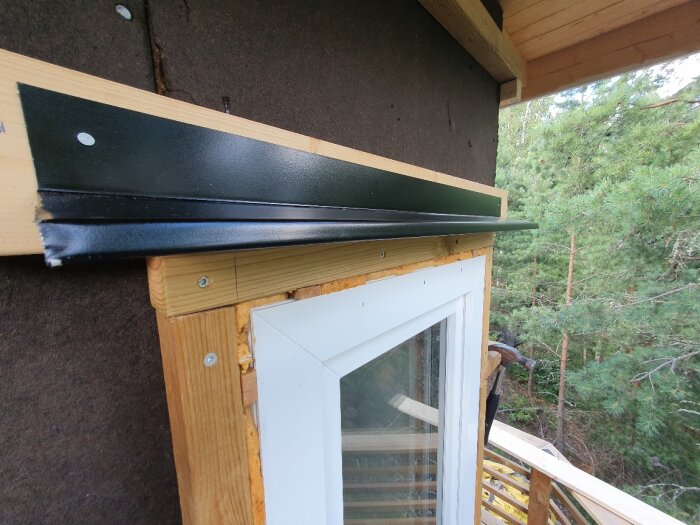
Mounted on nail battens, or rather another horizontal batten since the nail battens didn't align vertically:
[image]
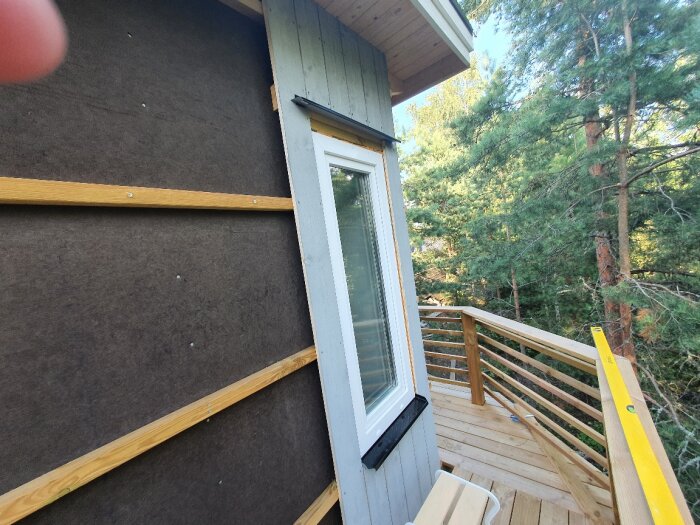
Then over with the panel with drip edge and it will be good...
[image]
Hi, don't take it the wrong way but this is an example of how it shouldn't look.
The flashing should also cover the air gap, either behind the asphalt board or directly against the asphalt board with sealing between the asphalt and the sheet metal.
Your flashing lacks the upturned edges it should have.
Then the metal should end 40mm outside the exterior of the frame if I remember correctly.
Because as it is now, driving rain that comes behind the panel can run into the construction above the window.
Vi vill skicka notiser för ämnen du bevakar och händelser som berör dig.


Farstatjej90 said:
GlennB said:


Cruzze said: