
6,345 views ·
18 replies
6k views
18 replies
Okay height difference between ceiling joists?
Hi everyone! Today I have a question about how much height difference there can be between the bottom edge of the ceiling joists without it being visible to the naked eye after the drywall is installed?
The joists are set at cc 45 and in one place at cc 35.
Is it like okay with 5-6mm or should spacers be used?
The joists are set at cc 45 and in one place at cc 35.
Is it like okay with 5-6mm or should spacers be used?

TS asks if the height difference in the ceiling drywall will be visible on the finished result and mentions the center-to-center measurement between the rafters.
Yes, it will be visible.
Of course, TS uses spacers so the ceiling becomes flat and nice.
Good luck
Yes, it will be visible.
Of course, TS uses spacers so the ceiling becomes flat and nice.
Good luck
Exactly, the studs are spaced at 45cm center to center, but the last stud is placed at 35cm for better distribution against the last wall. The original ceiling to which the studs are mounted is not straight, so if you put the level across the bottom against three studs, there is a height difference between these studs. My question is how much it can differ without the new ceiling appearing wavy. I hope this clarifies what I mean!Violina said:
Ok..Trattkantarell said:
Exactly, the studs are placed 45cm apart center to center, but the last stud is placed at 35cm for better distribution against the last wall. The original ceiling that the studs are mounted against is not straight, so if you now place the level across the underside against three studs, there is a height difference between these studs. My question is how much it can differ without the new ceiling appearing wavy. I hope it became clearer what I mean!
Yes, whether you need spacers or not mostly depends on how wavy a ceiling you are willing to have? Many ceilings require an almost straight base to even be installed...
The last time I did it, I set the level to 2mm tolerance and became quite annoyed with myself when I started installing the gypsum.
I don't even know how 5-6mm would work, to be honest.
You have to consider that the boards can crack and the paper can tear as well; it's not just about what's visible.
I don't even know how 5-6mm would work, to be honest.
You have to consider that the boards can crack and the paper can tear as well; it's not just about what's visible.

Thanks for the straightforward answer, further lowering is not an option, though. I'll have to put spacers between the suspension points and the frame.useless said:
Yes, it sounds complicated. If the studs and horizontals are perfectly straight so that you can place a 3, 4, or 5 mm strip along the entire length, it works, but if the difference varies at the ends and in the middle so you have to start making long thin wedges, there's a high risk that it becomes uneven in the other direction instead.
I wonder what TS means by "regel"? Is it the hanbjälke (i.e., the bottom of the actual truss) or something that is in the truss, like the glespanel? And what are the "nedpendlingspunkterna"? Where the gles is attached to the trusses? If so, it's just a matter of putting in some masonite pieces there to make it all straight?
Apologies for my questionable terminology, that's what happens when you're a beginner and learning along the wayjoakim_j said:
I wonder what TS means by "regel"? Is it the ridge beam (the bottom of the roof truss itself) or something attached to the truss, like furring strips? And what are "nedpendlingspunkterna"? Where the furring is attached to the trusses? If so, just put some masonite pieces there to make it all straight?
what I mean is:Regel = hat profile (25mm high)
Nedpendlingspunkt = the wood piece where the hat profile is attached in two places in the ceiling. The ceiling is 380cm wide
Around the walls is the primary profile.
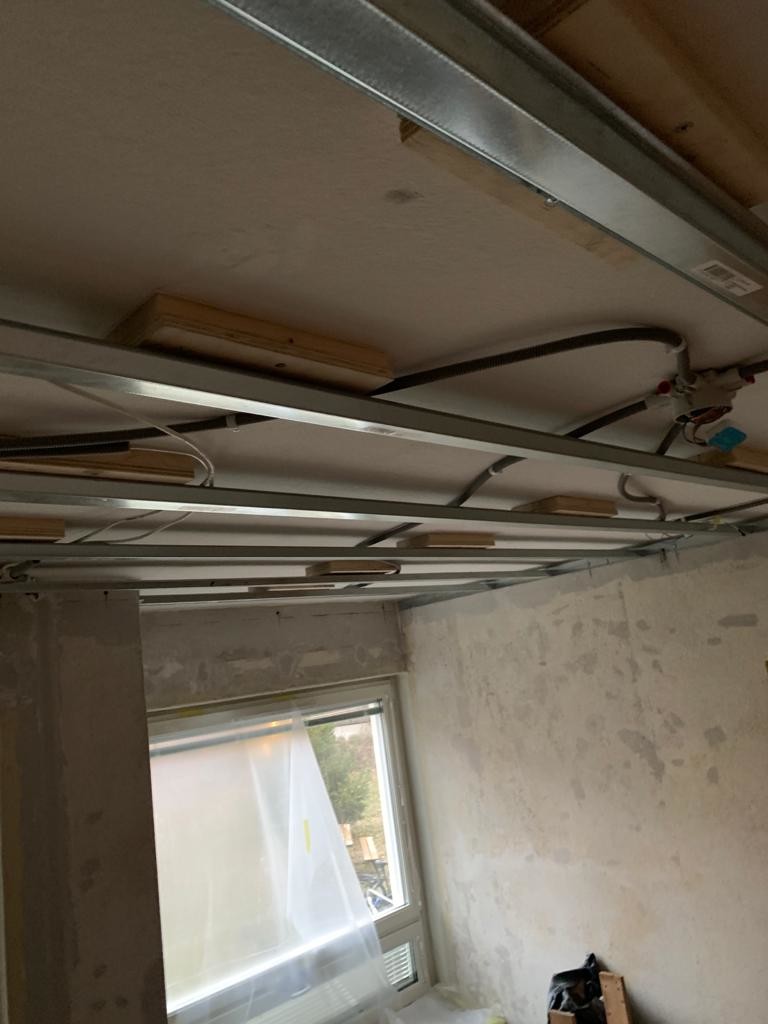
The project was complicated from the start hehe...Yes, it sounds complicated. If the joists and horizontals are perfectly straight so that you can place a 3, 4, or 5 mm strip along the entire length, it works, but if the difference is varying at the ends and middle, and you have to start making long thin wedges, the risk is high that it will become uneven in the other direction instead.
I think I understand the problem you're referring to, but I'm wondering how it would make a difference if you put strapping underneath? You would need point-specific spacers there as well, right?