
49,558 views ·
125 replies
50k views
125 replies
New central - is this installation okay?
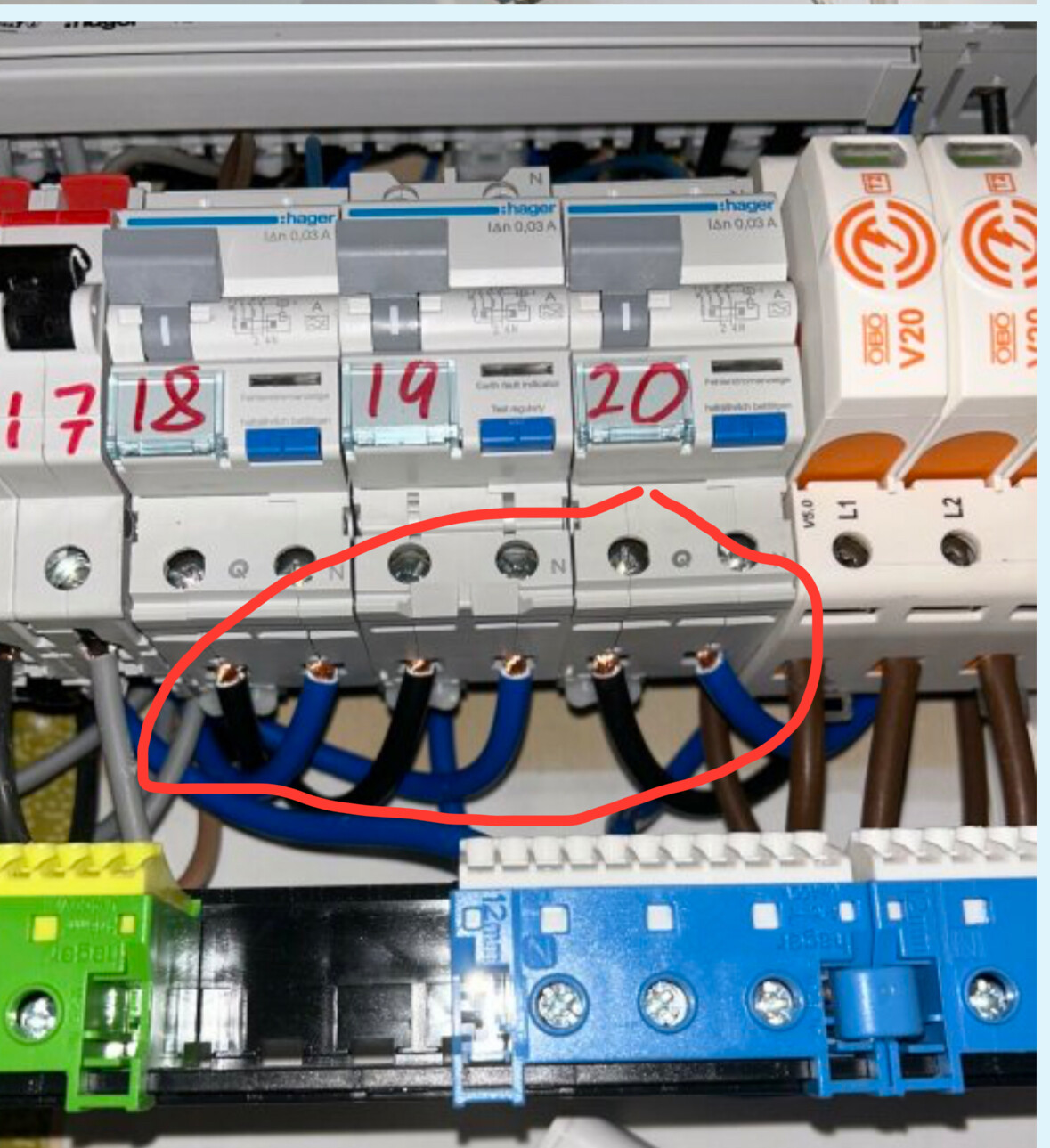
Residual current circuit breakers are very good for sockets and fixtures outdoors.S SueCia said:There is some missing information in the central register, such as rated current and area, but it's not a disaster. I still think it looks decent. I don't understand the thing with so many residual current circuit breakers, but that's a matter of taste and not directly wrong.
Placing the residual current device to the right on the middle row even though according to the documentation it protects the entire middle row and bottom row is a bit strange, but not wrong.
The most serious thing we can see from the pictures is definitely the non-insulated conductors outside the central and the large cutout in the casing.
If they trip, the indoor installation is not affected, e.g. the freezer or the power supply to the burglar alarm...
S
SueCia
Electronics enthusiast
· Dalarna
· 5 580 posts
SueCia
Electronics enthusiast
- Dalarna
- 5,580 posts
I know, but it's not relevant in this case as TS has received several residual current devices that are, in my opinion, completely unnecessary, and none of them pertain to outdoor electricity...P Peter787 said:
I prefer one residual current device for all indoor electricity and one for all outdoor electricity.
Why would it be negative for the burglar alarm to be on the same residual current device as the outdoor electricity? That was a bad example, I can even see advantages to having the burglar alarm on the residual current device for outdoor electricity


Well. Nowadays, most alarms probably have a battery backup. But I think it was in the early '90s that it was known (or maybe it was an urban legend) that Volvo had the car alarm on the same fuse as the indicators. It was apparently easy to pry off one of the indicator lenses and short circuit to the body. So many Volvo cars that were burgled also had a broken indicator. The alarm initiates flashing when it goes off, and the fuse blows immediately.S SueCia said:
You don't want a thief to be able to neutralize the house alarm by causing a ground fault in a garden lamp.
Last edited:
A cunning burglar would certainly appreciate your stance, causing a ground fault at the outlet outside and the alarm is dead within a few days when a possible backup battery is drained.S SueCia said:I know, but it's not relevant in this case as the OP has received multiple personal protection breakers which, in my opinion, are completely unnecessary. And none of them pertain to the outdoor electricity...
Then I prefer a residual current circuit breaker for all the indoor electricity and one for all the outdoor electricity.
Why would it be negative for the burglar alarm to be on the same residual current circuit breaker as the outdoor electricity? That was a bad example, I can even see advantages of having the burglar alarm on the residual current circuit breaker for the outdoor electricity

I would suggest at least two RCDs for indoor electricity, where lighting and outlets are reasonably evenly distributed among these and where each (main) part of the residence has at least one light point per RCD.S SueCia said:I prefer a residual-current device (RCD) for all indoor electricity and an RCD for all outdoor electricity.
Why would it be negative for the burglar alarm to be on the same RCD as the outdoor electricity? That was a bad example, I can even see advantages to having the burglar alarm on the RCD for outdoor electricity.
No, never any significant part of the burglar/fire alarm on the outdoor electricity's RCD.
It's better for the alarm to be on the same RCD as the heating, because then you at least get a notification if the heating might be without power.
Admittedly, it's just as easy to open the meter cabinet and turn off the main switch as it is to create a ground fault.
S
SueCia
Electronics enthusiast
· Dalarna
· 5 580 posts
SueCia
Electronics enthusiast
- Dalarna
- 5,580 posts
S
SueCia
Electronics enthusiast
· Dalarna
· 5 580 posts
SueCia
Electronics enthusiast
- Dalarna
- 5,580 posts
As I said, I see advantages to having the alarm on the outdoor electricity, just as I see advantages to having it on the indoor electricity.Demmpa said:
I would say at least two RCDs for the indoor electricity, with lighting and sockets fairly evenly distributed across these, and that each (main) part of the residence has at least one light point per RCD.
Never have any essential part of the burglary/fire alarm on the outdoor electricity's RCD.
It's better for the alarm to be on the same RCD as the heating, so you at least get a notification if the heating might be without power.
Admittedly, it's just as easy to open the meter cabinet and turn off the main switch as it is to create an earth fault.
From a burglary protection standpoint, it's definitely best to have it on the outdoor electricity.
I've worked for 12 years at Securitas and led installations of, among other things, burglar alarms, but you know best...S SueCia said:

What are the advantages?S SueCia said:
Why is it an advantage from a burglary protection standpoint to have the burglar alarm on the outdoor electricity?
