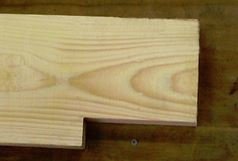
I'm working on a small house and need a support beam for the rafters to rest on, but I realize I don't know how to notch the studs properly to recess the support beam.
The best I can think of is using a handsaw, but that would involve a lot of manual sawing and I often struggle to cut straight with the handsaw, which is important here since I want a horizontal and straight support beam. I imagine it's important to be precise to avoid unnecessary skewed loads.
Is there a smart solution? I'm considering setting up all the studs and making the horizontal cut with a circular saw (should work in the miter saw as well), but the vertical cut?
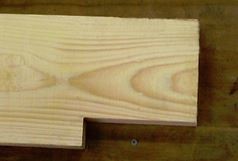
A 45x145 needs to be recessed into a 45x95 stud, like this, but a bit deeper.
I will build a garage next year and am currently planning extensively. I will make a bearing cut by laying all the joists evenly on the track and then sawing 45mm deep through all at once. That way, the height will be correct/equal, and then mark and take the long cut with a jigsaw. It should be straight enough.
As I see it, the height is most important so that the beam lies stably.
I will build a garage next year and am now planning full-time. For the bearing cutouts, I will lay up all the studs evenly on the rail and then cut 45mm deep through all of them at once. This way, the height will be correct/even, then mark it and take the long cut with a jigsaw. It should be straight enough. As I see it, the height is the most important thing so the bearer lies stable.
That's what I did. But I probably just used a regular hand circular saw, not a plunge saw with a guide for that 45mm deep cut through all the studs. And I probably sawed freehand along the drawn line. I clamped the whole bundle of studs together with a clamp first.
So, I don't remember exactly for sure, but that's how I remember doing it. You draw a line and then wear safety goggles and watch carefully where the blade works the material along the line, so it will definitely be good enough. A 1mm difference is unlikely to noticeably affect the house.
I also drew up for the long vertical cut (a Hultafors square is conveniently exactly 45mm wide, like the studs (the bearer)), and sawed it with the jigsaw. It's not difficult to get it good enough here either, as long as the jigsaw is of decent quality and the blades as well. I used a blade that had touched a nail/screw and got a bit dull on some teeth on one side, so it didn't cut a 90° straight cut anymore. :| So use a fresh and good blade, check a stud now and then to make sure the cut is truly 90° all the way.
I have only nailed, indeed a plank horizontally on top as well and the rafters above the standing studs.
With the tie beam on the outside, they will align with the nailing studs further down on the wall.
The easiest way is if you have a circular saw or even better a plunge saw with a guide. First, cut all the studs to the correct length using a miter saw, make a length stop so all the studs are the same length. Assemble the studs, draw with a square where the notch should be, and place the guide rail or a list to guide against if you have a circular saw. Set the depth on the saw and make a cut the same on all. Then set how much you want to cut out from the stud on a table saw and cut away the piece. It becomes very precise and good!
The easiest way is if you have a circular saw or even better a plunge saw with a guide rail. First, cut all the studs to the correct length using a miter saw, and make a length stop so all the studs are the same length. Put the studs together, mark where the notch should be with a square, and lay the guide rail or a list if you have a circular saw. Set the depth on the saw and make a cut equally on all. Then set how much to saw from the stud on a table saw and remove the piece.
It becomes very precise and good!
Reviving an old thread.
A thought when making the cut with the table saw, do you run it so the whole piece of wood comes loose?
I'm thinking if you do that, the saw cut remains on the other side of the stud since the blade is round.
Does this matter, or should you use a jigsaw for the last bit?
A question when making the cut with the table saw, do you cut so that the whole piece of wood comes off?
I think if you do it that way, the saw cut will remain on the other side of the beam since the blade is round.
Does this matter or should you use a jigsaw for the last bit?
We cut so the whole piece falls off, if you're meticulous, you can hand saw or use a jigsaw for the last bit, but it doesn't matter if it's built into a wall...
We keep going until the whole piece falls off; if you're particular, you can hand saw or use a jigsaw for the last part, but it doesn't matter if it's built into a wall..