Hi! On the upper floor of our 70s house, we have an original bathroom that needs renovation. We have torn down walls and have now started removing the old disgusting floor.
First there was a brown vinyl flooring
Under the vinyl flooring, about 10 mm chipboard,
Under the chipboard, about 15 mm styrofoam
Under the styrofoam, there were 15 mm tongue and groove boards. This is the original floor.
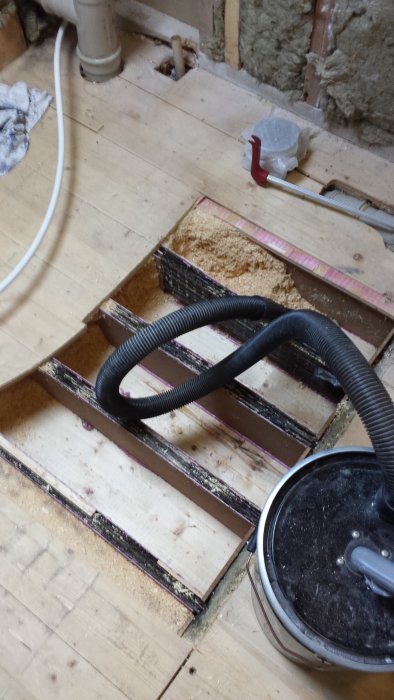
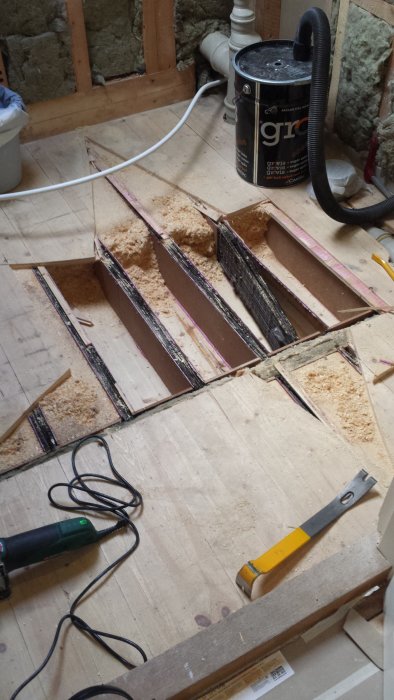
Under the boards are boxes of 3 mm masonite sheets filled with 170 mm sawdust.
Between the long sides of the masonite sheet boxes, there seems to be something that could be corrugated cardboard, and on the short sides, there appears to be some old glass wool.
Under the sawdust, there are planks.
If I measure at the staircase between the lower and upper floor, I estimate the floor to be about 230 mm thick. If I measure 170 mm sawdust + 15 mm tongue and groove boards for the original floor and guess that the boards under the sawdust are also 15 mm, it totals to 200 mm. Then there's only 30 mm left which is probably the ceiling of the lower floor, maybe with some spacers.
I have sawed open like a star on the floor to find something but nowhere do I see joists, neither under the sawdust nor the glass wool.
How is this constructed, are the walls on the lower floor the only support for everything? How would you reinforce this floor? I'm currently thinking about removing all the sawdust under the floor and framing up on the walls of the lower floor (if I can find them).
Hello.
Looks like you have a Mockfjärdshus. And in that case, the underside is the same as the topside. That is, there are no studs. The masonite is glued like small blocks that are joined together. About 20x20 cm.
The outer walls are likely the same construction.
So you should go ahead with what you are considering.
Frame a new floor structure.
Yes, it looks exactly like an old Mockfjärds house. In that case, both walls and floors are built from chip-filled "cassettes," and you won't find any other joists. Google "elementhus Mockfjärd" and you'll find some info on this forum.
I think it varies depending on the house model you have and in which part of the house you are. Do you have a basement? If so, you can get an idea of how the beams are positioned and joined.
Our house looks similar to the one in the drawing on this page: http://www.czbygg.se/menysidor/Elementhusmontor_244
The beams span across the entire living room without any support underneath. There is a similarly sized basement room directly under the living room without any load-bearing walls or columns in the middle. In the part where the bedrooms are located, there is a long load-bearing basement wall directly under the long wall where the bedroom entrances are. The beams are laid across this wall. Whether the beams are as long as the width of the house there or joined at this wall, I haven't figured out yet.
Click here to reply
Vi vill skicka notiser för ämnen du bevakar och händelser som berör dig.