
Hello,
I've torn down my old kitchen and have a new one on the way.
On the walls are rock-hard old particle boards that resemble MDF, very stiff and compact.
I wasn't planning to replace them originally, just put on a layer of plasterboard to have a nice surface to paint on and to dampen sound a bit in the adjacent room.
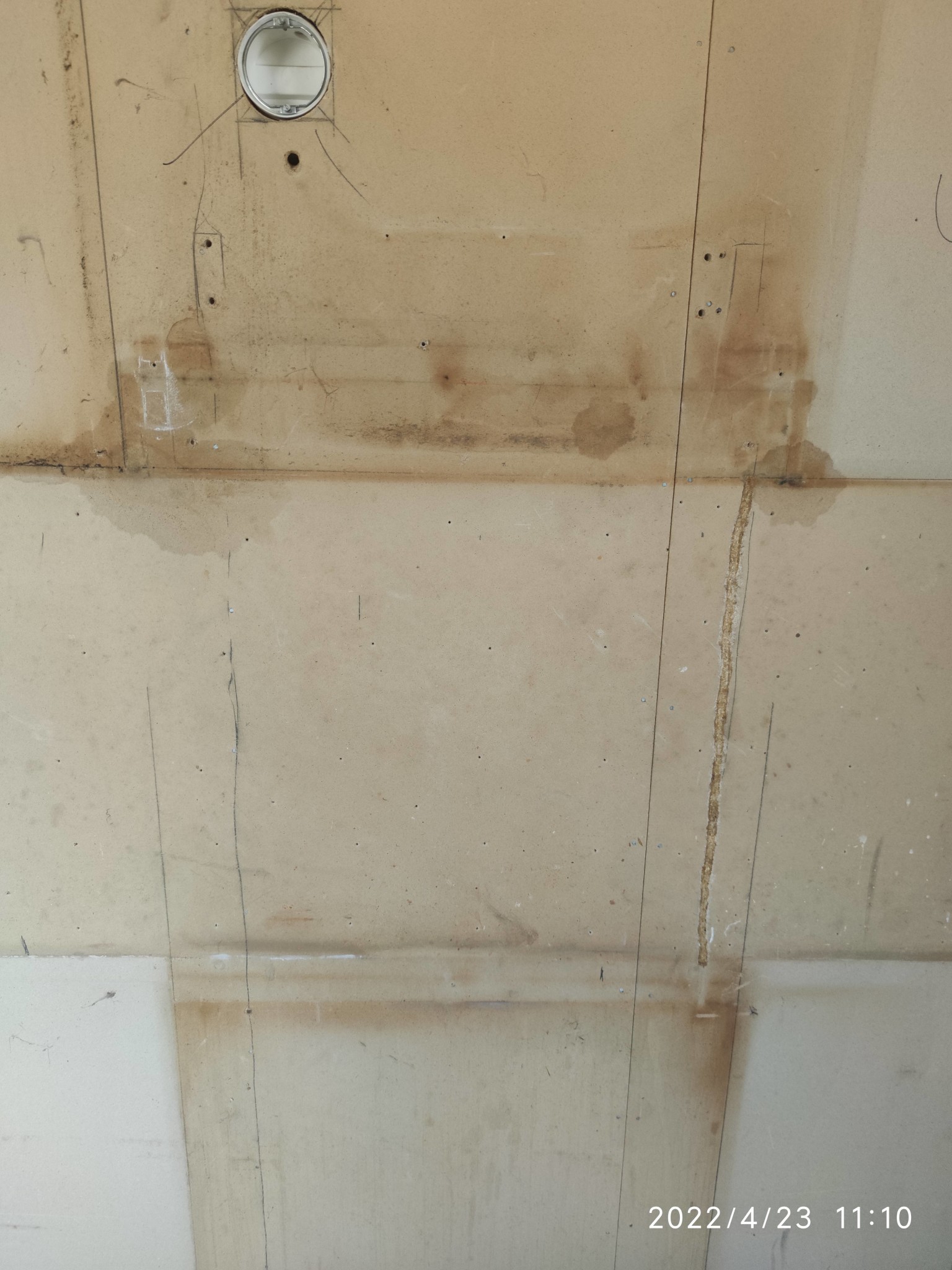
But then I started thinking about the consequences and am wondering if it might be worth the time to replace them to get rid of old nail holes? The old kitchen was built in '77, it's about 10 linear meters. I've uploaded a picture of the most worn part.
Would you have replaced them? Thanks.
I've torn down my old kitchen and have a new one on the way.
On the walls are rock-hard old particle boards that resemble MDF, very stiff and compact.
I wasn't planning to replace them originally, just put on a layer of plasterboard to have a nice surface to paint on and to dampen sound a bit in the adjacent room.
But then I started thinking about the consequences and am wondering if it might be worth the time to replace them to get rid of old nail holes? The old kitchen was built in '77, it's about 10 linear meters. I've uploaded a picture of the most worn part.
Would you have replaced them? Thanks.



The holes don't do any harm behind the drywall, right? I imagine that OSB boards are better than particle board for screwing things into. But pre-drilling before mounting the cabinets will probably take less time than replacing the boards.
In my kitchen, there were recently tiles on the masonite boards without drywall. So it's certainly possible to set tiles on something other than drywall. But as I interpret the question, it's about whether the particle boards should be replaced before the drywall is put up. Not whether there should be drywall on the outside or not.richardtenggren said:
richardtenggren
Ingen-gör
· Norrlandet
· 6 615 posts
richardtenggren
Ingen-gör
- Norrlandet
- 6,615 posts
Now that you mention it, I probably interpreted it all wrongA Avemo said:In my kitchen, until recently, there were tiles on the masonite boards without gypsum. So it is indeed possible to place tiles on something other than gypsum. But as I interpret the question, it's about whether the particle boards should be replaced before the gypsum boards are installed. Not whether there should be gypsum on the outermost layer or not.

I thought so too. What I was mostly (perhaps unnecessarily) critical of was whether it was inappropriate to take a chance with some holes behind the drywall just in case when I install the new kitchen later, in case I, for example, hit old holes that make only the drywall bear the weight, or if there was an established truth about the strength to consider or something.A Avemo said:
If it's just the holes you want to get rid of, get a dowel or skewers in the right diameter. Dip in wood glue and press into the hole. Snip off with pincers or side cutters. Repeat with all holes. The next day, cut the pins flush with the panel. Done.
But I doubt it has any practical significance. Draw out the measurements on the drywall, and you'll see if anything seems to clash a lot, and there you can either screw a little beside the intended line or plug according to the above.
But I doubt it has any practical significance. Draw out the measurements on the drywall, and you'll see if anything seems to clash a lot, and there you can either screw a little beside the intended line or plug according to the above.
You can check if you have large holes right where the cabinets (rails) are to be screwed in.D Davion said:What I most questioned (perhaps unnecessarily) was whether it was inappropriate to take a chance with some holes behind the gypsum just in case when I screw up the new kitchen later, in case I, for example, hit old holes that make only the gypsum bear the load, or if there was an established truth about strength to consider or something.
Click here to reply